Taiwan has announced 11 sanctions against the Philippines over what it calls an insincere apology for the coast guard shooting of a fisherman last week. One of them will really stick.
And it will hurt both sides.
Recalled diplomats can be replaced, and suddenly suspended talks on fishing or aviation cooperation can be resumed as sanctions come off some day when Manila recasts its apology for the May 9 shooting or Taiwan decides to drop its demands. Most of the $11 billon two-way trade relationship will stay intact.
It’s harder to say that about a freeze on Filipino migrant labor in Taiwan, also one of the sanctions.
The freeze effective from Wednesday bars new laborers, and the 88,000 Filipino workers in Taiwan now must leave once their contracts end. Contracts usually cover three years.
For the Taiwan side, the slow departure of Filipino workers without replacements will mean a loss of up to 1,000 English-speaking degree holders in white-collar IT jobs and many more thousands of manual workers in high-tech factories.
When Taiwan banned importation of Filipino labor in over a civil aviation dispute 14 years ago, the number of migrant workers onshore dropped from about 114,000 to just under 73,000 between 1999 and 2001. There is no word on how long the ban imposed this week will last.
“Our policy is to suggest that Taiwanese companies hire workers from other countries,” a Council of Labor Affairs official told this blog, asking not to be quoted by name.
That might not be so simple. Migrants from other Southeast Asian countries can easily keep working in home care, construction and fishing, all jobs that Taiwanese don’t want. But high-tech firms prefer Filipinos for their degrees, work experience and English reading ability, key for example to reading equipment labels. They earn a minimum wage equal to $638 per month, far below what locals would get.
High-tech, particularly contract manufacturing of consumer electronics, is incidentally Taiwan’s top source of exports. “I would think (the labor freeze) would have an impact on the IT industry,” says Peter O’Neill, coordinator for services to migrants in the Catholic diocese of Taiwan’s Hsinchu county, a high-tech hotspot.
Remittances from workers abroad, Taiwan included, made up 9% of the 2011 Philippine GDP.
Filipinos worry about a different kind of impact. Some have worked in Taiwan more than 10 years, building trusted long-term relations with Taiwanese employers. Back in the Philippines and jobless, they must compete with peers for work in other countries, and competition will stiffen without Taiwan as a market.
“They’ll decide to go to other countries,” O’Neill predicts, noting a number of phone calls this week from nervous workers. “That means more migrants competing for South Korea, Singapore and Canada.”-ForbesTaiwan has announced 11 sanctions against the Philippines over what it calls an insincere apology for the coast guard shooting of a fisherman last week. One of them will really stick.
And it will hurt both sides.
Recalled diplomats can be replaced, and suddenly suspended talks on fishing or aviation cooperation can be resumed as sanctions come off some day when Manila recasts its apology for the May 9 shooting or Taiwan decides to drop its demands. Most of the $11 billon two-way trade relationship will stay intact.
It’s harder to say that about a freeze on Filipino migrant labor in Taiwan, also one of the sanctions.
The freeze effective from Wednesday bars new laborers, and the 88,000 Filipino workers in Taiwan now must leave once their contracts end. Contracts usually cover three years.
For the Taiwan side, the slow departure of Filipino workers without replacements will mean a loss of up to 1,000 English-speaking degree holders in white-collar IT jobs and many more thousands of manual workers in high-tech factories.
When Taiwan banned importation of Filipino labor in over a civil aviation dispute 14 years ago, the number of migrant workers onshore dropped from about 114,000 to just under 73,000 between 1999 and 2001. There is no word on how long the ban imposed this week will last.
“Our policy is to suggest that Taiwanese companies hire workers from other countries,” a Council of Labor Affairs official told this blog, asking not to be quoted by name.
That might not be so simple. Migrants from other Southeast Asian countries can easily keep working in home care, construction and fishing, all jobs that Taiwanese don’t want. But high-tech firms prefer Filipinos for their degrees, work experience and English reading ability, key for example to reading equipment labels. They earn a minimum wage equal to $638 per month, far below what locals would get.
High-tech, particularly contract manufacturing of consumer electronics, is incidentally Taiwan’s top source of exports. “I would think (the labor freeze) would have an impact on the IT industry,” says Peter O’Neill, coordinator for services to migrants in the Catholic diocese of Taiwan’s Hsinchu county, a high-tech hotspot.
Remittances from workers abroad, Taiwan included, made up 9% of the 2011 Philippine GDP.
Filipinos worry about a different kind of impact. Some have worked in Taiwan more than 10 years, building trusted long-term relations with Taiwanese employers. Back in the Philippines and jobless, they must compete with peers for work in other countries, and competition will stiffen without Taiwan as a market.
“They’ll decide to go to other countries,” O’Neill predicts, noting a number of phone calls this week from nervous workers. “That means more migrants competing for South Korea, Singapore and Canada.”-Forbes
Indonesia has approved a two-year extension to a landmark ban on clearing primary rainforests and peatlands, officials said Thursday. Environmentalists praised the move but said the government must do more to curb the nation's burgeoning production of greenhouse gases.
President Susilo Bambang Yudhoyono signed the decree on Monday to continue the 2011 moratorium, which barred new logging and palm oil plantation permits under a $1 billion deal with Norway, said his environment adviser, Pungki Agus Purnomo.
He said the ban will preserve 64 million hectares (158 million acres) until 2015. It will not affect areas where concessions were granted before the moratorium.
Environmentalists hailed the extension while also urging leaders to better enforce the law. They say some protected areas continue to be exploited because of corruption and illegal fires and logging.
Indonesia's largest environmental group, Walhi, said the government must also work to stop logging permits from being issued at the local level.
"It is just like a presidential instruction to his subordinates ... it has no power to sanction against violators," said Walhi environmentalist Berry Nahdian Furqan, who added that the ban should be made permanent.
Indonesia is one of the world's biggest greenhouse gas emitters, largely because many of the palm oil plantations on the islands of Borneo and Sumatra are planted on carbon-rich peatland that must be drained first, releasing vast amounts of carbon dioxide into the atmosphere each year.
Rapid deforestation has occurred in recent years in Indonesia as it feeds the world's hunger for palm oil, pulp and paper. The destruction has caused damage ranging from deadly flash floods and landslides to a loss of habitat for endangered species such as orangutans, elephants, tigers and rhinos.-Yahoo News
Singapore wants to purchase more agricultural products from the Philippines given rising demand there.
Lam-Chan Lee Tiang, senior specialist of the Agri-Food & Veterinary Authority (AVA) of Singapore said in a trade meeting at the sidelines of the 9th International Food Exhibition Philippines yesterday that while they have been importing food items from the Philippines, it still wants to get other fresh and processed products.
Given the Philippines’ available land and manpower, Department of Agriculture secretary Proceso Alcala said in the same event the country could provide food products to meet rising demand in Singapore.
“We are checking supply to ensure that it can be sustained,” he said.
Alun Zhou, managing director of trade firm 101 Fruits, said that while his company has been purchasing durian from countries like Malaysia, Thailand, and Indonesia, he still intends to import the same products from the Philippines.
Alcala said Singapore buyers who are interested in importing upland vegetables are set to visit Baguio City.
The Singapore delegation is likewise going to Davao to see the farms there.
Aside from fresh fruits and vegetables, Alcala said Singapore also wants processed food.
He said the government is working on improving the packaging of food products.
He also said government would try to ensure available supply for exports.
Incentives, he added, may also be given to local farmers or exporters.
Philippine commercial counsellor Glenn Penaranda noted that Philippine food imports of Singapore are currently valued at $100 million.
Lim Xiu Qing Joyce, executive manager of overseas food supply of AVA, said there is room for Philippine imports to Singapore to grow as vegetables only make up about seven percent of total shipments.
Fruits, meanwhile, comprise about one percent of Philippine shipments to Singapore.-The Philippine Star
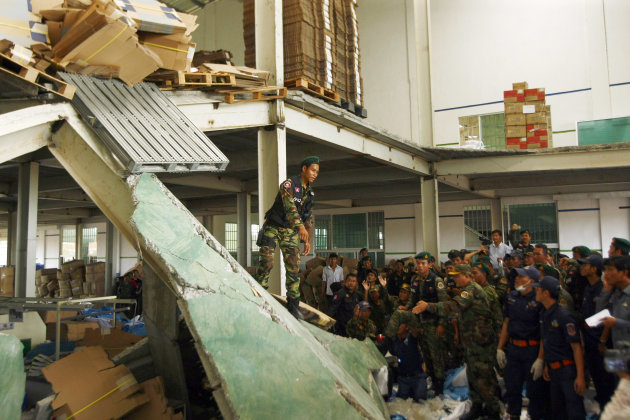
The ceiling of a Cambodian factory that makes Asics sneakers collapsed on workers early Thursday, killing two people and injuring seven, in the latest accident spotlighting the often lethal safety conditions faced by those toiling in the global garment industry.
About 50 workers were inside a workroom of the factory south of Phnom Penh when the ceiling caved in, said police officer Khem Pannara. He said heavy iron equipment stored on a mezzanine above them appeared to have caused the collapse.
Two bodies were pulled from the wreckage and seven people were injured, he said. Rescuers picked through rubble for several hours and after clearing the site said that nobody else was trapped inside.
At a clinic where she was being treated for her injuries, worker Kong Thary cried on the telephone as she recounted the collapse.
"We were working normally and suddenly several pieces of brick and iron started falling on us," the 25-year-old said.
The accident comes just a little more than three weeks after a building housing five garment factories in Bangladesh crashed down on thousands of workers, killing 1,127 people. That disaster is the deadliest in the history of the global garment business and has led to calls for Western retailers to do more to ensure the safety of those who make their products.
"This shows that the problem is not only isolated to Bangladesh, and that companies (elsewhere) are trying to drive prices down by taking shortcuts on workers' safety," said Phil Robertson of Human Rights Watch.
An initial investigation showed the ceiling that collapsed Thursday was poorly built and lacked the proper building materials to support heavy weight, said Ou Sam Oun, governor of Kampong Speu province, where the factory is located.
Chea Muny, chief of a trade union for factory workers, identified the factory as a Taiwanese-owned operation called Wing Star that produces sneakers for Asics, a Japanese sportswear label. He said shoes made at the factory were exported to the United States and Europe.
An Asics spokeswoman in Tokyo confirmed the factory was in contract to make Asics running shoes. She said Asics was trying to determine what happened.
"We understand that some people have died, so first we offer our condolences," said spokeswoman Masayo Hasegawa in Tokyo. She said she did not have information on the last time the building structure had been inspected but added, "We want the highest priority to be placed on saving lives."
The factory complex, which opened about a year ago, consists of several buildings and employs about 7,000 people, said Khem Pannara, the police officer. The structure where the collapse occurred was mainly used as a storage warehouse for shoe-production equipment but had a small work area for about two dozen people, Chea Muny said.
The garment industry is Cambodia's biggest export earner, employing about 500,000 people in more than 500 garment and shoe factories. In 2012, the Southeast Asian country shipped more than $4 billion worth of products to the United States and Europe.
The U.N.'s International Labor Organization, citing Commerce Ministry figures, says the number of footwear factories nearly doubled in four years to 45 in 2012, accounting for $268.66 million in exports, with further growth expected. The European Union, which allows Cambodian products duty-free and quota-free entry, represents almost half their market, with Japan the runner-up. The 45 factories employ 69,184 workers.
Although low pay and uncomfortable working conditions would cause some to describe many of the factories as sweatshops, Cambodian workers have several advantages over their Bangladeshi counterparts, including a sometimes feisty labor movement.
Cambodia also hosts a unique program of the International Labor Organization called "Better Factories Cambodia" that assesses and reports on working conditions in all the country's export garment factories, with plans to extend the monitoring to footwear facilities. The impetus for the program was an agreement under which Cambodia pledged better labor conditions in exchange for better trade privileges with the United States.
Critics says that the program is ineffective because it presents findings in an aggregate form rather than publicly naming and shaming factories that fail to meet proper standards. But the program says it is not intended to guarantee full compliance, and instead "brings about improvement on working conditions and compliance over time."
Last month, the program released a report that called for "urgent attention" to worker safety violations in Cambodia's garment and footwear industry.
It found "a worrying increase in fire safety violations," including that only 57 percent of factories kept paths free of obstructions. It reported "unacceptable" heat levels, abuse of overtime hours and a lack of worker access to drinking water.
A separate report on a pilot project on footwear factories found they were not in compliance with a host of labor standards, especially regarding occupational safety and health. Chemical safety is a special concern, because the use of toxic solvents is much more widespread than it is for clothing.-Yahoo World News
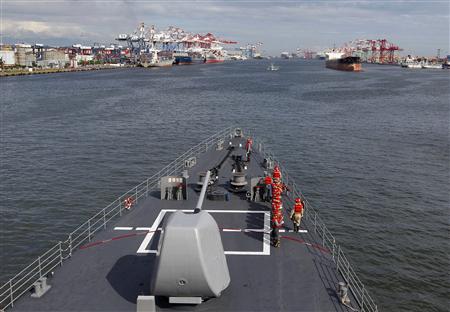
Taiwan has conducted military exercises near the Philippines amid a row over the death of a Taiwanese fisherman.
Two frigates, one destroyer and other coast guard vessels have taken part in the drill in the Bashi channel between the two sides.
The fisherman, Hung Shih-cheng, was shot by the Philippine coast guard last week in waters both sides claim.
The Philippine president issued an apology on Wednesday, but Taiwan said the apology was "unacceptable".
The military drill is expected to last for two days.
"The move is aimed to highlight our determination to safeguard sovereignty," Rear Admiral Lee Tung-pao said. "The coastguards have vowed to protect our fishermen wherever they are."
Meanwhile, 14 Taiwanese police investigators have arrived in Manila to take part in an inquiry into the death, AP news agency reported.
A spokesman for Philippine President Benigno Aquino said that the Philippines had "gone the extra mile" and should not have to "appease" Taiwan.
"We have acted uprightly and decently as a respectable member of the international community," presidential spokesman Edwin Lacierda said.
On Wednesday, Philippine President Benigno Aquino sent a representative, Manila Economic and Cultural Office Chairman Amadeo Perez, to Taiwan to "convey his and the Filipino people's deep regret and apology" to the fisherman's family over the "unfortunate and unintended loss of life".
Taiwan Premier Jiang Yi-huah called the apology a "positive move" but rejected the description of the death as "unintended".
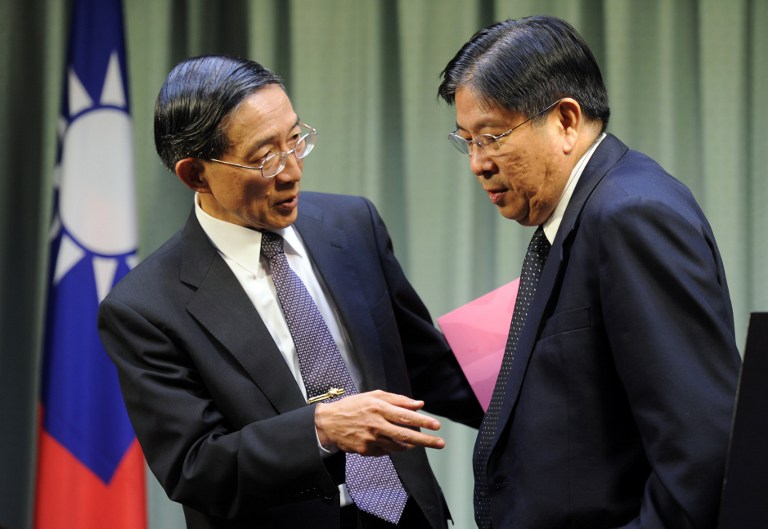
"[Mr] Perez did not have sufficient authorisation and this shows the Philippines' lack of sincerity in resolving the incident," Mr Jiang told reporters.
Taiwan then implemented a series of new diplomatic measures, including a travel alert against the Philippines, the halting of some trade and academic exchanges, and the military drills.
Taiwan had already rejected an initial apology from Antonio Basilio, head of the Philippine Representative Office in Taiwan, instead announcing it would stop processing work applications from Filipinos and recall its envoy from Manila.
'Taiwanese compatriots'
The US has voiced concern over the tensions "between two neighbouring democracies and close [US] partners".
 US State Department spokesman Patrick Ventrell said the US hoped both sides would "refrain from actions that could further escalate tensions".
"We want them to work through their differences on this issue as expeditiously as they can," he added.
The US has close relations with both countries. It considers the Philippines a major non-Nato ally, and has legally committed itself to helping Taiwan defend itself, through the 1979 Taiwan Relations Act.
Mr Hung, the 65-year-old fisherman, was shot dead on 9 May when a Philippine coastguard vessel opened fire on his boat, which was in disputed waters.
The Philippine coastguard said its crew acted in self-defence, believing his boat was trying to ram their vessel. However, the other Taiwanese fishermen on board denied this.
Taiwan and the Philippines have had overlapping territorial claims for years. The two countries have never negotiated a sea border, partly because the Philippines recognises China, not Taiwan.
On Wednesday, a spokesman for the Chinese government said that mainland China had "an obligation" to protect the safety and interests of "Taiwanese compatriots", China's state-run agency Xinhua reported.
China claims sovereignty over Taiwan, although the island has been separately governed since 1949.-British Broadcasting Corporation
The trial has started in Singapore of church leaders accused of misusing funds to boost the singing career of the founding pastor's wife.
Pastor Kong Hee is one of six accused of misusing up to $40m (£26.2m) of City Harvest church funds to help his wife, Ho Yeow Sun, also known as Sun Ho.
The six are charged with conspiracy to commit criminal breach of trust.
They have yet to enter pleas but could face up to 20 years in jail if convicted.
The misuse of funds at the evangelical church, one of Singapore's richest, is alleged to have happened between 2007 and 2008, local media say.
Mr Kong and his wife maintained her pop music career was a way of reaching out to non-Christians.
Prosecutors say, however, that church investment in two companies was a "sham" to further Ms Ho's career.
City Harvest has an estimated 30,000 members. It also has affiliate churches in Malaysia, Indonesia, India, Taiwan, Brunei and Australia.
Its services - attended by thousands - are more pop concert than Sunday mass says the BBC's South East Asia correspondent, Jonah Fisher.
Ms Ho, whose music career began in 2002, has several albums in Mandarin to her name and is known in China and Taiwan.
She has also worked with US music industry figures such as songwriter Diane Warren and rapper Wyclef Jean, who produced her English album.-British Broadcasting Corporation
Hundreds of thousands of people in Bangladesh and Myanmar were ordered to evacuate Wednesday as a cyclone bore down on coastal areas home to flood-prone refugee camps for victims of sectarian unrest.
The United Nations has warned that more than eight million people could be at risk from Cyclone Mahasen, which is expected to make landfall on Thursday or Friday somewhere near the border between the two countries.
Bangladesh told hundreds of thousands of people living in low-lying areas to move to cyclone shelters, while Myanmar announced plans to relocate roughly 166,000 people on its northwest coast to safety.
But in Myanmar's state of Rakhine, many Muslim Rohingya made homeless by communal bloodshed last year said they were too scared to move, reflecting their deep mistrust of the authorities and of local Buddhists.
"We could die here. We have no place to go," said Yu Sut Taw, a Muslim man living in a camp on the outskirts of the state capital Sittwe, one of several in Rakhine which are home to a total of about 140,000 displaced persons.
AFP reporters who visited two camps on Wednesday saw few signs of a mass evacuation under way.
Buddhist-Muslim clashes in the region last year left about 200 people dead and whole neighborhoods burned to the ground.
Illustrating the dangers facing some of those who have tried to flee, 58 Rohingya were missing after their boat capsized on Monday as they tried to escape by sea to higher ground along the coast.
The cyclone appeared to have lost some of its strength as it churned northwards through the Bay of Bengal, the UN Office for the Coordination of Humanitarian Affairs said in a statement late Tuesday.
But it may still bring "life-threatening conditions" for 8.2 million people in northeast India, Bangladesh and Myanmar, it warned.
Around 30 million of Bangladesh's 153 million people live along the coast, which is also home to ramshackle camps housing Rohingya refugees.
Mohammed Kamruzzaman, a government magistrate in charge of a Rohingya camp in the Bangladeshi town of Cox's Bazaar, said they used loudspeakers to warn people of the impending danger.
"We've also stockpiled dry food, kept medical teams and ambulances on standby and shifted the sick and pregnant women from the camps to hospitals," he said.
Authorities in the southeastern city of Chittagong shut all garment factories ahead of the storm.
"I have not seen a cyclone before. I am afraid," said Manik Mia, one of a group of 25 construction workers who took shelter at the Daksin Patenga School just meters from the Bay of Bengal. "I hope Allah will save us."
Cyclone Mahasen was packing winds of up to 88 kilometers (55 miles) per hour at its center and could unleash a storm surge of up to seven feet (two meters), said Shamsuddin Ahmed, deputy chief of Bangladesh Meteorological Department.
Bangladesh and Myanmar have both been frequent victims of cyclones which have left hundreds of thousands of people dead in recent decades.
Cyclone Nargis, which devastated Myanmar's Irrawaddy Delta in May 2008, killed about 140,000 people.
Experts say Bangladesh is better prepared to handle cyclones than authorities across the border in Rakhine, where the military was deployed to oversee the evacuation.
"Some people don't want to leave. We don't want to see them die so we will move them under the law of protection from natural disasters," said Aung Min, minister of the Myanmar president's office.
"We will continue to evacuate as many as possible until the last minute when the cyclone hits."
He said about 27,000 Rohingya had already been moved but there was a lack of proper cyclone shelters.
"We don't have any cyclone shelter in Rakhine state. We see that we should have constructed cyclone shelters there."
Myanmar said the cyclone could delay President Thein Sein's planned state visit to Washington -- the first in almost half a century by a leader of the country formerly known as Burma, which is emerging from decades of military rule.
Rights groups have criticized Myanmar for failing to provide permanent housing sooner for displaced Rohingya, after months of warnings of the danger posed to the camps by this year's monsoon.-GMA News
A Taiwan's F-16 fighter jet crashed in waters near Chiayi county on Wednesday afternoon, according to local media reports.
The pilot managed to eject from the craft before it crashed and was later rescued. He suffered minor injuries.
An engine malfunction may have caused the crash, which occurred during a routine training mission.-China Daily
Rescue work is continuing at a major US-owned gold and copper mine in Indonesia after a tunnel collapsed on Tuesday, trapping more than 20 workers.
Police say four miners died and 10 others were evacuated after the tunnel caved in at Freeport's Grasberg mine, in the eastern province of Papua.
The situation at the mine is still thought to be volatile, police add.
Freeport has suspended all operations at the mine out of respect for the workers killed, the company says.
The head of Freeport's Indonesia unit, Rozik Soetjipto, says it is a temporary suspension out of sympathy for the victims but also due to some safety considerations around underground operations.
The accident has had no effect on the open mining pit at Grasberg, he adds.
Freeport, which is handling the rescue operation, said in a statement on Tuesday that "the rescue process is difficult and will take some time to complete".
About 40 workers were undergoing safety training at the time of the tunnel's collapse, said Freeport's Indonesia subsidiary.
The condition of the 10 people who were rescued is not known.
A police spokesman said the situation remained uncertain because the ground was shaky and rocks continued to fall.
The Grasberg mine has an estimated 24,000 employees.
In 2011, workers staged a three-month protest asking for better pay, with miners only going back to work after negotiating a pay rise of almost 40%.
The details surrounding the incident are difficult to verify independently, as foreign journalists are banned from reporting in Papua.
Indonesia says this is because the province is too dangerous for foreign media, but human rights groups say this is Jakarta's way of keeping observers out of the troubled province, says the BBC's Karishma Vaswani in Jakarta.
Papua became part of Indonesia in 1969 after a controversial election many Papuans say was a sham. A low-level war for independence has been waged in the province ever since.-British Broadcasting Company
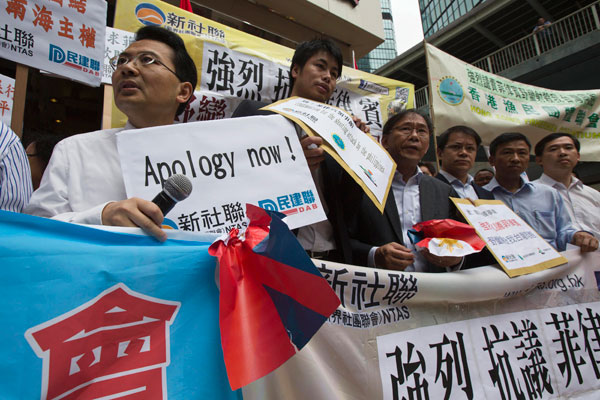
Taiwan on Wednesday, May 15 slapped sanctions on the Philippines, including a ban on the hiring of new workers, rejecting an apology by President Benigno Aquino for the killing of a Taiwanese fisherman.
Philippine coastguards shot dead the 65-year-old last week after they said his vessel illegally sailed into Philippine waters and outrage in Taiwan at the incident grew amid a perceived lack of remorse in Manila.
In a bid to contain the diplomatic fallout, Aquino sent Amadeo R. Perez, chairman of the Manila Economic and Cultural Office (MECO) which handles relations with Taiwan, to the island on Wednesday to act as his "personal representative" and apologize.
"(The envoy) will convey his and the Filipino people's deep regret and apology to the family of Mr Hung Shih-cheng, as well as to the people of Taiwan over the unfortunate and unintended loss of life," presidential spokesman Edwin Lacierda said in Manila.
Premier Jiang Yi-huah said Taiwan acknowledged Lacierda's statement but deemed it "unacceptable" that the death was described as unintended.
"Perez did not have sufficient authorization and this shows the Philippines' lack of sincerity in resolving the incident and therefore our second wave of 8 sanctions are initiated immediately," Jiang told reporters.
These include a "red" travel alert urging Taiwanese not to visit the Philippines and the suspension of exchanges between high-level officials, as well as a halt to exchanges on trade and academic affairs.
Jiang urged Taiwanese to support the government in pressuring the Philippine government but said the Filipino people should be treated "calmly."
In Manila, President Benigno Aquino's spokesman Edwin Lacierda reiterated the president's calls for calm, but declined further comment "with the objective of preventing further escalation while deliberations are ongoing".
Basilio said the Philippines will now send special envoy Amadeo Perez to reiterate his "deep regret and apology from the people of the Philippines" to the people of Taiwan and the fisherman's family.
"The Filipino people and government understand the hurt and grief that the Taiwan people have felt at the death of the one of their fellow citizens," he told a press conference at Taiwan's foreign ministry.
Perez, who arrived in Taiwan around noon, is chairman of the Manila Economic and Cultural Office which represents the Philippines in Taiwan in the absence of diplomatic ties.
Manila recognizes Beijing rather than Taipei as the government of China.
But Taiwan's Premier Jiang Yi-huah said it was unacceptable that the apology came from the "people of the Philippines" rather than the government as it was the coastguard that was responsible for the shooting.
"Philippine civil servants killed a person and damaged the boat, the Philippine government cannot avoid responsibility," he said.
Jiang said Perez would offer a donation from the Philippine people to the fisherman's family and it was not clear "whether the Philippine government will be responsible for the compensation".
He also demanded Manila clarify whether it was conducting a criminal or an administrative investigation and what kind of punishment it plans for those responsible -- dismissal, imprisonment or a fine.
The shooting incident triggered public fury in Taiwan, and aggravated tensions that were already running high in the region over rival claims to the nearby South China Sea.
China, the Philippines, Taiwan, Vietnam, Malaysia and Brunei all have competing claims to parts of the strategic and resource-rich maritime region.
Taiwan has threatened to conduct a naval exercise in waters near the Philippines in protest over the fisherman's death.
There are currently 87,000 Philippine workers in Taiwan and labour authorities said nearly 2,000 new applications are submitted monthly.
In 2011, Taiwan temporarily expanded the screening period for Philippine workers and threatened to freeze hiring over a diplomatic row sparked when Manila deported Taiwanese nationals to China.-Rappler
Investors are becoming increasingly picky about which bonds and stocks they buy in Southeast Asia's fast-growing economies as the risk of policy bungling makes them more discerning.
The ebb and flow of cash from money managers and retail investors into Indonesia, the Philippines, Thailand and Malaysia is still on balance an inflow into these markets. The dynamics have however changed, with marked differences between countries.
Unlike in 2011 or 2012 when the simple risk-on and risk-off switches could trigger flows in and out of the region, investors are a lot more discriminating.
Malaysia, conventionally a flight-to-safety market, is in demand at the conclusion of a tight election, but high-yielding Indonesian rupiah bonds are also sought after, despite a recent downgrade in its sovereign ratings outlook.
The Philippines continues to impress markets with growth rates and reform talk. The country even got a surprisingly early upgrade to investment grade last month. Yet, investors find Philippine bonds and stocks expensive, and don't want to bear the risk of those promised reforms being derailed.
High-yielding Thailand, meanwhile, is giving foreign investors cold feet with talk of capital controls and a public feud between the central bank and finance minister over what to do about the strong baht. Some have pulled money out. Others are staying invested in Thai bonds to ensure they get the benefit of a possible rate cut.
But, the region is undoubtedly in flavor. Citibank reported, using data from fund tracker EPFR, that Asian regional funds excluding Japan were the only ones with meaningful inflows last week, receiving $386 million, whereas Greater China funds saw $302 million of outflows.
And data compiled by ANZ Bank showed Malaysia received $144 million and Indonesia $161 million in the week to May 8, the highest in Southeast Asia. Thailand got $132 million and the Philippines just $102 million.
"You want to invest where the policymakers are going to be helpful," said Gary Dugan, chief investment officer at Coutts private bank.
Coutts is underweight the Philippines, hesitantly invested in Thailand and underweight Indonesia, where Dugan believes there is a risk that interest rates will have to be increased as policymakers fumble over a much-needed decision to reduce fuel subsidies.
Scarce growth
Being fussy isn't an option for many investors, particularly for benchmark-tracking fund managers, in a world of scarce growth and earnings.
That explains why money continues to seek Indonesian and Thai assets, despite signs these markets are frothy, as they should be after a few years of extremely loose central bank policies across developed markets.
Foreigners hold a record 34.4 percent of Indonesian government bonds.
"Foreign investors have maintained an underweight position in Indonesia but are net buyers because emerging market funds get sizeable inflows," said Ashish Agrawal, a rates strategist at Credit Suisse.
"In some sense they are reluctant buyers of bonds. Everyone is focused on the implication of measures taken, if any, to reduce fuel subsidies, something that the rating agencies have also highlighted."
Still, at the margin, foreign investors prefer Indonesia to the more expensive Philippines, where the equity market trades at nearly 18 times the 2013 earnings, which is hard to justify for an economy growing at 7 percent.
Likewise, their dollar bonds carry lofty prices, even after accounting for the superior Philippine rating. Philippine bonds due 2037 are trading at a spread of 66 basis points over U.S. Treasuries, compared with Indonesian bonds due the same year and at a spread of 153 bps.
In April, Indonesia saw inflows of $1.848 billion while Philippines saw outflows of $449 million.
But valuations pose less of a risk than the possibilities for unexpected policy moves, such as that of Thailand cutting rates to deter hot money or of the Philippines or Thailand imposing capital controls.
"The greater risk going forward is that one day you wake up and find the currency has adjusted by 4-5 percentage points," said Dugan.-Interaksyon
The Philippines on Tuesday agreed to apologize for the fatal shooting last week of a fisherman from Taiwan by Filipino coast guard officers.
The agreement was announced hours before an ultimatum from Taiwan for an apology was due to expire at midnight.
Manila agreed to apologize, clarify the truth, punish those held responsible and start early negotiations with Taiwan on a fishery agreement.
But it has not officially agreed to pay compensation for the incident, in which coast guards killed a 65-year-old fisherman on Thursday, Taiwan media reported.
Reports said the Philippines will send Amadeo Perez, chairman and chief executive officer of the Manila Economic and Cultural Office, as an envoy to Taiwan on Wednesday to make a promise on compensation and to visit the victim's family.
Observers said the deal, in which Manila acknowledges its mistakes, can largely satisfy Taiwan's demands and ease public outrage on the island.
On Saturday, Taipei issued a 72-hour ultimatum to the Philippines to make an official apology, or face sanctions including a freeze on sending Filipino workers to the island.
There are about 87,000 Filipino domestic helpers and other workers in Taiwan, who send home hundreds of millions of dollars a year.
Taiwan also sent four coast guard and naval vessels to protect its fishermen in waters near the Philippines at the weekend.
It is unclear whether Taiwan will still conduct a naval drill in the waters where Hung Shih-cheng, skipper of the 15-metric-ton Guang Ta Hsin 28 was shot dead. Taiwan authorities said earlier on Tuesday the decision would depend on the reaction of the Philippine government.
Yang Baoyun, an expert on Southeast Asian studies at Peking University, said the possibility of Taipei staging the exercise still exists, but the scale and intensity might be reduced.
"Under the new circumstances, the military exercise could take the form of routine maritime patrols to account for heightened public sentiment, to better protect fishermen and to further deter the Philippine side," Yang said.
Beijing on Tuesday voiced support for Taiwan, saying it has always firmly safeguarded Taiwan compatriots' security and legitimate rights, Xinhua News Agency reported.
"We hope the Philippines will conduct a thorough investigation into the incident and provide a concrete explanation at an early date," Foreign Ministry spokesman Hong Lei said at a regular news conference.
On Friday, the Philippine Coast Guard admitted the shooting, which left more than 50 bullet holes in the fishing vessel, but insisted it happened within its own waters.
This claim was denied by the victim's son, who was with his father and two other fishermen on the boat at the time, as well as by Taiwan authorities who said the incident happened in an overlapping area of the two sides' exclusive economic zones.
Luo Yuan, deputy secretary-general of the China Military Science Society of the Chinese People's Liberation Army, said the Philippines brutally violated international law.
On Monday, Washington urged all sides "to refrain from provocative actions", while Philippine President Benigno Aquino called for calm, and guaranteed an in-depth investigation into the incident.
On Sunday, Antonio Basilio, resident representative of the Manila Economic and Cultural Office in Taiwan, visited the victim‘s family, and "extended condolences and apologies".
But Taiwan was not satisfied with these actions. Hundreds of fishermen burned Philippine flags, and hurled eggs at the Manila Economic and Cultural Office in Taipei on Monday.
Li Guoqiang, deputy director of the Center for Chinese Borderland History and Geography at the Chinese Academy of Social Sciences, said Manila's response came late, as it was stuck in an "awkward situation".
"The Philippines believed the incident area was within its own territory, so answering Taipei's requests means a retreat from its previous territorial claims; but Manila cannot stay silent as well."
Li also said Manila had tried to play down the incident but strong reactions from Beijing and Taipei made this attempt difficult.-China Daily
A fleet of Chinese boats prepared to fish and a naval patrol conducted drills near disputed islands in the South China Sea, state media reported Tuesday.
State-run broadcaster CCTV said 24 fishing boats arrived Monday, after a 7-day voyage, in waters near the Spratly Islands, which are claimed all or in part by China, Taiwan, Vietnam, Malaysia and the Philippines.
"Tonight we plan to have four fishing ships sent into the water for fishing. For tomorrow we plan (to send) two boats for fishing operations. Of the four boats, two will be deep sea fishing, and the other two will carry out mid-level water fishing," the fleet's supply ship captain Chen Rihai told CCTV on Monday.
More ships are due to join the fleet on Wednesday (May 15), CCTV said, bringing the total number to 32. The fleet plans to fish along the islands over a duration of 40 days.
The South China Sea Naval Fleet conducted firing and boarding drills near the Spratly Islands on Sunday (May 12) as part of routine military patrols, CCTV reported.
The East China Sea Naval Fleet also entered the South China Sea on Monday for drills and patrols near the islands, CCTV said.
The Chinese Foreign Ministry said on Monday that the country would protect the legal rights of its fishermen.
China and some of its Southeast Asian neighbours are embroiled in diplomatic rows over territory in the South China Sea, potentially rich in oil and gas and criss-crossed by crucial shipping lanes.-ABS-CBN News
Taiwan stepped up pressure on Manila Tuesday, May 14, saying it would conduct a naval drill in waters near the Philippines if Manila did not officially apologize for the killing of a Taiwanese fisherman.
Taiwan has demanded the Philippines apologize by midnight Tuesday (1600 GMT) over the killing of the 65-year-old fisherman by coastguards last week or face a potential freeze in sending workers to the island.
The defence ministry said the military was prepared to conduct an exercise in the waters where Hung Shih-cheng of the 15-tonne Guang Ta Hsin 28 was shot Thursday.
"We've prepared ourselves and staging an exercise in the Bashi Channel is one of the military's options," he told AFP.
"Whether or not to conduct the drill would be up to the reaction of the Philippine government."
Taiwan has also asked the Philippines to bring to justice the coastguards responsible and start negotiating a fisheries agreement.
Lo declined to provide details but the state Central News Agency said the exercise would be held Thursday and involved a Kidd-class destroyer, a Perry-class frigate and 3 coastguard frigates.
A number of fighter jets would also be involved in the drill which would for the first time target the Philippines as the enemy, it said.
The incident has sparked public outrage in Taiwan, where hundreds of angry fishermen burned Philippine flags and hurled eggs at Manila's de facto embassy in Taipei Monday.
Taiwan at the weekend sent 4 coastguard and naval vessels to protect its fishermen in waters near the Philippines.
US State Department spokeswoman Jen Psaki has urged all sides "to refrain from provocative actions" while Philippine President Benigno Aquino called for calm and guaranteed an in-depth investigation into the incident.
The Philippine coastguard has admitted firing at one of four Taiwanese fishing vessels it said had strayed into its waters, allegations denied by the victim's son who was with his father and two other sailors on the boat at the time.
Taiwan prosecutor Liu Chia-kai described the incident as "nothing but a slaughter", after examining the boat which he said was hit by more than 50 bullets.
The incident comes at a time of heightened tensions around the region over rival claims to the nearby South China Sea.
China, the Philippines, Taiwan, Vietnam, Malaysia and Brunei all have competing claims to parts of the sea.- Rappler
Japan Tuesday seized a Taiwanese fishing boat inside its exclusive economic zone, the first incident since Tokyo and Taipei signed a fishing rights accord for disputed waters, the Fisheries Agency said.
The Taiwanese fishing boat was spotted in waters near Taketomi island, part of Japan's southern Okinawa chain, the agency said.
One of the agency's patrol ships seized the boat and arrested the captain, it said.
The incident occurred outside the waters that are at the center of a three-way territorial tussle involving Taipei, Tokyo and Beijing for which Japan and Taiwan have agreed fishing rights.
Under the agreement, Taiwanese trawlers are permitted to fish in waters off East China Sea islands controlled by Japan as the Senkakus, but also claimed by China and Taiwan as the Diaoyus.-GMA News
Thailand and Myanmar will sign a deal on May 27 to set up a special purpose vehicle (SPV) to manage the massive Dawei project for a deep seaport and economic zone, said Prime Minister's Office Minister Nivatthamrong Boonsongpaisal.
The signing will take place after a meeting of the Joint High-Level Committee, co-chaired by Myanmar Vice President Nyan Tun and Thai Deputy Prime Minister Kittiratt Na-Ranong, from May 26-28 in Thailand.
Nivatthamrong, who co-chairs the Myanmar-Thai Joint Coordinating Committee, said the Thai government had assigned the Neighbouring Countries Economic Development Cooperation Agency to sign the SPV deal with a state agency under aegis of Myanmar's Ministry of Planning and Economic Development.
Thailand and Myanmar each will hold a 50-per-cent share in the SPV in the initial stage.
He added that Thailand and Myanmar each separately invited Japan to take part in the SPV but Tokyo is expected to take time to consider the case. He expects that in the future the SPV will see two more countries as shareholders besides Thailand and Myanmar. He said the appropriate number of countries taking shares in such an SPV was four to maintain a balance of interests.
The signing of the SPV will show that the project is making progress and will encourage investors to form special purpose companies (SPCs) to invest in specific areas such as roads and the seaport.
Nivatthamrong said Italian-Thai Development had continued construction work on the roads and port.
He added that Myanmar wanted to study Thailand's industrial zones to acquire information on all aspects of the Dawei project, given its size and comprehensive nature. The Thai government has coordinated with relevant state agencies to provide all crucial information to Myanmar.
The Thai state agencies have also prepared key information for potential investors to help them calculate the cost-effectiveness of participating via SPCs.
Many state agencies such as the Industrial Estate Authority of Thailand and the Electricity Generating Authority of Thailand are keen to take part in the project, Nivatthamrong said, adding that PTT might also invest in it.-Asia News Network
Malaysians are more positive on the global and local economic outlook compared to the second half of 2012, according to Ernst & Young's latest bi-annual South-East Asia issue of the Global Capital Confidence Barometre.
The survey, which covered over 1,500 senior executives from large companies around the world across various sectors, also indicated that the Malaysian confidence level was higher than its international peers.
The report showed that 100 per cent of the Malaysian respondents surveyed believed that the global economy was stable or improving compared to 54 per cent six months ago. They felt likewise about the Malaysian economy compared to 77 per cent in the previous survey.
“The majority of respondents expected the country's growth to be within 1 per cent to 5 per cent over the next 12 months, similar to that achieved in 2012,” it said.
Ernst & Young Malaysia Transaction Advisory Services leader George Koshy said: “There has been a significant positive shift in corporate confidence among the corporates in Malaysia. The confidence level is also higher than the outlook of their peers globally and regionally.”
He said Malaysian companies were optimistic about global corporate earnings and credit availability, while there was also a positive trend in the stock market outlook and expectations in employment growth coupled with favourable sentiments on the regulatory environment for business growth.
“As such, we can expect companies in Malaysia to focus on growth and capital optimisation over the next year,” he added.
Regionally, confidence has picked up, with most Southeast Asian markets maintaining steady growth and providing good prospects for investments, underpinned by the increased growth certainty in China, steady monetary and economic policies in main Southeast Asian markets, the opening up of frontier markets such as Myanmar, and improved capital markets around the world, stated the report.-Asia News Network
The Lao government has gained a new partner to back its hydropower development policy after the World Bank resumed its support for the construction of dams.
According to a report published in the Washington Post this week, the bank is making a major push to develop large-scale hydropower projects in Africa and Asia after a decade of backing away from such projects.
“Large hydro is a very big part of the solution for Africa and South Asia and Southeast Asia. I fundamentally believe we have to be involved,” said Rachel Kyte, the bank's vice president for sustainable development as quoted in The Washington Post.
The earlier move out of hydro “was the wrong message. That was then. This is now. We are back.”
According to the US newspaper, World Bank lending for hydropower has scaled up steadily in recent years, and officials expect the trend to continue amid a world wide boom in water-fueled electricity.
Such projects were shunned in the 1990s, in part because they can be disruptive to communities and ecosystems. But the World Bank is opening the taps for dams, transmission lines and related infrastructure as its president, Jim Yong Kim, tries to resolve a quandary at the bank's core: how to eliminate poverty while adding as little as possible to carbon emissions.
The bank backed out of large-scale hydropower because of the steep trade-offs involved. Big dams produce lots of cheap, clean electricity, but they often uproot villages in dam-flooded areas and destroy the livelihoods of the people the institution is supposed to help.
A 2009 World Bank review of hydropower noted the “overwhelming environmental and social risks” that had to be addressed but also concluded that Africa and Asia's vast and largely undeveloped hydropower potential was key to providing dependable electricity to the hundreds of million s of people who remain without it.
“What's the one issue that's holding back development in the poorest countries? It's energy. There's just no question,” Kim said in an interview.
The World Bank and Asian Development Bank played an important role in helping Laos to develop the Nam Theun 2 dam in Khammuan province, the largest existing hydropower plant in Laos. The dam became operational in 2010.
The Lao government aims to develop dams in ways that are sustainable as part of efforts to generate revenue for poverty reduction projects.
The government believes the use of dams as an energy source will help to reduce greenhouse gas emissions, which is a major problem faced by the global community.
Laos has the potential to build about 100 dams with a combined generating power of about 26,000MW. At present, Laos has only 14 dams with a combined installed capacity of about 3,200MW.-Asia News Network
Deputy Trade Minister Bayu Krisnamurthi has sent its first exports of crude palm oil (CPO) by land at the Indonesia-Malaysia Nanga Badau border checkpoint in Kapuas Hulu, West Kalimantan.
Sixty tonnes of CPO will be sent to Serawak, Malaysia, by PT.
Paramitra Internusa Pratama, a subsidiary of PT Sinarmas Agribusiness and Food, one of Indonesia's leading conglomerates.
"The opening of an export land lane in Badau is very strategic to our interests in our effort to sell our commodities externally," the deputy minister said on Saturday.
Badau is currently the nation's only industrial-scale export land lane. The government has opened a customs and excise office at the border post to speed exports.
Paramitra CEO Susanto said the company would soon expand capacity to 80 tonnes to meet market demand and would pay attention to local residents and local business businesses.
"We are not just doing business here. We’re also building the society and infrastructure like education and healthcare facilities," he said.
Palm oil plantations in Kalimantan are expected to produce 4.5 tonnes of CPO in 2013, which would be up from 2.4 million tonnes last year and would place the island behind Sumatra, which produced 18 million tonnes of CPO last year, as the nation’s largest producer.-Asia News Network
Four Filipino UN peacekeepers abducted by armed men while patrolling in the demilitarised area between Syria and the Israeli-occupied Golan Heights have been released, officials have said.
The UN and the Philippine army both say that the four are in good health.
They are now with the Philippine battalion in the Golan Heights, a Philippine army spokesman told AFP.
Martyrs of Yarmouk rebels abducted them on Tuesday "for their own safety" amid clashes in the Yarmouk Valley.
Strategic significance
"They are fine, but as a matter of procedure they will have to undergo stress debriefing and a medical check-up," Philippine Brigadier General Domingo Tutaan told AFP.
"We are happy that this has been resolved and the soldiers have been released seemingly unharmed."
In March, the Martyrs of Yarmouk detained 21 UN observers from the Philippines, before releasing them three days later.
The Golan Heights, a rocky plateau in south-western Syria, has a political and strategic significance that belies its size.
Israel seized the region from Syria in the closing stages of the 1967 Six-Day War, and thwarted a Syrian attempt to retake it in 1973.
Both countries signed an armistice in 1974, after which the UN Disengagement Observer Force (UNDOF) was put in place to monitor the demilitarised zone. It has 917 lightly-armed military personnel from Austria, India, the Philippines, Morocco and Moldova.
UN spokeswoman Josephine Guerrero said the Filipino peacekeepers were abducted while patrolling near Position 86 inside the demilitarised zone, about 4km (2.5 miles) from the Jordanian border.
UN Secretary-General Ban Ki-moon strongly condemned the detention of the four peacekeepers and called for their immediate release.
In a post on its Facebook page, the Martyrs of Yarmouk Brigade insisted the peacekeepers were not hostages. The heavy presence of Syrian government forces posed a danger to the peacekeepers, as well as "criminal elements" in the area, it said.-British Broadcasting Corporation
The government of Taiwan has given the Philippines until Wednesday to apologise for the death of a Taiwanese fisherman whose vessel was fired on by the Philippine coastguard.
Taiwan is also demanding compensation and the arrest of those responsible.
It has warned the Philippines of diplomatic and economic measures if it does not respond positively.
The Philippine coastguard acknowledged that it had fired at the boat to "disable" its machinery.
It says that it was acting in self-defence.
Demands
Fisherman Hung Shih-cheng, 65, was shot dead on Thursday when the coastguard vessel opened fire on his boat.
He was in waters south-east of Taiwan and north of the Philippines, an area considered by both countries to be their exclusive economic zone.
Hours after his remains and vessel were returned to Taiwan, the president's office and the foreign ministry issued a series of demands to the Philippines.
They asked for a formal apology, the speeding up of the investigation into his death, punishment of the perpetrators, the payment of compensation to the fisherman's family and talks over fishing rights in the disputed area.
Taiwan also threatened to send the Philippines' representative back to Manila if its neighbour does not respond within 72-hours.
The BBC's Cindy Sui in Taiwan says that while the Philippines' representative to Taiwan has expressed sympathy and condolences to the victim's family, the Philippines has refused to apologise, pending the investigation.
Officials in Manila have said that their initial findings suggest that the coast guard acted in self-defence and that fishing boat tried to ram into the coastguard vessel.
The three surviving fishermen on board the vessel, including Mr Hung's son and son-in-law, have disputed this account.
After inspecting the boat, Taiwanese officials also said they did not find this explanation credible as there were 52 bullet holes in the boat and the fishermen were unarmed.
"This is very brutal and cold-blooded," Taiwanese President Ma Ying-jeou said on Saturday, warning that his country would consider sanctions against the Philippines amid widespread public anger towards Manila over the shooting.
Taiwanese officials say that the coastguard chased the boat for some time and did not offer help to the distressed vessel after it was damaged by the shooting.
It argues that opening fire on an unarmed fishing boat violated international law.
Tens of thousands of Filipino migrant labourers work in Taiwan's manufacturing sectors and homes.-British Broadcasting Corporation