The Philippines on Thursday posted surprisingly strong growth in the first quarter, knocking China from pole position in Asia, driven by robust domestic consumption and government spending.
The stellar pace of expansion, which blew past expectations, pulled the peso up from an 11-month low and cemented views the central bank would leave its key policy rate on hold this year.
Growth is seen powering on after the Philippines earlier this month got an investment grade rating from Standard & Poor's, the second debt agency to do so this year. That lowers borrowing costs and helps to attract foreign capital for an economy mired with high unemployment and poverty.
First quarter GDP grew a seasonally adjusted 2.2 percent over the prior three months, the fastest clip since the first quarter of 2012. A Reuters poll of economists had forecast 1.6 percent growth.
From a year earlier, the economy grew 7.8 percent, helped by robust domestic spending, making the Philippines the fastest growing economy in Asia as it pushed past China's 7.7 percent annual pace and 1.6 percent quarterly growth.
The Philippines' year-on-year GDP figure also topped the 6.1 percent growth forecast in a Reuters poll and was the fastest since the second quarter of 2010, then boosted by spending related to national elections that put President Benigno Aquino in power.
"We may now be moving along a new growth trajectory," economic planning chief Arsenio Balisacan told reporters.
Capital formation jumped an annual 47.7 percent in the first quarter as the private sector invested heavily to expand capacity given strong domestic consumption.
Public construction climbed 45.6 percent as a faster budget roll-out and better fiscal position allowed for more spending to rehabilitate decrepit school buildings, roads and bridges.
Per capita GDP grew an annual 6.1 percent in the first quarter, the highest in at least two years, although unemployment was at a year-high of 7.1 percent as of March.
With a fast-growing population, estimated at 96.8 million as of March, job creation can't keep pace with the around 1 million new entrants to the job market every year, Balisacan said.
The challenge was to create more broad-based growth so that the poorer sectors of society could benefit from jobs in high growth sectors, he added.
Bernard Aw, analyst at Forecastweb in Singapore said the Philippines' improved risk and debt profile would help shield the peso from external vagaries.
The export-reliant Philippines is facing some risk that demand for its high-tech products will slow on more evidence that the recovery in global growth is losing momentum.
But the global slowdown had little impact on manufacturing. Data showed the sector grew an annual 9.7 percent in the first quarter on domestic demand for food items, household appliances, chemicals, and communication, transport and machinery equipment.
Market reaction was mixed. While the peso was up at 42.28 per dollar, the local stock market slid as much as 3.4 percent in line with sharp declines in regional bourses.
RATES SEEN ON HOLD
At a time when several regional central banks have cut rates to bolster growth, economists said the Philippine central bank would most likely leave its key overnight borrowing rate on hold for the rest of the year. Inflation is forecast to stay within the central bank's 3 to 5 percent target band this year despite strong growth.
Bangko Sentral ng Pilipinas (BSP) Governor Amando Tetangco said he did not foresee the inflation target being breached over the policy horizon despite strong GDP growth.
The central bank next meets to review policy on June 13. It has kept its policy rate steady at a record low of 3.5 percent since December 2012, but has slashed the rate on its special deposit account (SDA) facility by more than 200 basis points since July 2012 to divert credit to more productive use.
"We think the BSP will continue to cut the SDA rate to lift domestic spending as well as save costs," said Trinh Nguyen, economist at HSBC in Hong Kong. The central bank has incurred heavy losses as the SDA facility attracted huge liquidity.
With the outlook on exports still murky, domestic consumption will remain as the main driver for economic growth this year. Manila is targeting growth of 6 percent to 7 percent in 2013 after an upwardly revised 6.8 percent expansion the prior year.-Reuters
The Philippines was one of the most improved countries in the region in the 2013 World Competitiveness Yearbook (WCY) ranking.
The country improved 5 notches to 38th out of 60 countries worldwide on the back of strong macroeconomic fundamentals and upbeat investor confidence. In 2012, the country ranked 43rd out of 59 countries.
Among its peers in the Asia-Pacific, the Philippines, with its score of 63.146, bested Indonesia and India which ranked 39th and 40th, overall.
Data showed that this is the best performance of the Philippines since 2009. The country's latest ranking beat the 39th overall rank it posted in 2010.
"The country has reversed two consecutive years of decline and it is now 11th among Asia-Pacific countries in the sample (compared to 13th in 2009). The Philippines has now overtaken both India and Indonesia in the sample of Asia-Pacific countries of the WCY," Institute for Management Development (IMD) said in a report.
"Backed by a robust 6.6% GDP growth – the second highest in Asia – a soaring stock market, and an upgrade to investment grade by two major rating agencies, the Philippines has been hailed by many analysts as the next economic tiger of Asia," it added.
Key factors
The WCY measures 4 broad factors in measuring competitiveness—economic performance, government efficiency, business efficiency and infrastructure.
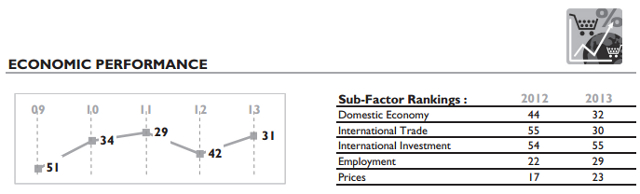
The survey results showed that the Philippines' rank in economic performance improved 11 places to 31st in 2013 from 42nd in 2012. This is the second best ranking that the country posted in economic performance after placing 29th overall in 2011.
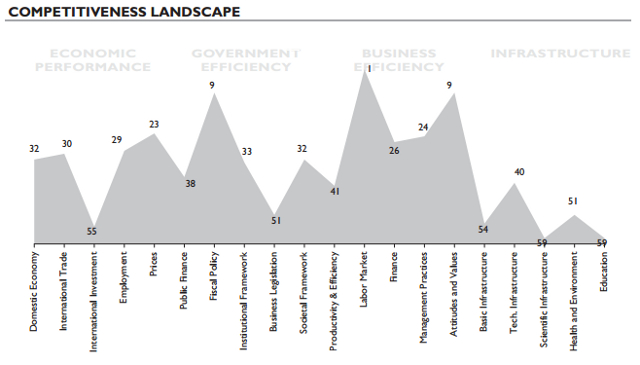
Among the sub-factors, the Philippines ranked highest in terms of prices at 23rd, a decline from 17th in 2012. The country's lowest rank in this category is international investment ranking, which decelerated to 55th in 2013 from 54th in 2012.
"This is backed by the 6.6% real GDP growth in 2012, the second highest in WCY, controlled inflation of 3.2%, and an 8.8% increase in exports of goods and services (in pesos)," IMD said.
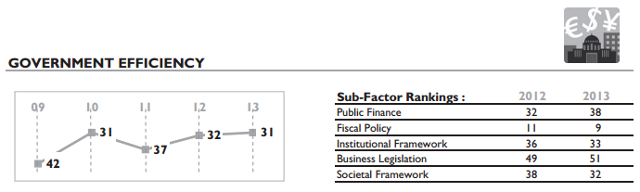
In terms of government efficiency, IMD data showed it hardly moved but improved from 32nd to 31st. This is the same rank it posted in 2010.
Although total tax revenues increased by 13.2%, the country's budget deficit increased to P242.8 billion in 2012 from P197.8 billion in 2011. IMD also said the country's debt-to-GDP ratio of 51.4% in 2012 is slightly higher than the 50.9% in 2011.
Among the sub-factors, the highest ranking was in fiscal policy, which was 9th overall, an improvement from 11th place in 2012. Business legislation, on the other hand, continued to trail other sub-factors and was ranked 51st overall, a slowdown from 49th place in 2012.
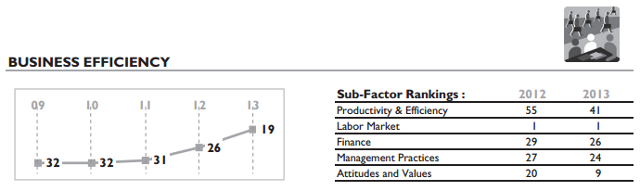
Further, business efficiency improved 7 places from 26th to 19th, mostly because of the soaring stock market. This is the first time since 2009 that the country's business efficiency ranking was above 20th place.
Among the sub-factors, labor market continued to be ranked 1st overall, maintaining its position in 2012. In this factor, productivity and efficiency ranked the lowest at 41st but was an improvement of 14 notches from 55th place in 2012.
"This is mostly pulled by the 5.4% growth (fourth in this year’s WCY) in overall productivity (real GDP per person employed), as GDP grew robustly while employment growth languished. However, it is noticeable that although the Philippines ranked high in growth of overall productivity, the country is ranked 59th in level of overall productivity," IMD said.
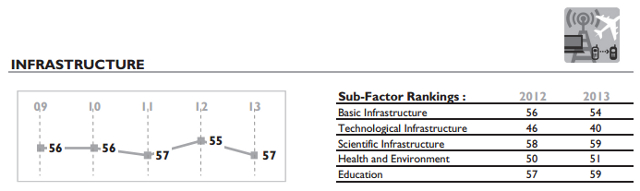
Despite efforts of the government to address the country's infrastructure constraints, infrastructure was the only factor that posted a decelation to 57th place in 2013 from 55th in 2012.
IMD data showed this is the same ranking Philippine infrastructure got in 2011, the lowest ranking it got since 2009. Data showed that this is because 4 out of the 5 sub-factors were ranked below 50.
Technological Infrastructure ranked the highest at 40th, an improvement of 6 notches from 46th in 2012. Tied for lowest place are Education and Scientific Infrastructure at 59th overall, a deceleration from 57th and 58th place, respectively.
"Poor infrastructure is a hindrance not only to more efficient domestic economic activity, but also in more successfully attracting foreign investments. The country’s ASEAN neighbors Malaysia, Thailand and Indonesia, are ranked 25th, 48th, and 56th, respectively, in infrastructure. It is not surprising that these countries also perform much better in attracting foreign investments," IMD said.
Inequality persists
Despite the glowing economic performance of the Philippine economy in 2012, IMD said it is important for the country to exert more effort in attaining inclusive growth.
IMD found it disappointing tha,t while the country did register above 6% growth in 2012, the National Statistical Coordination Board (NSCB) data showed poverty incidence hadly moved in the first semester of 2012.
The country's poverty incidence stood at 27.9% in the first semester of 2012, virtually unchanged from the same period in 2006 and 2009.
Poverty incidence in the same period in 2009 was 28.6% and in 2006, 28.8%, National Statistical Coordination Board (NSCB) Secretary General Jose Ramon Albert said in a press conference last April 23.
Data showed that most of the poorest provinces are located in Mindanao while the least poor were located mainly in Luzon. IMD said this mirrors 2011 data that showed the National Capital Region accounted for 36% of GDP but only 13% of population while Mindanao contributed only 14% but has 24% of population.
INTERACTIVE: The poorest provinces in the Philippines
"The result was disappointing, to say the least, as poverty incidence hardly moved from the 2009 level, in spite of six percent average annual GDP growth during these years. Regional GDP figures show the imbalance of growth and development in the country," IMD said.
IMD added that NCR's per capita GDP was almost 13 times greater than ARMM. This may not be a surprise considering that investments in infrastructure favored Luzon.
It noted that majority of the PPP projects rolled out in 2011 and in 2012 are in Luzon, with a small share going to Visayas, and none in Mindanao.
There are also imbalances in employment. IMD said 40% of workers in the Philippines are "vulnerable" or unpaid family workers and own-account workers.
IMD said occupations with the highest wage such as government, private enterprises, and organization officials are paid more than 4 times the lowest-paid occupation - laborers and unskilled workers.
"Wages are also highly uneven – average wage in NCR (the region with the highest wage) is almost twice that in the lowest wage region (Region IX)," IMD said.
"Wages in the highest-paid sector (extra-territorial organizations and bodies) are almost 7 times higher than in the lowest-paid sector (private households with employed persons)," it added.
Challenges in 2013
IMD said the following are the main challenges of the Philippines in 2013:
Infrastructure - many roads remain unpaved and the main airport is operating beyond capacity
Corruption - ranked 105th out of 174 by Transparency International
Unemployment - is amongst the highest of the ASEAN5 group
Undeveloped financial system and access to finance - access to finance is one of the greatest challenges facing SMEs
Natural disasters - on average 20 typhoons visit annually, causing billions of pesos in damages
Since 1997, the AIM Policy Center has been a partner institute of the International Institute for Management Development (IMD) for the annual release of the WCY.
It draws on hard economic data from various international and national sources, as well as the executive opinion survey of top and middle managers from the ranked countries. The study analyzes over 300 competitiveness criteria to assess and rank the nations. - Rappler
Indonesian mosques have been ordered to cut down on their use of loudspeakers, an Islamic group said Wednesday, a move that may provide some relief to millions who live near the places of worship.
There are some 800,000 mosques in Indonesia, which has the world’s biggest Muslim population, and many use speakers to blast out the call to prayer as well as fiery Koranic verses, often at high volumes in the early hours.
But now the Indonesian Mosques Council has asked the places of worship to restrict the use of loudspeakers following years of complaints by weary residents.
“We must not force something that we believe is good on others who may see it as a disturbance,” said Masdar Masudi, deputy head of the council that groups many of the country’s mosques.
“Even Muslims, such as those who are ill or have insomnia, will definitely get annoyed at the noise.”
Loudspeakers that face into surrounding neighborhoods should broadcast only the call to prayer, which is often relatively quiet and short, said Masudi.
If there are several mosques in the same area, only one should broadcast the call, he said.
For longer and louder readings, speakers can still be used, but they must face into the grounds of the mosque, he said.
Mosques become particularly noisy during the holy month of Ramadan, when Muslims forgo food, drink and sex between dawn and dusk and the loudspeakers blare out Koranic verses almost constantly.
Previous attempts to get mosques to lower their volume have met with extreme opposition.
An elderly Indonesian was forced earlier this year to withdraw a legal action against a noisy mosque in the city of Banda Aceh on Sumatra Island after an angry mob threatened to kill him.
Nevertheless, he ended up winning a rare victory -- the mosque in question turned down the volume significantly after the case.-Al Arabiya
The Department of Foreign Affairs announced today that Prime Minister Kay Rala Xanana Gusmão of the Democratic Republic of Timor-Leste will visit the Philippines from June 5 to 9 upon the invitation of President Benigno S. Aquino III.
The two leaders will discuss areas of mutual interest and cooperation between the Philippines and Timor-Leste, such as education, trade and investment, infrastructure, and defense. While in the Philippines, Prime Minister Gusmão will give a lecture at the University of the Philippines College of Law. He will also undertake a familiarization tour of Subic and Clark and meet with potential Filipino investors in Timor-Leste.
Prime Minister Gusmão was Timor-Leste’s first President after achieving independence on May 20, 2002. He is currently serving his second five-year term as Prime Minister, having first assumed the position in 2007. He is concurrently Minister for Defense and Security.
Prime Minister Gusmão was one of the leaders of the East Timorese resistance movement. He actively campaigned with the international community to help bring about Timor-Leste’s independence.
The Prime Minister is widely recognized for his leadership and has received numerous citations and awards from international bodies such as the UNESCO Félix Houphouet-Boigny Peace Prize (2002) and First Class Medal for Contribution to Humanity awarded by the President of the Republic of Vanuatu (2011), among others.-Official Gazette
The Vatican has suggested for the papal nuncios to the Philippines and Malaysia to meet to discuss the humanitarian concerns in connection with the territorial dispute over Sabah.
Sultanate of Sulu and North Borneo spokesman Abraham Idjirani said the Vatican’s suggestion was relayed to Sultan of Sulu Jamalul Kiram III, during his meeting with Catholic Bishops’ Conference of the Philippines (CBCP) president Archbishop Jose Palma at the CBCP head office in Intramuros, Manila on Wednesday.
He said that the Cebu prelate informed Kiram that, “one of the orders from the Vatican, as per our understanding, was for the nuncios to the Philippines and Malaysia to sit down together and really talk about the issue.”
Palma will be the one who would reportedly arrange the meeting between the two papal nuncios.
“The Sabah issue is a geopolitical issue. This would affect the on going discussion of the Moro Islamic Liberation Front (MILF) and the peace talks. When we say ‘religious point of view’, we are talking about the humanitarian concerns for both the Muslims and the Christians,” Idjirani added.
There are also plans to create an international interfaith between Muslims, Christians and other faiths.
“This meeting serves as strategic path to reach achieve a complete resolution on Sabah issue including the Mindanao conflict,” he added.
It was the second time that Kiram visited the CBCP president, the first meeting took place last April 3.-Philippines News Agency
Hundreds of Buddhist men on motorcycles, screaming and waving iron rods and sticks, roamed the streets of a town in northeastern Myanmar on Wednesday in a new wave of violence targeting Muslims. At least one person died and four others were injured, state television said.
A mosque, a Muslim school and other buildings were burned in the two days of rioting. Many Muslims stayed locked inside their homes and shops remained shuttered in Lashio town, near the border with China, the latest region to fall prey to the country's spreading religious violence.
The flare-up in Lashio reinforced doubts that President Thein Sein's government can or will act to contain the violence and crack down on racial and religious intolerance.
The rioting was sparked Tuesday by reports that a Muslim man had splashed gasoline on a Buddhist woman and set her on fire. The man was arrested and the woman was hospitalized with bad burns.
Mobs took revenge by burning down the mosque and other buildings on Tuesday, but caused no reported casualties. Calm appeared to return as troops were deployed on the streets and authorities banned gatherings of more than five people and imposed an overnight curfew.
But on Wednesday several hundred angry young men drove motorcycles through Lashio's downtown area. A Buddhist monk was seated on the back of one of the motorcycles, waving a stick.
On another street, a crowd threw rocks at buildings. Smoke billowed in another area, and local politician Sai Myint Maung said a movie theater had been burned and there were rumors that more troublemakers were gathered on the outskirts of the town.
Wary Muslims hid in their homes, fearing the kind of brutal violence that claimed dozens of lives earlier this year in other parts of the country, and the large-scale attacks that killed hundreds in western Myanmar last year.
"I never expected that such racial violence would erupt in Lashio," Sai Myint Maung said. "Our small town is multiethnic and we have lived in peace for a long time."
A local freelance journalist was attacked as he photographed a mob ransacking some shops.
"The mob accused me of recording their act and asked me to surrender the camera. I handed over the memory card and I was hit on my head with an iron pipe, causing a gash on my head," Khun Zaw Oo said. He said he managed to flee but a companion also holding a camera was attacked and badly injured.
The government appealed for calm.
"Damaging religious buildings and creating religious riots is inappropriate for the democratic society we are trying to create," presidential spokesman Ye Htut said on his Facebook page. He said "two religious buildings and some shops" in Lashio were burned, without specifying whether they were Muslim or Buddhist.
"Any criminal act will be dealt with according to the law," Ye Htut said.
State TV said a 48-year-old man had been arrested for throwing gasoline on a 24-year-old Buddhist woman and setting her on fire. It identified the man as an Indian Muslim but did not explain the reason for the attack.
The man was charged with causing grievous injuries and arson, as well as drug possession due to stimulants found in his pocket, the TV report said. The woman was being treated for burns on her chest, back and hands.
National police said nine people were arrested for involvement in the two days of violence, but didn't say if they were Buddhists or Muslims.
Minority Muslims have been the main victims of Myanmar's religious violence, but so far there have been no criminal trials of members of the Buddhist majority, raising questions over whether Muslims can find justice.
The sectarian violence first flared in western Rakhine state last year, when hundreds of people died in clashes between Buddhists and Muslims that drove about 140,000 others, mostly Muslims, from their homes. Most are still living in refugee camps.
This month, authorities in two areas of Rakhine announced a regulation limiting Rohingya families to two children. The policy drew sharp criticism from Muslim leaders, rights groups and opposition leader Aung San Suu Kyi. U.S. State Department spokesman Patrick Ventrell on Tuesday said the U.S. opposes coercive birth limitation policies, and called on Myanmar "to eliminate all such policies without delay."
The clashes had seemed confined to the Rakhine region, but in late March, similar Buddhist-led violence swept the town of Meikthila in central Myanmar, killing at least 43 people. Earlier this month, a court sentenced seven Muslims from Meikthila to prison terms for their role in the violence.
Several other towns in central Myanmar experienced less deadly violence, mostly involving the torching of Muslim businesses and mosques.
Muslims account for about 4 percent of Myanmar's roughly 60 million people. Anti-Muslim sentiment is closely tied to nationalism and the dominant Buddhist religion, so leaders have been reluctant to speak up for the unpopular minority.
Thein Sein's administration, which came to power in 2011 after half a century of military rule, has been heavily criticized for not doing enough to protect Muslims. He vowed last week during a trip to the U.S. that all perpetrators of the sectarian violence would be brought to justice.-Yahoo News
While much of the world was reacting to the collapse of the Rana Plaza garment factory in Bangladesh, another clothes-making country, Indonesia, was gripped by its own labor nightmare – the discovery of a kitchenware factory that had held dozens of employees locked in small rooms and deprived them of pay for months.
The case was an extreme example of abuse, but workers'-rights groups say it revealed how even countries that have made progress on improving labor standards are under pressure to cut costs and remain competitive.
A mix of government support and binding agreements between unions and foreign companies have helped give Indonesian workers a voice and improved health and safety, say activists, meaning workers here are more concerned with salaries than ceiling collapses. "We're much better than Bangladesh in many ways; we have one of the best minimum wages in Asia, and we're relatively free to form trade unions," says Surya Tjandra, a labor laws expert at Jakarta's Atma Jaya University.
Like much of Asia, Indonesia built its garment industry on the back of a large pool of low-cost labor, starting in the 1970s. But factory conditions have improved since the sweatshop-plagued 1990s. And after Indonesia's autocratic leader Suharto stepped down 15 years ago, ushering in democracy, labor reforms accelerated.
Former President Megawati Sukarnoputri supported several worker-friendly laws, including a 2003 law that mandates high severance payments. In the past year, minimum wages shot up by as much as 40 percent.
Indonesia's unions also have grown noisy, frequently taking to the streets to protest low wages and other grievances. They've had some success, but still face challenges organizing. Government officials worry that disruptive protests, which occasionally result in violence, could drive away foreign investors.
That's why big-name brands have a critical role to play in improving factory conditions, say labor activists.
They point to a freedom of association protocol [FOAP] signed in June 2011 by trade unions, supplier factories, and six international sportswear brands – including Adidas, Nike, and Puma – which helps ensure that workers can organize in factories to push for better pay and working conditions. It's the first such accord worldwide to involve commitments between local labor groups and suppliers and global retailers.
After the accord was signed, a factory making goods for Nike agreed to pay more than $1 million in unpaid overtime to nearly 4,500 workers as part of a settlement with a local union. In April, a supplier for Adidas came to a similar compensation agreement.
An agreement with six companies may be small when compared with the new accord on fire and building safety in Bangladesh signed by dozens of companies. But the six represent the bulk of the global athletic footwear market, which means they have an important role to play in setting industry standards, says Jeroen Merk, a policy coordinator at the Clean Clothes Campaign, one of the organizations that advocated for the protocol.
Accords like the FOAP are important, says Scott Nova, executive director of the Worker Rights Consortium, a labor-monitoring group, because they are binding agreements "that speak to the obligations of factory owners and the brands and retailers."
Implementation however, remains a challenge. Factories still prevent workers from carrying out union activities; the law allows unions to form but does not set out specific rights that allow them to function. "There have been huge problems with workers being robbed of severance pay," Mr. Nova says, "and while the minimum wage is substantially higher due largely to massive worker protests, it's still a poverty wage."
The minimum wage, set by local governments, ranges from $80 to $160 a month, compared with $37 in Bangladesh and $75 in Cambodia. Indonesia is the world's 12th-largest exporter of textile products, accounting for roughly 1.8 percent of global demand. In recent years it has lost market share to Vietnam and Cambodia, but its relatively better working conditions could start to draw more orders from foreign retailers.
"We're well proven in quality and delivery times," says Ade Sudrajat, the chairman of the Indonesian Textile Association, adding that factories also comply with buyers' codes of conduct on health and safety, which most major retailers have drafted.
Nike was one of the first companies to create codes governing the conditions at its supplier factories following a series of public scandals in the 1990s that partly involved unpaid workers in Indonesia.-Yahoo News
Finance Minister Chatib Basri predicted Indonesia will have an economic growth at the level of 6.4-6.9 percent in 2014.
"The government is optimistic that the target can be achieved considering the improvement in the world`s economy and the growth of Indonesia`s industry and trade sectors," said the minister during a meeting with members of the parliament here on Tuesday.
The minister also mentioned about inflation rate which will be at the level of 3.5-5.5 percent next year. He said the government will boost food commodity`s production to control food price and implement policies in the energy sector.
"Low inflation rate, in long term, will boost Indonesia`s economy to be convergent with other countries` economy in the region. It will make our economy more competitive," said the minister.
Bank Indonesia (BI) has predicted that the national economy in the second quarter of 2013 will grow at a slower pace than projected earlier, and so will the economic growth this year.
The domestic economy expanded 6.02 percent in the first quarter of 2013, down from 6.11 percent a quarter earlier or lower than the central bank`s forecast of 6.2 percent.
The Bank of Indonesia has predicted that the economy in the second quarter of 2013 will grow at a slower pace than its forecast and will not be much different from the first-quarter growth.
Overall, the 2013 economic growth is expected to move to the lower percentage limit of 6.2-6.6 percent.
The current account deficit in the first quarter of 2013 was recorded at 2.4 percent of the gross domestic product, down from 3.5 percent a quarter earlier.
The shortfall in the current account deficit was the result of improving balance of trade fueled by a drastic drop in the import of consumer goods, the central bank noted.
Meanwhile, capital and financial transactions in the first quarter of 2013 recorded a deficit, along with declining foreign investment inflows because of worsening global economic situation and high inflationary pressure.-Philippines News Agency
Vietnamese economists forecast the country's economy will remain flat this year as in 2012, waiting for the actual adjustment in economic restructuring.
The viewpoints were given during the launch of the Vietnam Economic Report 2013, an annual document providing an overview of the macro-economy over the past year, possible scenarios in the years to come and proposals for policy-makers.
The report, which was debut in capital Hanoi on Monday, set out two economic scenarios for Vietnam with Gross Domestic Product ( GDP) growth reaching either 5.04 percent or 5.35 percent in 2013.
Nguyen Duc Thanh, Director of the Center for Economics and Policy Research and editor of the report, pointed out that Vietnam' s economy is facing a series of short and long term difficulties including settlement of bad debts, revival of businesses and real estate market.
High interest rates have reduced the quality of business environment and the competitiveness of the economy, while local companies have yet to make full use of opportunities created by the country's integration into the World Trade Organization (WTO), Thanh added, suggesting to speeding up economic reform.
The report includes seven chapters and two appendices, encompassing an overview of the global economy and Vietnam's economic performance in 2012, post-WTO inflation trends in Vietnam from 2006 to 2013, non-performing debts in the commercial bank system, international lessons and practical application to Vietnam, and Vietnam's economic prospects and policy proposals in 2013. - Philippines News Agency
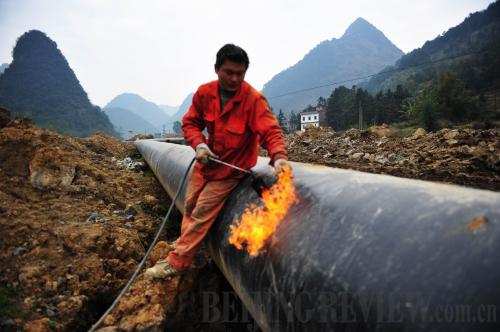
Myanmar President U Thein Sein said on Monday that the ongoing China-Myanmar oil and gas pipeline project, which is nearing completion this year, is an important and mutually beneficial cooperation project.
U Thein Sein made the remarks when meeting with Liao Yongyuan, general mangaer of the China National Petroleum Corporation (CNPC), here.
He said Myanmar is now opening up in all directions, but still will continue to maintain China-Myanmar friendship and strive to enhance the neighborly, friendly and cooperative ties between the two countries.
He expressed welcome for Chinese companies to invest in Myanmar and set up oil refinery plant, among others.
Liao said CNPC has as always attached importance to and fulfilled its social responsibility in the course of the pipeline construction, as reflected by the construction of a number of school buildings and clinics along the pipeline.
On the same day, Myanmar Vice President U Nyan Tun also met with Liao's entourage, speaking highly of CNPC's participation in Myanmar's social welfare undertakings.
Chinese Ambassador to Myanmar Yang Houlan was also present at the meeting.-Philippines News Agency
China should withdraw its ships from Ayungin Shoal (Second Thomas Reef) because that area of the West Philippine Sea (South China Sea) is an “integral part” of the Philippines’ national territory, the Department of Foreign Affairs (DFA) said Monday.
Ayungin lies 196 kilometers from Palawan province, well within the Philippines’ 370-km exclusive economic zone (EEZ), Raul Hernandez, spokesman for the DFA, told reporters. “That’s why [China should withdraw its ships from] the area and respect the maritime zones of the Philippines.”
The Philippines on May 10 protested the presence of a fleet of Chinese fishing boats, accompanied by patrol vessels, at Ayungin, but China has not responded.
Instead of answering the Philippine protest, China insisted that it had “indisputable sovereignty” over Ayungin and other parts of the Spratly archipelago in the middle of the West Philippine Sea.
No security meeting
In response, President Aquino announced a $1.82-billion spending plan for the modernization of the military to enable it to defend Philippine territory against “bullies entering our backyard.”
China’s intrusion has spurred calls for a meeting by the National Security Council, but Malacañang says there is no need for such a consultation to deal with the new tensions in the Spratlys.
Deputy presidential spokesperson Abigail Valte said Monay that Aquino was staying with current efforts, including the diplomatic protest brought by the DFA, to resolve the situation.
Defense officials last week confirmed the presence of two Chinese patrol vessels and a frigate near Ayungin, which the Chinese call Rena’i Reef.
The Chinese media reported that a flotilla of some 30 fishing vessels had been sent to the Spratly Islands, the biggest fishing expedition by China so far this year.
Nine-dash claim
Chinese foreign ministry spokesperson Hong Lei told a news conference in Beijing last week that it was “beyond reproach” for Chinese vessels to patrol the area, as Rena’i Reef was part of the Spratlys, which belonged to China, as shown by its “nine-dash-line” map.
The map shows most of the West Philippine Sea, including parts near the shores of other countries in the region, as part of China’s territory.
The Philippines claims parts of the Spratlys, including Ayungin Shoal, and Brunei, Malaysia, Vietnam and Taiwan claim other parts of the archipelago where islets, reefs and atolls are believed to be sitting on vast energy reserves.
According to Hernandez, the DFA continues to coordinate with the military on the course of action the Philippines should take in the face of yet another “provocative and illegal” Chinese deployment of vessels to parts of the sea within the country’s territory.
Support from Japan
Speaking before Southeast Asian top diplomats at a foreign policy forum in Tokyo last week, Foreign Secretary Albert del Rosario said he hoped China would act as a “responsible and positive force” amid the dispute.
Del Rosario called for a peaceful approach, instead of aggression, to settle disagreements in the region.
During his two-day visit to Tokyo, Del Rosario gained Japan’s support for the Philippine case against China in the United Nations arbitral tribunal.
Like the Philippines, Japan is disputing territory with China in the East China Sea.
Japan administers a group of islands in the sea that it calls the Senkakus, but referred to by China as the Diaoyus.
Japan followed the United States, Germany and the European Parliament in expressing support for the Philippines’ case against China, which Manila brought to the UN tribunal in January after exhausting all other means to resolve its territorial dispute with Beijing.
“The support of the international community for our arbitration initiative is a validation that we are on the right track in resolving the West Philippine Sea issue through a peaceful and rules-based approach,” Hernandez said. - Philippine Daily Inquirer
China on Tuesday said the security and stability of the South China Sea should not be undermined after the Philippines demanded withdrawal of Chinese warships from the Second Thomas Shoal and Vietnam accused a Chinese patrol ship of damaging one its fishing boats around the Paracel Islands.
Last week, the Philippine foreign ministry filed a diplomatic protest over the continued presence of three Chinese government vessels near Second Thomas Shoal.
Chinese foreign ministry spokesman Hong Lei hoped actions would not be taken that undermine the security of the South China Sea.
"It is beyond reproach for Chinese boats to carry out ordinary patrols in these waters. We hope the relevant parties will abide by the Declaration on the Conduct of Parties in the South China Sea and refrain from taking actions that complicate and exaggerate the situation and undermine the stability and security of the South China sea," said Hong.
Three ships, including a Chinese navy frigate, were first spotted in the area around May 8, escorting a fleet of 30 fishing boats from Hainan province. Until Monday (May 27), two maritime surveillance vessels remained near the shoal.
"The accusation made against China by Vietnam is completely inconsistent with the facts. The Vietnamese fishing boat entered China's Xisha Islands (Paracel Islands) and conducted illegal fishing activities, severely violating Chinese sovereignty and Chinese laws. It is totally beyond reproach for relevant departments of China to take normal law enforcement measures. We urge the Vietnamese side to take effective measures to educate its fishermen so as to stop such illegal fishing activities," Hong said.
A statement on the Vietnamese foreign ministry's website said that a Chinese patrol boat had slammed into a Vietnamese fishing boat while it was fishing in the Vietnamese territory of the Paracel Islands on May 20.
Claims by an increasingly powerful China over most of the South China Sea have set it directly against U.S. allies Vietnam and the Philippines. Brunei, Taiwan and Malaysia also claim parts of the waters and China has a separate dispute with Japan in the East China Sea.-ABS-CBN News
Informal meetings between Philippine and Thai trade officials early this month are expected to result in Bangkok’s full compliance with the World Trade Organization (WTO) ruling on tobacco.
“Thailand has continued to engage with the Philippines in discussions on issues of concern to the Philippines. Additional informal consultations requested by the Philippines with several Thai government agencies took place in Bangkok on May 3-4,” Thailand told the WTO’s Dispute Settlement Body (DSB) in a May 13 status report. Thailand presented this status report during the DSB meeting on May 24.
During the said informal talks, the Philippines was represented by Ambassador Esteban B. Conejos Jr., the country's permanent representative to the WTO; Trade Assistant Secretary Ceferino S. Rodolfo; and Assistant Director Angelo Salvador M. Benedictos of the Department and Trade and Industry-Bureau of International Trade Relations (DTI-BITR).
Conejos had asked his Thai counterpart to schedule meetings with the concerned agencies in Thailand that have yet to comply with the WTO ruling.
“In Thailand’s view, these consultations were productive and provide the best means of resolving this dispute. Thailand looks forward to achieving a mutually satisfactory outcome to the dispute,” the status report read.
In 2011, Thailand lost the tobacco case that the Philippines lodged before the WTO in behalf of the Philippine unit of cigarette manufacturer Philip Morris. In its ruling, the WTO agreed that Thailand slapped discriminatory taxes on cigarettes imported from the Philippines.
To comply with the WTO decision, Thailand last year adopted a royal decree abolishing the value-added tax (VAT) exemption enjoyed by resellers of locally made cigarettes, making them at par with imports, which were not VAT-exempt.
But Thailand has yet to fully comply with the WTO ruling even as the reasonable period of time to comply lapsed last year. For instance, the Thai Customs’ Board of Appeals ruling issued last November concerning certain customs valuation entries of imported tobacco from 2002 to 2003 was “inconsistent” with WTO rules, the Philippine WTO mission had said.-Interaksyon
Burmese opposition leader Aung San Suu Kyi has condemned a decision by local officials in Rakhine state to enforce a "two-child policy" on Rohingya Muslims.
The ban has been in place since 1994, but officials recently began enforcing it in areas where they say the high birth rate is fuelling ethnic tension.
The tensions led to violent clashes between Buddhist and Muslim communities in the western state last year.
Ms Suu Kyi has been criticised for not speaking up for Rohingya rights.
Tens of thousands of Rohingya Muslims were displaced by the violence and live in temporary camps.
'Illegal' move
The 1994 ban, that prevents Rohingya Muslims having more than two children, was allowed to lapse in recent years.
But a commission set up to investigate the violence in Rakhine suggested the use of family planning education to address what it described as the rapid growth of the Muslim population.
On Saturday, authorities in Rakhine introduced the two-child policy in two townships, Maung Daw and Bu Thi Daung. It is not clear how it will be enforced.
The vast majority of Rohingya Muslims - about 800,000 people - live in the two townships. Most of those living in camps are elsewhere in Rakhine.
"Under this directive, Bengali [Rohingya] men are allowed to have only one wife and each married couple can have two children. Where there are more than two children, they are considered illegal," Reuters news agency quoted a senior immigration official as saying.
Ms Suu Kyi told reporters she could not confirm whether the policy was being implemented, but if it was, it was illegal.
"It is not good to have such discrimination. And it is not in line with human rights either," she said.
Phil Robertson of the US-based Human Rights Watch (HRW) described the move as outrageous and chilling.
HRW have accused the Burmese authorities of being party to ethnic cleansing during the violence in June and October last year, which left about 200 people dead and up to 140,000 displaced.
The Rohingyas are a stateless group of some 800,000 people who are not recognised as Burmese citizens.
The United Nations describes them as a religious and linguistic minority from western Burma, and one of the most persecuted minorities in the world.
However, many Burmese officials refer to them as Bengalis - a reflection of the widespread belief that this community belong in neighbouring Bangladesh.-Yahoo World News
The Philippines and Taiwan have begun parallel investigations into the shooting of a Taiwanese fisherman amid a diplomatic row.
A team of eight from Manila arrived in Taiwan on Monday, while a team from Taipei also arrived in the Philippines, officials from both sides confirmed.
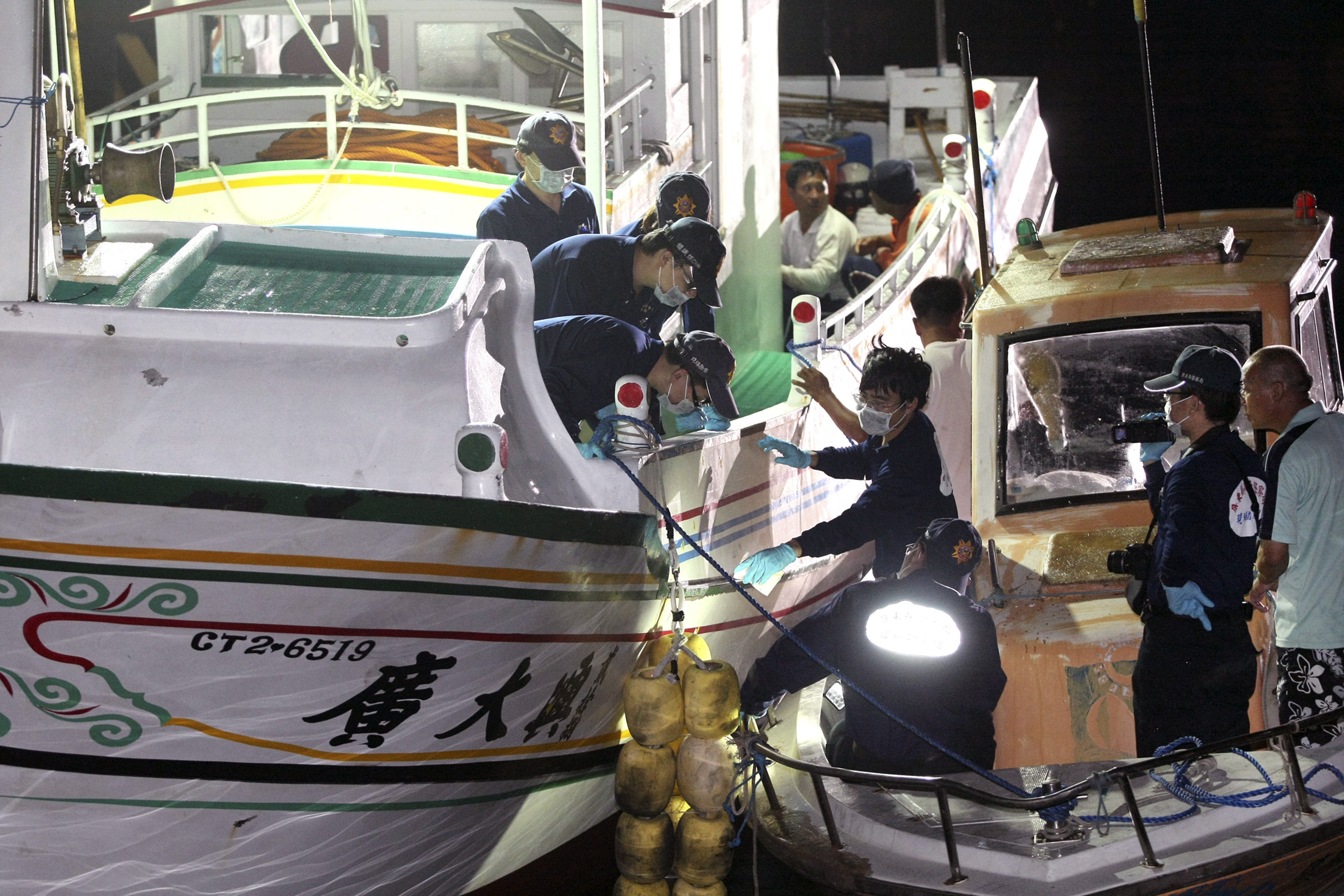
The Philippine coast guard shot dead fisherman Hung Shih-cheng, 65, on 9 May in disputed waters.
Taiwan has dismissed Manila's apologies and has imposed economic measures.
"The [Philippine] visitors will have a look at the autopsy report on Hung Shih-cheng this afternoon," a spokesman for Taiwan's Justice Ministry was quoted by Agence-France Presse news agency as saying.
The team, which will stay until Friday, will be inspecting evidence, reviewing data and taking a look at the Taiwanese fishing vessel, the spokesman added.
Meanwhile, a spokesman from the Philippine National Bureau of Investigation also confirmed the arrival of the team from Taiwan, but gave no further details.
The fisherman was shot in waters which both sides say lie within their 200-nautical-mile from shore exclusive economic zone.
The Philippine coastguard said its crew acted in self-defence, believing Mr Hung's boat was trying to ram their vessel. However, the other Taiwanese fishermen on board denied this and gave a different version of events.
The Philippines apologised for the incident, but Taiwan rejected the apology, saying it lacked sincerity.
Taiwan has imposed a host of economic measures against the Philippines, including suspending visa processing for Filipino workers and cutting trade exchanges. It has also conducted military drills in the disputed waters.-British Broadcasting Corporation
Bangkok has emerged as the world’s top tourist destination, with 15.98 million visitors projected to descend in Thailand’s capital city this year, according to the third annual Global Destination Cities Index released by MasterCard MA +0.30% on Monday.
Based on data MasterCard collected from governments, central banks, related public agencies and airlines so far this year, the projection for the entire year says Bangkok is surpassing London, the previous holder of the top place, by a very narrow margin.
Monday’s report marked the first time any Asian city has been projected to be the top-ranked tourist destination. London came in second, with 15.96 million visitors expected in 2013, and Paris, third, with 13.92 million visitors. MasterCard looked at 132 cities.
Other Asian cities that made it to the Top-20 Global Destination Cities in 2013 include Singapore at number four, with 11.75 million visitors; Kuala Lumpur at number eight, with 9.2 million visitors; Hong Kong at number nine, with 8.72 million visitors; Seoul at number 11, with 8.19 million visitors; Shanghai at number 14, with 6.5 million visitors, Tokyo at number 16, with 5.8 million visitors, and Taipei, with 5.19 million visitors.
The study found that Bangkok is experiencing a large increase in its number of tourists in 2013, up 9.8% from 2009. That compares to New York’s increase at 5.0% and London’s at 3.8%. Paris, meanwhile, saw a small dip in its number of tourists (negative 0.7%).
Caroline Lledo, who was visiting with her mother from France, said Thailand has many offerings.
“We like culture and the people are so nice. We also love shopping here,” Ms. Lledo said.
MasterCard Worldwide’s global economic adviser Yuwa Hedrick-Wong cited overall value for money spent for why Bangkok is attractive. That is true for Thailand overall as well.
However, in terms of visitor spending, Bangkok is projected to bring in a total of US$14.3 billion dollars and is ranked at fourth this year, while New York continues to be the top city, where visitors will spend around $18.6 billion dollars in 2013.
Tourism Authority of Thailand (TAT) adviser Suwanchai Ritthirak cited official data in saying that each foreign visitor spends an average of 9.6 days and 4,100 baht (about US$141.50) in the country. Therefore, to boost Bangkok’s ranking, more needs to be done to increase either or both factor.
Asia-Pacific destinations have outperformed cities in the other parts of the globe, said Mr. Hedrick-Wong. Looking at the past five years, he predicted that Asia will likely continue to see a boost in the number of tourists. Not only will more international visitors visit the region, but more Asians will be traveling to cities beyond their own countries.-Wall Street Journal
Japan has announced fresh loans to Burma and cancelled the remainder of its debt with the country, as Tokyo seeks to boost economic ties.
The announcement came during a visit by Japanese PM Shinzo Abe to Burma, where he had talks with President Thein Sein.
Mt Abe pledged about $500m (£330m) in new loans and wrote off $1.74bn of Burma's debt to Japan, officials said.
Japan, a key donor to Burma, maintained trade ties with the country during its years of military rule.
Correspondents say Mr Abe's visit - the first visit by a Japanese prime minister since 1977 - marks a further improvement in already warm relations.
Last year Tokyo cancelled $3.4bn of Burma's debt. Saturday's announcement means the outstanding debt has been written off as well.
The new loans will cover infrastructure development projects and power station maintenance.
On Saturday Mr Abe visited the site of a proposed port and business park which Japan and Burma are to develop jointly.
He also met opposition leader Aung San Suu Kyi.
Burma has undergone a programme of reforms since a nominally civilian government was installed in 2011.
Hundreds of political prisoners have been released, and censorship rules have been relaxed. The EU and US have lifted the majority of sanctions against Burma as a result.
However, Burma has experienced serious anti-Muslim violence in recent months.-British Broadcasting Corporation
Taiwan on Saturday protested to the Philippines for sending naval ships to disputed South China Sea islands in the latest diplomatic spat between the two governments.
"The foreign ministry expresses its serious concern and firm opposition over the Philippines' dispatch of naval vessels to Renai (Second Thomas) Shoal in the Spratly Islands," it said in a statement.
Taiwan's government "denies all unlawful claims to sovereignty over, or occupation of, these areas by other countries" it said.
The statement did not say when and how many Philippine ships were allegedly sent to the area or for how long. A foreign ministry spokeswoman was not immediately available for comment when reached by AFP.
The Spratlys, a sprawling group of islands, are claimed in whole or part by Taiwan, China, Vietnam, Malaysia, the Philippines, and Brunei.
The potentially resource-rich sea, home to important trade routes, is an increasingly dangerous flashpoint and there have been a string of recent diplomatic rows between countries with overlapping territorial claims.
The Philippine government and military spokespeople declined to comment.
Taipei and Manila have already been embroiled in a diplomatic row over the fatal shooting of a Taiwanese fisherman by Philippine coastguards who claimed his vessel had intruded into their territorial waters earlier this month.
Taiwan has rejected claims that the shooting took place in Philippine waters and that the killing was "unintended". President Ma Ying-jeou has described the incident as "cold-blooded murder".
Amid widespread public outrage on the island, Taiwan's government has rejected repeated apologies from the Philippines and announced a series of economic sanctions against the country, including banning the entry of any more workers.
Taiwan has also recalled its de facto envoy and held a military exercise in waters near the northern Philippines last week. - GMA News
A documentary using small clay figures to tell the story of how Cambodian filmmaker Rithy Panh's family perished under the Khmer Rouge regime won the top prize in the second most important competition at the Cannes film festival on Saturday.
"L'Image Manquante" (The Missing Picture) was among the 18 films that premiered in the Un Certain Regard category that was set up to encourage emerging and innovative filmmakers and run alongside the main competition at the world's top film festival.
Panh, 49, a prolific filmmaker whose films concentrate on the brutality in Cambodia when an estimated 1.7 million people were killed during the 1975-79 Khmer Rouge regime, said the prize was important for his country.
"For a country that has emerged from its difficulties and years of war, it is important to say we are still alive," Panh told Reuters after receiving his award at a red carpet ceremony in the French Riviera resort.
The jury led by Danish director Thomas Vinterberg, whose film "Jagten" (The Hunt) won Mads Mikkelsen the best actor award at Cannes last year, described the documentary as "one of the most powerful films I have seen in many years".
The runner-up was "Omar" by Palestinian director Hany Abu-Assad, a political thriller involving Palestinians living under Israeli occupation in which a young baker, Omar, is tortured by Israel's secret police to betray his friends.
"Omar", which was shot in the West Bank and Israeli-Arab town of Nazareth last year, received a standing ovation at its premiere as the first film fully funded by the Palestinian cinema industry.
"It is the only festival that I think still cares about different films," said Abu-Assad, known for the 2005 award-winning film "Paradise Now", as he received his award.
Another director in Un Certain Regard to get a standing ovation was Iran's Mohammad Rasoulof who was jailed in 2010 for anti-regime propaganda but came to Cannes this year with "Manuscripts Don't Burn", shot in secret in his home country.
The non-professional actors of "La Jaula de Oro" (The Golden Cage), a film about three young Guatemalans trying to cross the Mexico-U.S. border from director Diego Quemada-Diez won an award for best cast.-GMA News
The Indonesian government, in partnership with Airbus has produced a CN295 military aircraft ideal for defense and environmental surveillance missions.
Indonesia is offering the Philippines a twin-engine medium-sized, multi-role aircraft for civilian and military use, a cheaper version of the C-130 Hercules troop and transport carrier.
The Philippines is the first stop in a tour around six ASEAN countries – Brunei, Vietnam, Myanmar, Thailand and Malaysia – to promote the capabilities and efficiency of the transport aircraft.
Accompanying the airplane on its visit to the Philippines for a demonstration of the airplanes capabilities is Indonesian deputy minister (retired) Gen. Sjafrie Sjamsuddien.
“We are promoting the use of a common defense system among the Asean countries and the CN295 perfectly fits this objective,” he said in a statement.
Department of Defense undersecretary for legal and legislative affairs and strategic concerns Pio Lorenzo Batino was at Villamor Air Base to watch a demonstration of the plane which made a 30-minute flight from the Ninoy Aquino International Airport.
The arrival of the Indonesians promoting an airplane capable of long-range reconnaissance and anti-submarine warfare, troop transport medical evacuation comes at a time when the Philippines has signified its intention to beef up its military.
President Aquino announced a $1.8-billion military upgrade to help defend the country’s maritime territory during the anniversary of the Philippine Navy.
The Philippines has been beefing up its armed forces, starting with the purchase of maritime vessels from the United States over what observers called “bullying” by China and the Republic of China (Taiwan).
The CN295 is a joint venture between Indonesia and Airbus.
Sjamsuddien said he believes a common use of the same aircraft type in the Asean region would strengthen cooperation among members while significantly reducing the operational and maintenance cost of the aircraft.
“In the segment of small and medium aircraft, the CN295, CN235 and NC212i are the perfect solution to the type of missions we undertake in this region,” Sjamsuddien said.
A reliable source told The STAR that the Philippine Air Force is planning to purchase three NC295 and one C-130 cargo plane for rescue and humanitarian missions.-The Philippine Star
Tens of thousands of people held a rally near Malaysia's capital against alleged electoral fraud, further raising the political temperature after divisive recent polls.
The latest in a series of protest rallies over the May 5 elections - which the opposition says were won fraudulently by the 56-year-old ruling coalition - saw a large crowd gather in an open field outside Kuala Lumpur Saturday night.
Malaysia's Home Minister Zahid Hamidi had earlier called the rally a "provocation", coming after four people were arrested including two opposition politicians, actions that sparked allegations of a post-election crackdown on dissent.
There were no reports of any police action against the latest rally, which was to include speeches by top opposition figures including leader Anwar Ibrahim.
Opposition speakers vowed to expose electoral fraud and keep up the pressure on the Barisan Nasional (National Front) government.
"We are never disappointed because we have won decisively, the moral victory. Tough times never last, only tough people do. We will prove to [the government] how tough we are," Anwar's daughter, parliament member Nurul Izzah, told the crowd.
Silencing opposition
Two senior opposition politicians and two activists were detained last week under the Sedition Act for criticising the conduct of the elections. They were later released.
Prime Minister Najib Razak, who before the elections sought to portray himself as a reformer, had pledged last year to repeal the decades-old Sedition Act.
The home ministry last week also said it had seized some 2,500 copies of opposition-party newspapers for allegedly failing to meet printing regulations.
The three-party opposition plans to file court challenges to the result in 27 parliamentary seats. If all are successful, the opposition says it would give them victory.
It is highly unlikely the opposition would prevail, as critics widely accuse the courts and Election Commission of being in thrall to the ruling coalition.
Global rights group Amnesty International urged the Malaysian government Friday to end what it called a "post-election crackdown", saying it was using the Sedition Act "against peaceful protestors".
Barisan gained only 46.6 per cent of the popular vote but won a firm majority, which critics blame on Barisan tinkering with districts to give its strongholds more weight.
The opposition claims that, among other problems, voter rolls were full of irregularities. The government denies the election was unfair.-Aljazeera
Authorities in Myanmar's western Rakhine state have imposed a two-child limit for Muslim Rohingya families, a policy that does not apply to Buddhists in the area and comes amid accusations of ethnic cleansing in the aftermath of sectarian violence.
Local officials said Saturday that the new measure would be applied to two Rakhine townships that border Bangladesh and have the highest Muslim populations in the state. The townships, Buthidaung and Maundaw, are about 95 percent Muslim.
The unusual order makes Myanmar perhaps the only country in the world to impose such a restriction on a religious group, and is likely to fuel further criticism that Muslims are being discriminated against in the Buddhist-majority country.
China has a one-child policy, but it is not based on religion and exceptions apply to minority ethnic groups. India briefly practiced forced sterilization of men in a bid to control the population in the mid-1970s when civil liberties were suspended during a period of emergency rule, but a nationwide outcry quickly shut down the program.
Rakhine state spokesman Win Myaing said the new program was meant to stem rapid population growth in the Muslim community, which a government-appointed commission identified as one of the causes of the sectarian violence.
Although Muslims are the majority in the two townships in which the new policy applies, they account for only about 4 percent of Myanmar's roughly 60 million people.
The measure was enacted a week ago after the commission recommended family planning programs to stem population growth among Muslims, Win Myaing said. The commission also recommended doubling the number of security forces in the volatile region.
"The population growth of Rohingya Muslims is 10 times higher than that of the Rakhine (Buddhists)," Win Myaing said. "Overpopulation is one of the causes of tension."
Sectarian violence in Myanmar first flared nearly a year ago in Rakhine state between the region's Rakhine Buddhists and Muslim Rohingya. Mobs of Buddhists armed with machetes razed thousands of Muslim homes, leaving hundreds of people dead and forcing 125,000 to flee, mostly Muslims.
Witnesses and human rights groups say riot police stood by as crowds attacked Muslims and burned their villages.
New York-based Human Rights Watch has accused authorities in Rakhine of fomenting an organized campaign of "ethnic cleansing" against the Rohingya.
Since the violence, religious unrest has morphed into a campaign against the country's Muslim communities in other regions.
Containing the strife has posed a serious challenge to President Thein Sein's reformist government as it attempts to make democratic reforms after nearly half a century of harsh military rule. It has also tarnished the image of opposition leader Aung San Suu Kyi, who has been criticized for failing to speak out strongly in defense of the country's embattled Muslim community.
The central government has not made any statement about the two-child policy, which was introduced at a local level. Calls seeking comment Saturday from two government spokesmen were not immediately returned, but Rakhine state official Myo Than said all local policies require "consent from the central government."
Win Myaing said authorities had not yet determined how the measures — which include a ban on polygamy — will be enforced. The policy will not apply yet to other parts of Rakhine state, which have smaller Muslim populations.
In its report issued last month, the government-appointed commission wrote: "One factor that has fueled tensions between the Rakhine public and (Rohingya) populations relates to the sense of insecurity among many Rakhines stemming from the rapid population growth of the (Rohingya), which they view as a serious threat."
Predominantly Buddhist Myanmar does not include the Rohingya as one of its 135 recognized ethnicities. It considers them to be illegal immigrants from Bangladesh and denies them citizenship. Bangladesh says the Rohingya have been living in Myanmar for centuries and should be recognized there as citizens.
China has been carrying out a planned birth policy since the late 1970s, generally limiting one child to urban couples and no more than two to rural families, to stem rapid population growth that Beijing believes is not sustainable economically and environmentally.-Yahoo World News