While the Preah Vihear dispute has rekindled nationalist and patriotic sentiments in Thailand, the week-long hearing at The Hague was outwardly met with relative calm across the border.
Coverage in the Cambodian press has been limited after the week of legal argument into Cambodia's request for the International Court of Justice (ICJ) to reinterpret the 1962 ruling. The ICJ is expected to deliver its ruling in October.
The main exception was reporting of Cambodian Prime Minister Hun Sen's call for calm from both sides on Monday, when he addressed several hundred villagers at a pagoda in Prey Veng province to explain Phnom Penh's position.
''I contacted Thai Prime Minister Yingluck Shinawatra and said it doesn't matter what the court's decision is, Cambodia and Thailand will not become enemies because Cambodia and Thailand are like tongue and teeth,'' Hun Sen said, adding he was confident Cambodia would win. ''They cannot be separated from each other.''
One organisation that has been keeping a close watch on local sentiment is the Documentation Centre of Cambodia, which has a nationwide network covering 5,000 villages. The head of the centre, Youk Chhang, said the centre had spoken to about 100 people a day, many of whom had gathered for the Khmer New Year, and noted their opinions about the ICJ hearing. All the interviews - whether in the field, by phone or by email - were transcribed and the names and addresses of the interviewees noted.
Despite the muted media response in the country, he said Preah Vihear was in every Cambodian's heart and they all took a personal interest in the issue.
''Cambodians have recently been taking a more civilised position in regard to the court case and this, I believe, has been influenced by the Khmer Rouge Tribunal,'' he said.
''Even though they know the issues well, they want to respect the legal process and leave it up to the judges to make a final decision.''
The majority of respondents from ethnic groups in Preah Vihear province had the simple belief that Thailand was involved in an audacious land grab and was using its political and military might to not only invade Cambodia, but also influence international opinion.
The area surrounding the temple is home to several indigenous groups, including the Kraol people.
''I became familiar with this issue recently through the media,'' said Saray Poeun, an ethnic Kraol living in Kratie province.
''I'm unhappy to hear that Thailand has always held on to the idea of invading our country. As a Kraol, the temple and land belong to the Kraol people, the Khmer and other ethnic groups in Cambodia. I appeal to the ICJ to find justice for us.''
Other residents of Preah Vihear province complained of the impact the dispute has had on their livelihoods. Saom Pheareak said it was impossible that ''Khmer kings built a temple on land that did not belong to Cambodia. Thailand used military power to seize that land. This act was detrimental to the lives of people along the border.''
A dozen law students and graduates were interviewed about the ICJ hearing, and few found any merit in Thailand's legal argument, describing it as ''lies'' and ''weak''. They all said they expected the ICJ to find in favour of Cambodia, but were unsure of Thailand's willingness to accept the ruling.
''The interpretation could lead to the end of the long territorial conflict between Thailand and Cambodia,'' said 20-year-old law graduate Sok Vanseka.
''But it also depends on the situation in Thailand; they may or may not accept the ICJ decision. Cambodia is not seeking to alter the 1962 verdict which is in effect. Thailand accused Cambodia of falsifying the map in order to occupy 4.6 square kilometres. The Thai argument is very weak.''
Chhay Vannlihuong, 20, a student at the Royal University of Law and Economics in Phnom Penh said: ''Thailand's argument was based upon a lie.
''They used unilaterally produced maps in order to claim the 4.6 square kilometre piece of land. We depend heavily on the maps produced by the French. The Thais said that the ICJ should not reinterpret the ruling, because Thailand has already implement the 1962 verdict. But I don't agree. If Thailand had respected the decision of the court, we would not have any problems today.''
Several students pointed to Thai ''invasions'' into Cambodian territory over the past 50 years, and a refusal to return antiquities taken from the temple, as proof that Thailand had not respected the 1962 ruling.
Former Khmer Rouge cadres also offered a historical perspective on the dispute and the two small ''Red Houses'' built by military commander Ta Mok, which today stand inside Thai territory.
''Ta Mok's troops had control of the Preah Vihear temple between 1979 and 1991,'' said former Khmer Rouge cadre Vong Pheak.
''The Red Houses inside Thai territory that we can see from our land were built by Ta Mok. After some Khmer Rouge cadres defected from the [Cambodian] government, Thailand took control of the [Red] houses''
A common argument repeated by the Khmer Rouge fighters is that Thai soldiers were not seen near Preah Vihear after 1979 and they never attempted to take the temple from them. One said he did not know the Red Houses were occupied by Thai troops until the border skirmish in 2008.
''Not a single foreign soldier came near the temple,'' said former Khmer Rouge soldier Chum Oeun.
''Only Khmer people lived there. The Red House was built by Ta Mok. Ta Mok directed the construction. The workers were brought from the Anlong Veng area. He [Ta Mok] built that house to serve as a place for his guests to relax after visiting the temple. At that time, not a single Thai soldier came anywhere near there.''
While strident in their defence of Cambodian territory against what they perceived as Thai land-grabbing, several of those interviewed could not understand the need for Cambodia's request for a re-interpretation of the 1962 ruling.
''Why do we need to re-interpret it?'' asked Sam-Ang Ek Sambo, a government official in Kampong Speu province: ''If a husband and wife have been divorced in court, they are divorced. No need to ask the court to read the verdict again. It's a waste of time.''
Others questioned why the hearings were held over the New Year period of both countries and why they were only made accessible online when so few rural Cambodians have access to the internet.-Bangkok Post (April 28, 2013)
ASEAN needs to continue to unify to ensure peace, security and development in the region, according to Prime Minister Nguyen Tan Dung.
Speaking at the 22nd ASEAN summit in Bandar Seri Begawan, Brunei, which ended Thursday, Dung said more co-operation was needed to cope with the global economic crisis, natural disasters, climate change, maritime security and epidemics.
He said ASEAN should make the best use of the Treaty of Amity and Cooperation (TAC), the Southeast Asian Nuclear-Weapon-Free Zone Treaty (SEANWFZ), the Declaration on the Conduct of Parties in the East Sea (DOC), the Declaration on the East Asia Summit on principles for mutually beneficial relations, the ASEAN Regional Forum and ASEAN Defence Ministers' Meeting Plus.
Regarding the East Sea issue, the PM proposed the association raise a united voice for peace, stability, maritime security and safety.
He noted the effective implementation of commitments and agreements such as the Declaration on Six-point Principles on the East Sea, and the ASEAN-China joint statement on the 10th anniversary of the signing of the Declaration of Conduct, the settlement of disputes by peaceful measures, the respect of international law - especially the United Nations Convention on the Law of the Sea (UNCLOS) - and the early conclusion of the Code of Conduct in the East Sea (COC).
Affirming Viet Nam's support for Thailand as the coordinator in the ASEAN and China dialogue relations, Dung said the two sides needed to accelerate negotiations.
Dung's views were shared by other ASEAN leaders, who agreed that the East Sea issue was a matter of concern for the entire organization as it relates to peace and security in the region.
ASEAN leaders also expressed satisfaction at the progress towards setting up an ASEAN Economic Community (AEC) by the end of 2015.
However, ASEAN member countries need to make greater efforts to realize the goal, according to the Chairman's statement at the Summit.
The statement said 77.57 percent of the AEC Blueprint had been implemented to date.
The leaders agreed to enhance ASEAN's competitiveness by facilitating trade and investment, leveraging upon on-going work to establish the AEC.
They also recommended rolling out a roadmap of initiatives to simplify ways of doing business and addressing investment impediments in the region.
Filipino Trade secretary Gregory Domingo said ASEAN had already achieved about three quarters of its targets relating to the goal of a single-market since it began the process in 2007.
But he also said many challenges were ahead, including a framework to open up the services sector within ASEAN, which includes banking, insurance, telecommunications and retail.
On trade, Domingo said agriculture was among the most difficult sectors to fully liberalize.
Official statistics show that since the adoption of the blueprint in November 2007, per capita income in the region has risen from US,267 to ,759 a year.
PM meets Sultan
On Wednesday, PM Dung met with the Sultan of Brunei, Haji Hassanal Bolkiah.
Dung congratulated Brunei on becoming the 2013 ASEAN chair and said he highly valued its ties with the country.
The PM suggested the two sides speed up negotiations and promptly sign memoranda of understanding on agriculture, fishery and labor cooperation, and an agreement to encourage and protect investment.
The two sides pledged to strengthen mutual trust, understanding and the exchange of high-level delegations between the two nations' ministries and departments.
The Sultan vowed to facilitate links in oil and gas, fisheries and agriculture with Viet Nam.
Regarding regional and international issues, the two leaders agreed to increase exchanges and consultations on issues of common concern, support each other at regional and international forums, particularly within ASEAN.
PM meets counterparts
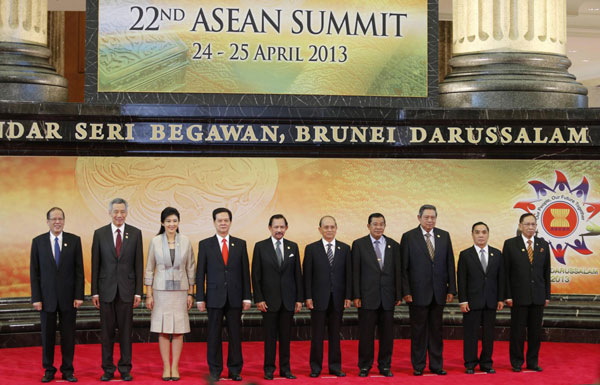
Dung also took the opportunity to hold bilateral meetings with his Thai and Singaporean counterparts Yingluck Shinawatra and Lee Hsien Loong, alongside Filipino President Benigno S Aquino.
At the meeting with Yingluck, the two sides noted with pleasure their growing friendship and all-around co-operation in the fields of national security and defence, trade, investment and socio-culture in recent times, especially since the Viet Nam–Thailand Joint Cabinet convened its second meeting on in October 2012.
Last year, two-way trade hit .67 billion and in total Thailand has invested in 300 projects worth .12 billion in Viet Nam.
The two leaders agreed to assign relevant departments to complete the details of a strategic partnership between the two nations.
Dung spoke highly of Thailand's co-ordinating role in ASEAN–China ties and declared that Viet Nam was always willing to work with Thailand towards this goal.
When greeting his Singaporean counterpart, Dung hailed Singapore as Viet Nam's leading investment partner, and noted that it had injected nearly 1,100 projects at a combined capital of billion. In 2012, two-way trade between the two countries hit .6 billion.
The Singaporean PM will visit Viet Nam in September, when the two countries are expected to issue a joint declaration pledging to lift bilateral ties to a strategic partnership, which will mark a new stage in their relationship.
At a meeting with Filipino President Aquino, Dung again praised the development of bilateral ties. Two-way trade between the regional partners reached nearly billion last year.
The Vietnamese PM called for Aquino to seek the prompt release of 24 Vietnamese fishermen held by the Philippines. Aquino promised to actively deal with the issue. -Philippines News Agency (April 26, 2013)
China on Friday accused the Philippines of trying to legalize its occupation of islands in the disputed West Philippine Sea (South China Sea), repeating that Beijing would never agree to international arbitration.
The Philippines is seeking a United Nations ruling on the validity of Chinese claims to the resource-rich sea, with a possible unfavorable verdict for China seen as a test of its willingness to yield over territorial disputes.
Manila said on Thursday that a UN arbitration court had set up a tribunal that would handle the Philippine case, but China said this was an attempt to steal Chinese territory.
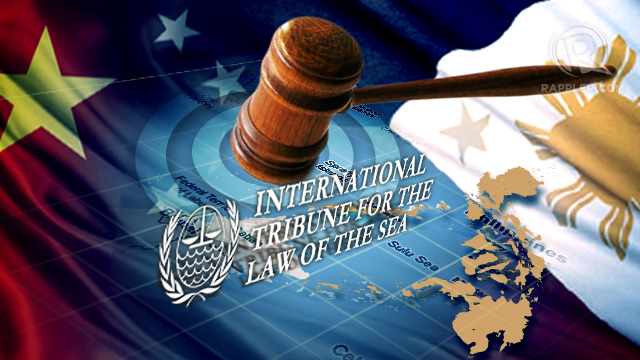
Manila’s announcement came after Shunjai Yanai, president of the International Tribunal for the Law of the Sea (Itlos), informed the Philippines about the appointment of the last three arbiters to the panel that would handle the Philippine case and rule on the country’s bid to clarify its rights in the West Philippine Sea.
On Friday, Philippine Foreign Secretary Albert del Rosario told reporters in Manila that the UN arbitral tribunal may open deliberations on the merits of the Philippine case by July.
The deliberations will proceed even without the participation of China, Del Rosario said.
Any decision the tribunal hands down will be “final and unappealable,” Del Rosario said.
“The first thing they will do starting Monday is to organize themselves and establish the rules of the tribunal,” Del Rosario said.
“The second thing that they will do is determine whether they have jurisdiction over the case,” he said. “That should take another couple of months and maybe by July, they can already be working on the merits of the case.”
Philippine sovereignty
The Philippines brought the case in January, asking the United Nations to order a halt to China’s activities that it said violated Philippine sovereignty over islands within its 360-kilometer exclusive economic zone recognized under the United Nations Convention on the Law of the Sea (Unclos).
Invoking that law, the Philippines asked the tribunal to invalidate China’s “nine-dash line” map, as it encroaches on the Philippine exclusive economic zone. The map shows Chinese territory covering almost the whole West Philippine Sea, including the islands near the shores of its neighbors that are believed to be sitting atop vast energy and mineral reserves.
‘Illegal occupation’
China’s foreign ministry posted a statement on its website on Friday saying the Philippines was attempting to “cover in a cloak of ‘legality’ its illegal occupation of Chinese islands and reefs.
Beijing called on the Philippines to immediately withdraw all personnel and facilities from the islands that it said the Filipinos were occupying. Those include five islands in the Spratly archipelago in the West Philippine Sea.
China has returned the Philippine notification of proceedings on the UN arbitral tribunal, rejecting arbitration and asserting “indisputable sovereignty” over the sea.
Instead of arbitration, China insisted on negotiations with the Philippines to settle the territorial dispute in the West Philippine Sea.
“The position outlined by China will not change,” the Chinese foreign ministry statement said.
Unclos unapplicable
The Unclos does not apply in this case, as what the Philippines is asking for is a decision on sovereignty, the ministry said.
“China’s refusal to accept the Philippines’ request for arbitration has full grounding in international law,” it said.
The Chinese statement came a day after the leaders of the 10-member Association of Southeast Asian Nations (Asean) called for urgent talks with China to seek a resolution to the increasingly tense territorial disputes in the West Philippine Sea.
After efforts to engage China in talks on a code of conduct in the West Philippine Sea all but collapsed last year at a summit in Cambodia, a close economic ally of China, the Asean leaders agreed on Thursday to send their foreign ministers to a meeting ahead of an Asean-China meeting expected in August to establish solidarity on the proposed code.
Asean members the Philippines, Vietnam, Malaysia and Brunei claim parts of the sea, as does Taiwan. The competing claims have for decades made the area one of Asia’s potential powder kegs.
The Philippines accused China of occupying Panatag Shoal (Scarborough Shoal), resource-rich shallows within the country’s exclusive economic zone, after breaking an agreement on the withdrawal of the two countries’ ships to ease tensions in the area.
The Chinese occupation of the shoal forced the Philippines to take action in the UN arbitration court.
Enforcement another matter
Asked whether the court’s ruling would be binding on China, Del Rosario answered: “Once it’s been determined that they have jurisdiction, ultimately an award will come down, and that award will be final and it will not be appealable.”
In a recent interview by e-mail, international law expert Tom Ginsburg, a professor at the University of Chicago, said that while the UN tribunal’s rulings are binding on both parties, there is no guarantee that China will comply.
“The panel decision is binding regardless of whether a party participates,” Ginsburg said. “Enforcement, however, is another matter.”
Ginsburg said that most international laws assume parties will comply in good faith, but this does not always happen.
“I do not expect that anyone will be able to force China to comply with any adverse decision that is issued,” he said.-Philippine Daily Inquirer (April 27, 2013)
Malaysian authorities are taking the first concrete step to counter negative impressions of Sabah following clashes with followers of Sulu Sultan Jamalul Kiram III — by offering Sabah tourism packages.
On Friday, the Tourism Malaysia Domestic Promotion Division launched the "Sabah, Sandakan & Tawau Tour Packages" featuring 10 tourist destinations in Sandakan and Tawau.
A report on Malaysia's state-run Bernama news agency described the tourism package as "an initiative to introduce these tourist destinations to domestic travelers after the Lahad Datu incident."
Tourism domestic promotion division director Musa Yusof said the Ministry of Tourism, Tourism Malaysia and relevant agencies had taken proactive action by setting up dialogues and the Sabah Tourism Task Force (STTF) last March 18 "to counter the negative impact of the Lahad Datu incident."
Last February, armed followers of Kiram engaged Malaysian forces in a three-week standoff that ended in deadly clashes on March 1 and 2. Following the deadly clashes, Malaysia mounted offensives to flush out Kiram's followers from Lahad Datu.
Movie names
The Bernama report said some of the packages included four days and three nights in Sandakan ("Return of The Planet Ape") and four days and three nights ("Finding Nemo & Dory") in Mabul Island.
"The packages were named after popular movies as people tend to remember famous movies more," Musa said.
He pointed out that Sandakan and Tawau have bountiful natural wealth, including Sukau-Kinabatangan, Sepilok Orang Utan Rehabilitation Centre, Selingan Island in Sandakan; and Tawau Hills Park, Teck Guan Cocoa Museum and Village, Mabul, Kapalai, Mataking, Sipadan Islands in Semporna.
Musa said Tourism Malaysia is confident of achieving the Sabah Tourism Board's target of two million domestic arrivals this year.
However, there was a slight decrease in domestic tourist arrivals for January and February this year compared to the same period last year.
Musa also said domestic tourists spent about RM42.3 billion in 2011, an increase of 21.9 percent compared to RM34.7 billion in the same period of 2010.
Politics
Meanwhile, a separate report by Malaysia's New Straits Times said the Malaysian Defense Ministry linked three opposition leaders to the "armed intrusion."
Minister Datuk Seri Dr Ahmad Zahid Hamidi said two of the three were leaders from the opposition parties based in the Peninsula while the other is in Sabah.
"We have identified the culprits and we have evidence to prove their involvement in the intrusion. However, we are still compiling more evidence to come out with a strong case against the three suspects," he said.-GMA News (Arpil 27, 2013)
The Philippines on Friday accused Beijing of engaging in the "de facto occupation" of a disputed shoal in the South China Sea, following a face-off that began last year.
Foreign Secretary Albert del Rosario said three Chinese government ships remained in the vicinity of the Scarborough Shoal, scaring off local fishermen.
"The Chinese have tried to establish a de facto occupation," he told reporters.
The Philippines says the shoal is well within its 200-nautical-mile exclusive economic zone, as recognised by international law.
However China insists the shoal is Chinese territory as part of its claim to almost all of the South China Sea -- including waters up to the coasts of other countries.
A face-off between the two countries began last year when China dispatched government vessels to stop the Philippines from arresting Chinese poachers in the area.
He said the Philippines tried to settle the matter through talks but when this failed, it was forced to ask a UN tribunal to strike down China's claims.
Del Rosario also said the Philippines had put off granting oil exploration contracts in disputed waters in the South China Sea due to the "sensitivity of the situation" with China.
"We have given this significant thought and decided what is best for the country. We also don't want to put (private companies) in a compromising situation," he added.
The Philippines has accused China of using intimidation to press its claims in the South China Sea, which are believed to encompass vast mineral resources and also include vital shipping lanes.
Taiwan, Brunei, Vietnam and Malaysia also claim parts of the South China Sea.
The rival claims have for decades made the waters one of Asia's potential military flashpoints.-ABS-CBN News (April 26, 2013)
Southeast Asian nations have quietly begun to row back on a deadline of forming an "economic community" by 2015, confirming what many economists and diplomats have suspected for years as the diverse group hits tough obstacles to closer union.
Rather than referring to the end of 2015 as a firm goal, officials at this year's first summit of leaders of the Association of Southeast Asian Nations (ASEAN), whose 10 members range from glitzy Singapore to impoverished Myanmar, prefer to call it a "milestone" to be built on in years ahead.
In so doing, they are bowing to the reality of slow progress and even some regression on politically sensitive goals, such as eliminating non-tariff barriers and lowering obstacles to the free flow of labor in the diverse region of 600 million people.
While failure to meet the ambitious goal, which was brought forward from 2020 originally, is no surprise, it risks undermining ASEAN's credibility at a time when it faces unprecedented divisions over maritime disputes with China.
"Essentially ASEAN's community-building is an ongoing process that will continue even after our 2015 milestones," Brunei Prime Minister and Sultan Hassanal Bolkiah told a summit-concluding news conference on Thursday.
He acknowledged "challenges due to the varying levels of development amongst us".
The summit's final communique contained no specific commitment to the 2015 goal, saying that leaders had agreed to "leverage upon ongoing work to establish the AEC", or ASEAN Economic Community.
The problems raise doubts over whether the group, whose renowned "consensus" approach is designed to protect national interests but also slows decision-making, can bridge yawning economic gaps between richer nations like Malaysia and newer, poorer members such as Myanmar and Laos.
"They are a long way off," says Jayant Menon, a senior economist at the Asian Development Bank in Manila, referring to the "Mekong" nations of Laos, Cambodia, Myanmar and Vietnam.
"This kind of exercise - highly ambitious, short time-lines - simply works to fracture the organization further."
Founded in 1967 in the midst of Cold War conflicts, insurgencies and coups in Southeast Asia, ASEAN has become the region's most successful grouping, credited with preventing strife and promoting a surge in trade and investment.
But critics say it appears to be reaching the limits of its integration unless its decision-making and institutional powers are strengthened. The ASEAN Secretariat in the Indonesian capital, Jakarta, has fewer than 1 percent of the staff numbers at the European Commission, a reflection of governments' reluctance to cede sovereignty.
"I think nobody will say that," Philippine President Benigno Aquino told reporters earlier in the oil kingdom of Brunei, where the summit was held this week, when asked if the 2015 goal was now impossible, adding there was much work to be done.
His trade minister, Gregory Domingo, said non-tariff barriers remained the thorniest problem, suggesting that the pace of reform was being dictated by the slowest-moving members.
"We are liberalizing on our own, but our liberalization has to be in sync with others. Otherwise, if we liberalize too fast ahead of others, it will be to our disadvantage."
Complex and unpredictable import standards in some countries - such as the number of bananas required in a bunch - were holding up the liberalization of agriculture trade, he said.
Signs that the AEC was not going according to plan emerged last September at a meeting in Cambodia when a top official said its completion may be delayed to the end of 2015 rather than the beginning.
Tough steps
Investors and multinational executives are eager for ASEAN to accelerate its integration to give them better access to a big, youthful population and rapidly growing middle class at a time when Southeast Asia is a rare bright spot in the global economy.
But many voice disappointment that progress in harmonizing regulations has not kept pace with the rhetoric and with businesses' own efforts to treat Southeast Asia as one market.
"Frankly, today you're either local or foreign in most countries; there's no in between when it comes to regulations," Nazir Razak, the chief executive of Malaysia's CIMB bank told Reuters in an interview in February. "It's time we give substance to what ASEAN means, what it means to be ASEAN."
ASEAN has made strong progress in some areas, reducing nearly all import tariffs among the wealthier six members to zero, for example, as it moves towards its goal of becoming a free-trade zone.
Overall, it says it has implemented 77.5 percent of AEC measures, up from 74.5 percent last October. But economists say the remaining 20 percent or so of steps are the tough ones, and that many agreed by ASEAN still face the hurdle of domestic ratification.
While formal tariffs have come down, other barriers to trade remain formidable, such as government protection for sensitive industries and sectors.
Malaysia, for example, has been reluctant to liberalize auto trade barriers for fear of competition from regional car-manufacturing powerhouse Thailand. The Philippines has kept in place heavy restrictions on foreign investors that critics say are aimed at shielding domestic businesses from competition.
Indonesia, Southeast Asia's biggest economy, has taken a protectionist turn over the past year by capping foreign ownership of mines and introducing a 20 percent export tax on metal ores in an effort to boost its industry.
Domestic political pressures have limited steps to liberalize worker migration within ASEAN to a handful of professions.
As ASEAN plods along, it risks being overtaken by more nimble moves as Asian countries strike more favorable free-trade deals with countries globally, adding complexity to a so-called noodle soup of regional agreements.
Several ASEAN countries are aiming to join the proposed Trans-Pacific Partnership, which includes the United States.
"This is pulling in different directions," said the ADB's Menon. "I don't know how this is all going to work out."-GMA News (April 26, 2013)
The International Tribunal for the Law of the Sea (ITLOS) has appointed all 5 members of the United Nations Tribunal that will hear the territorial case filed by the Philippines against China over the West Philippine Sea (South China Sea).
The members of the United Nations Conventions on the Law of the Sea (UNCLOS) are:
1. Judge Chris Pinto (Sri Lanka), President
2. Judge Rüdiger Wolfrum (Germany), Member, current ITLOS Judge
3. Judge Stanislaw Pawlak (Poland), Member, current ITLOS Judge
4. Judge Jean-Pierre Cot (France), Member, current ITLOS Judge
5. Judge Alfred Soons (The Netherlands), Member
Pinto earlier appointed Pawlak to the Tribunal while the Philippines nominated Wolfrum when it filed the case before ITLOS.
The Department of Foreign Affairs said the Philippines was informed of the update through a letter submitted by Pinto to Solicitor General Francis Jardeleza on Wednesdday, April 24.
On January 22, the Philippines decided to elevate the territorial dispute over the West Philippine Sea to Annex VII arbitration under the UNCLOS as the standoff between the Philippine Navy and Chinese fishing vessels that entered Scarborough Shoal continues a year since it began.
The government wants the tribunal to declare China's 9-Dash claim as "invalid" and "unlawful."
The development comes as heads of state at the 22nd ASEAN Summit discussed the possibility of adopting a Code of Conduct for the West Philippine Sea that will minimize the risk of conflict between claimant nations in the area.-Rappler (April 25, 2013)
The Philippines is determined to challenge China's territorial claims in the South China Sea before a U.N. arbitral tribunal, in a clear rebuff to Beijing's pleas to keep their dispute a bilateral issue, according to Philippine officials.
A Philippine diplomat, speaking amid a summit in Brunei of leaders of the 10-member Association of Southeast Asian Nations, told Kyodo News that his government will pursue the case "all the way."
"Our position is very clear (on that)," the diplomat added.
In January, Manila initiated arbitral proceedings under the 1982 U.N. Convention on the Law of the Sea, or UNCLOS, to clarify the country's maritime entitlements in the disputed South China Sea.
Philippine President Benigno Aquino said Manila wants to get something in writing, be it a treaty or an agreement, which spells out clearly how rival claimants to the South China Sea should behave.
"What we are after is (clarification)," Aquino said. "This is a process, an avenue open for all of us to finally come up with something that is definitive (like) what are your entitlements, what are your obligations, and then have a permanence of clarity, and not something that they can take back."
"With clarity, you behave with each other (correctly) as opposed to differing interpretations or what constitutes correct behavior," he said.
"There is no turning back," said another Philippine diplomat regarding his government's resolve to bring the territorial disputes with China to an arbitral tribunal under UNCLOS.
"Diplomacy is an option, but you cannot talk to another if the other party can't be trusted in the first place, or if that party insists on a certain set of rules that will not work for us," he said.
China has "firmly opposed" the Philippine decision, insisting the territorial dispute is a bilateral matter that should be resolved by the two countries.
To Beijing, the Philippines' latest move is "a completely political provocation under the disguise of legal procedures," said a document China circulated among some ASEAN members.
"The crux of the current problem is the Philippines' attempt to make its provocative moves 'legal' through 'abuse of process' against China, and to gain sympathy and moral support from the international community," the document says.
It warns that the "Philippines' acts will seriously undermine efforts to properly handle and resolve relevant issues." It did not elaborate. "The international community needs to be clear-minded about this."
"The Philippines' submission to arbitration against China at this point has created obstacles for negotiated settlement of disputes between the two sides," the paper says. "Such move violates the agreement reached between China and the Philippines on resolving disputes through bilateral negotiations."
The paper stresses the need for ASEAN "to take the right position on this matter" and urges the Philippines "to correct its mistake."
China has also accused the Philippines of violating the Declaration on the Conduct of Parties in the South China Sea, or DOC, which ASEAN and China inked in 2002.
Philippine Foreign Secretary Albert del Rosario disagrees, saying the Philippine arbitral initiative will benefit all parties.
He said the U.N. process will clearly define maritime entitlements of both the Philippines and China under UNCLOS like fishing rights, rights to resources and rights to enforce sea laws within each country's exclusive economic zone.
"For ASEAN and the rest of the global community, the clarification of maritime entitlements under UNCLOS would assure peace, security, stability and freedom of navigation in the region," he said.
The Philippines' desire to have a legally binding code of conduct aimed at reducing conflicts in the South China Sea has not changed, said Del Rosario, adding Manila will continue to work with ASEAN and China in crafting such a code and in implementing its commitments under the DOC.
Indonesian Foreign Minister Marty Natalegawa said, "The course that the Philippines has chosen, in our view, is consistent with the DOC, consistent with the ASEAN-China process."
The DOC, he said, "recognizes the need to exercise self-restraint in terms of actions at sea, recognizes the need to solve problems through diplomatic negotiations and by respecting international law."
However, Natalegawa stressed the need "to ensure a great deal of transparency and sharing of information, so whatever the rationale behind it, is not seen to be inimical, is not seen to be unfriendly towards anyone."
Asked whether the step taken by the Philippines will further delay the start of the talks, Natalegawa said, "I think it's too early to say that."
ASEAN is eager to commence formal talks with China on hammering out a code of conduct, but an ASEAN diplomat claims Beijing is "temporizing" the talks.
Indeed, the China paper calls the move by the Philippines "a totally irresponsible act that has severely undermined the atmosphere for China and ASEAN to start consultation process."
"Should the Philippines be allowed to have its way," the paper warns "the spirit and principles of the DOC will face a grave challenge, the start of the COC will be severely disrupted, and efforts made by countries in the region over the years to uphold peace and stability in the South China Sea will be instantly ruined."-ABS-CBN News (April 25, 2013)
President Benigno Aquino III and Vietnam Prime Minister Nguyen Tan Dung have agreed to further enhance the cooperation of the two countries.
The two leaders held a bilateral meeting at the sidelines of the 22nd Association of Southeast Asian Nations (Asean) Summit held in Brunei Darussalam, presidential spokesperson Edwin Lacierda said.
He said that Aquino and Nguyen were upbeat over "the progress of economic relations" between the two countries as they agreed to "further enhance" and strengthen relations.
He added that Vietnam expressed support for the Philippines initiatives on maritime security, noting the improvement of this initiative between the two countries.
"Both leaders are happy with the progress of economic relations and discussed ways on how to further enhance these relations. Both countries acknowledged the improvement of maritime security between the two countries and Vietnam expressed support for the Philippines international initiatives on this matter," Lacierda said.
Diplomatic relations between the two sides started in July 1976 upon the signing of a Joint Communiqué by then Philippine Foreign Minister Carlos P. Romulo and Vietnamese Vice Prime Minister for Foreign Affairs Phan Hien.-Sun Star (April 25, 2013)
Southeast Asian leaders on Thursday, April 25, called for urgent talks with China to ensure that increasingly tense territorial disputes over the South China Sea did not escalate into violence.
The 10-member Association of Southeast Asian Nations (ASEAN) wrapped up a two-day summit in Brunei with a chairman's statement in which they emphasized the importance of "peace, stability and maritime security in the region."
Brunei's Sultan Hassanal Bolkiah, the host of the talks, told reporters after the summit that the leaders wanted to "urgently work on a code of conduct" with China aimed at defusing tensions in the strategically vital body of water.
"We have agreed on what I see as a two-step approach. Firstly, the overlapping claims are for the claimant states to deal with. Secondly, both ASEAN and China wish to promote a calm and peaceful atmosphere and to urgently work on the Code of Conduct," Bolkiah said in a press conference after the summit.
"We would like all parties concerned to seize the current positive momentum and to reach an agreement on the Code of Conduct. And we all agree to encourage continuing discussion, dialogue, and consultation in all levels especially among claimant countries and to keep the lines of communication open," he added.
The other key focus at the summit was pushing forward plans to create a single market for Southeast Asia and its 600 million people -- known as the ASEAN Economic Community -- by 2015.
However the flashpoint South China Sea issue dominated the meeting, amid growing concern among some Southeast Asian countries over China's increasing aggression in laying claim to the waters.
China says it has sovereign rights to nearly all of the South China Sea, which is believed to sit atop huge deposits of oil and gas. It is also home to some of the world's busiest shipping lanes and richest fishing grounds.
ASEAN members the Philippines, Vietnam, Malaysia and Brunei, as well as Taiwan, also claim parts of the sea.
The competing claims have for decades made the area one of Asia's potential powder kegs for military conflict. China and Vietnam fought battles in 1974 and 1988 for control of islands that left dozens of soldiers dead.
Tensions have risen again in recent years as China has used increasingly aggressive diplomatic and military tactics to assert its authority.
Among the actions that have caused alarm were China's occupation of a shoal close to the Philippines' main island last year, and the deployment last month of Chinese naval ships to within 80 kilometers (50 miles) of Malaysia's coast.
ASEAN endured unprecedented infighting last year as the Philippines and Vietnam failed to persuade the bloc to send a united message of concern to China.
Cambodia, a close China ally that held the rotating chair of ASEAN in 2012, blocked the efforts of the Philippines and Vietnam.
Road to nowhere?
Southeast Asian leaders said this week's summit had successfully led to a regained sense of unity within ASEAN on the issue, with Philippine President Benigno Aquino praising his Brunei host for deft diplomacy that helped build a consensus.
"Everybody is interested in having a peaceful resolution and also in voicing... concern that there have been increasing disputes," Aquino told reporters.
Nevertheless, analysts said ASEAN's calls for China to agree on a legally binding code of conduct for the sea would likely lead nowhere.
ASEAN and China first agreed to work on a code in 2002, but the Asian superpower has since refused to discuss it further.
"China was never enthusiastic about a code of conduct, as it does not want to sign an agreement that will constrain its sovereignty-building activities," Ian Storey, a senior fellow at the Institute of Southeast Asian Studies, told AFP.
However Aquino said he was happy that ASEAN leaders had at least united in trying to ensure the disputes over the South China Sea did not "become bloody".
"So there is unity of purpose and one can always be hopeful that that will lead to something more concrete," he said.
Indonesian Foreign Minister Marty Natalegawa said ASEAN foreign ministers would hold talks with China on the issue during a scheduled event in Beijing later in the year.
But officials gave no indication of whether there could be any meetings before then.
Bolkiah and other Southeast Asian leaders said progress had been made this week on the ASEAN Economic Community, and more than three-quarters of its framework had been agreed upon.
But they also cautioned the hardest phases of the negotiations had just begun. - Rappler (April 25, 2013)
The ASEAN leaders took note of and expressed satisfaction at the progress towards setting up an ASEAN Economic Community (AEC) by the end of 2015, according to the Chairman's statement of the 22nd ASEAN Summit Thursday.
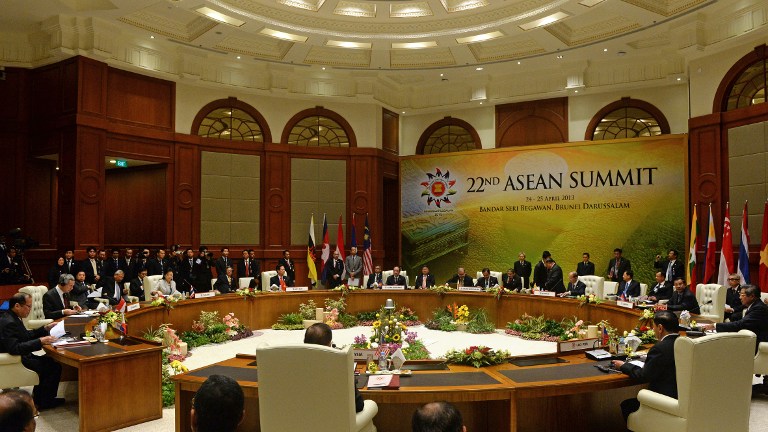
The two-day summit under the theme "Our People, Our Future Together" opened at the Prime Minister's Office here Wednesday, where leaders of the 10 member states gathered to review and deliberate on the economic integration efforts, and a host of regional and international issues of common concern.
According to the statement, 259 measures, or 77.54 percent of the AEC Blueprint, have been implemented as of now.
The leaders agreed to enhance ASEAN's competitiveness by better facilitating trade and investment, leveraging upon on-going work to establish the AEC. They also recommended rolling out a roadmap to set out initiatives to ease the way of doing business and address investment impediments in the region.
Official statistics show that since the adoption of the Blueprint in November 2007, per capita income in the region has risen from $2,267 to $3,759 dollars in 2012.
The total trade of the 10-nation bloc grew by 16.8 percent, from $2.05 trillion in 2010 to $2.4 trillion in 2011, as intra-ASEAN trade reached $598 billion from $520 billion, an increase of 15.1 percent year-on-year.
The ASEAN region has also continued to attract foreign investors, generating a record foreign direct investment inflow of $114 billion in 2011, a 23 percent rise from 2010.
Established in 1967, ASEAN groups Brunei, Cambodia, Indonesia, Laos, Malaysia, Myanmar, the Philippines, Singapore, Thailand and Vietnam.-China Daily (April 26, 2013)
A protest by villagers evicted from land near a Chinese-backed mine was violently quelled by police Thursday, activists said, in an echo of a crackdown at the flashpoint site last year.
Farmers attempting to plow land seized to make way for the mine clashed with police protecting the site, according to Ba Htoo, an environmental activist speaking to AFP from the scene in Monywa, central Myanmar.
"About 200 police asked the villagers -- who went to farmland in the copper mine area -- to stop... police said the area was restricted.
"There were some clashes between the police and villagers," he said, adding one villager was shot and more than two dozen others hurt by police batons.
It was unclear if the police used real or rubber bullets.
A monk who is an activist in a village near the Letpadaung mine confirmed villagers were injured -- although he was not at the scene -- explaining some farmers who refused compensation went to reclaim their land.
"They tried to farm the land with their cows and carts. The police stopped them and there were clashes," the monk, called Nandasarya, told AFP, adding at least one villager received gunshot wounds.
Myanmar opposition leader Aung San Suu Kyi has urged villagers in the area to accept compensation for their land, following a probe into a brutal crackdown on protest at the mine last year.
The Nobel laureate, who is normally venerated around the country, was in March heckled by villagers enraged by her recommendation that the copper mine continue to operate, despite concerns over its environmental impact and land grabbing.
Suu Kyi's report to parliament last month said police used phosphorus against demonstrators at the mine in November in the harshest crackdown on protesters since the end of military rule.
However, the probe into the clampdown, which left dozens wounded including monks, recommended the mine project should not be scrapped, despite conceding it only brought "slight" benefits to the nation.
Since decades of brutal junta rule ended two years ago, Myanmar has seen protests against land grabbing as disgruntled rural people test the boundaries of their freedom to demonstrate under a reform-minded government.-GMA News (April 26, 2013)
The Philippines has grabbed the spotlight amid a lackluster global economy, with a think tank describing it as a “rising star” poised to record one of the fastest growth rates in the world and a credit-rating firm raising its growth forecast for the country.
Moody’s Analytics said in a report released Wednesday that the Philippines is likely to grow between 6.5 and 7 percent this year and within the same range next year, outperforming not only the anemic advanced economies but also many robustly growing emerging markets.
It also said that if favorable economic trends continue, the growth rate for the Philippines could be close to 8 percent by 2016.
“The Philippines has been among the brightest parts of a generally gloomy global picture,” Moody’s Analytics said in the report, titled “Philippines Outlook: Asia’s Rising Star” and authored by its senior economist Glenn Levine.
It said the story of the Philippines was noteworthy, noting that the country swung from being a “perennial underachiever” in Asia until the last few years.
Moody’s Analytics, a sister company of credit rating watchdog Moody’s Investor Service, said the country’s 6.6-percent growth in 2012 was achieved despite weak growth in the United States, a crisis in the eurozone and a slowdown in China.
It said the problems of the United States, the eurozone and China— key export markets—significantly dampened the performance of other economies last year.
Sustainable growth
The Philippines, however, managed to temper the drag of a weak external environment because of a strong household consumption, a nascent rise in private investments and a spike in government spending.
S&P’s rosy forecast
“This impressive rate of GDP [gross domestic product] growth [last year] looks sustainable, as risks are low and most sectors of the economy are growing solidly. We expect GDP growth to remain in the 6.5 to 7-percent range in 2013 and 2014, making the Philippines one of the world’s fastest-growing economies,” Moody’s Analytics said.
Echoing a similar tune, international credit-rating firm Standard & Poor’s has raised its growth forecast for the Philippines for this year from 5.9 to 6.5 percent. At the same time, it said the economy was expected to post another robust growth of 6.3 percent in 2014.
S&P’s updated growth projections for the Philippines were cited in its latest report on Asia, which it said would grow by a decent pace this year and next year as a region. But, it said, the impact of external factors on individual countries would vary.
Domestic demand strong
The credit rating agency said the advantage of the Philippines—together with a few neighbors namely China, Indonesia, Malaysia, Thailand and Vietnam—was that domestic demand was strong and so any adverse impact of weak global demand on the country’s exports would not significantly harm its overall growth.
“China and the Asean 5—Indonesia, Malaysia, Philippines, Thailand and Vietnam—are more domestically driven and, therefore, continue to enjoy relatively high and stable growth rates. This is not the case elsewhere,” S&P said in the report, titled “Emerging Asia Will Grow but Won’t Be Firing on All
Cylinders.”
S&P also said that unlike other countries, the Philippines and the rest of the Asean 5 were not expected to suffer from the weakening yen, a trend that has alarmed advanced economies and some Asian economies.
Weakening yen
This was because the Philippines and the four other Southeast Asian economies were net importers of goods from Japan. A weakening yen, therefore, would actually be beneficial as this would make Japanese imports cheaper.
Anticorruption agenda
Moody’s Analytics, meanwhile, highlighted the benefits of the anticorruption agenda of the Aquino administration.
It said the reform programs of the current administration had significantly improved business sentiment in the Philippines.
“The government’s 2011-2016 development plan provides a five-year blueprint for growth and development, providing transparency, predictability and accountability. The crackdown on corruption and encouragement of local and foreign investments, in particular, have worked well,” it said.-Philippine Daily Inquirer (April 25, 2013)
Hundreds of cases of Malaysian election violence have been reported since campaigning for tightly-contested May 5 polls got under way during the weekend, police were quoted saying on Wednesday.
A total of 387 incidents were reported in the first three days of the two-week campaign, which kicked off Saturday, and at least 15 people have been arrested over the violence, national police spokesman Ramli Yoosuf told The Star newspaper.
"They were in possession of weapons of such as machetes and suspected of slashing rival party supporters and criminal intimidation, mostly while putting up flags and banners," Ramli said.
The pro-government newspaper gave no indication of who was perpetrating the violence, but the opposition has complained that their supporters were the victims in most attacks. AFP has been unable to confirm that.
Malaysia is bracing for long-anticipated elections that have raised speculation of the country's first change of regime since independence from Britain in 1957.
The vote pits a coalition dominated by the United Malays National Organisation (UMNO) which has ruled Malaysia for 56 years, against an upstart opposition promising a more liberalised society.
The independent group Bersih, which advocates clean elections, has warned that the contest could be marred by political violence and intimidation.
Ramli said the cases included individuals who attempted to run down rival political supporters in cars, adding that one election operations centre in a northern state was set on fire, but giving no other details.
No deaths have yet been reported, but Malaysian media last week reported a man was left in a coma after a beating by ruling party supporters in the north of the country. The man was later reported to have regained consciousness.-Channel News Asia (April 25, 2013)
By exercising restraint in dealing with issues including China’s maritime incursions, the Association of Southeast Asian Nations (ASEAN) has kept its cohesion and preserved good relations among members, according to the Philippine representative to the regional bloc.
“The members of ASEAN, they exercise restraint, they look for peaceful ways to settle their bilateral problems,” Philippine Ambassador to ASEAN Elizabeth Buensuceso said in an interview here on Tuesday.
“Very recently, our relations with Malaysia – despite the volatility of the situation or the possibility that it might erupt into something worse, it did not, because there is ASEAN,” she said, apparently referring to Sulu Sultan Jamalul Kiram’s sending of armed supporters to Lahad Datu in Sabah to press his claim on the territory.
“You saw the conflict between Thailand and Cambodia – without ASEAN there would have been war. And this, for me, is a very important achievement of ASEAN,” she said.
The Philippines has chosen not to bring up the Sabah issue during the summit here. President Aquino has also not arranged bilateral meetings with other leaders.
Malaysian Prime Minister Najib Razak will be represented by Tan Sri Abu Zahar Ujang, Malaysia’s Senate president.
Foreign Affairs spokesperson Raul Hernandez said the Sabah issue is considered a bilateral one “so this will not go to the meetings of ASEAN.”
Hernandez squelched speculation that the issue was deliberately being avoided.
“I think it’s more because of the short period of this summit. People are busy and this is actually a very short summit and not like the one that we had last November. So I think this is more of the time consideration that has been put in place,” he said.
While ASEAN had tackled border problems between Thailand and Cambodia, Myanmar and the state of the Rohingya, Hernandez said “it would also depend on the chairman which areas and which items would they consider to be part of the agenda of the summit.”
Hernandez said Brunei Sultan Haji Hassanal Bolkiah did not discuss the Sabah issue with Aquino during his state visit to the Philippines last week.
Malaysian forces are still hunting remnants of Kiram’s armed followers in Lahad Datu. Malaysia had been accused of using excessive force in flushing out Kiram’s followers. The Kirams had also asked for help from Brunei.
The President earlier ordered a study on the country’s Sabah claim even as he stressed that the issue must be resolved peacefully. Thousands of Filipinos have been displaced because of the violence and the Philippine government has expressed fears that relations with Malaysia may be affected.
Kuala Lumpur is brokering the peace talks between the Philippine government and the Moro Islamic Liberation Front. The two sides signed a framework agreement in October last year, an event witnessed by Razak himself at Malacañang.-The Philippine Star (April 25, 2013)
It's the first of two annual summits that ASEAN leaders attend each year and this time, they will be meeting in Brunei on 24 and 25 April.
Singapore's Prime Minister Lee Hsien Loong, together with Foreign Affairs Minister K Shanmugam, will be at the two-day meeting.
Observers expect the South China Sea issue and achieving the 2015 ASEAN Economic Community target to top the leaders' agenda.
The South China Sea territorial issue has threatened ASEAN's unity and credibility. Cambodia, a China ally, refused to have the issue mentioned in a post-ministerial statement when it hosted the meetings last year.
That drew protests from Vietnam and the Philippines, and ASEAN ended up not issuing an after-conference communique for the first time in the bloc's 45-year history.
China, Taiwan and ASEAN members Brunei, Malaysia, the Philippines and Vietnam have overlapping claims across the South China Sea, which Beijing claims in its entirety.
Observers say as host and chair this year, Brunei has the ability to be neutral.
Chairman of the Singapore Institute of International Affairs, Associate Professor Simon Tay, said: "The internal demand is really, how do these four claimants to the South China Sea, the ASEAN members, relate to the non- claimants?
"Will they drag the whole group to their point of view or does the group have to be more neutral. The fundamental difference between last year and this year is the Chinese domestic politics, the change of leader at the very top, but also through a lot of other factors including the role of the PLA (People's Liberation Army)...these are factors which are still at play, and this coming summit may be early for China to really show its full hand."
On the ASEAN Community 2015 target, observers say the grouping is moving in the right direction.
Co-director of the Asia Competitiveness Institute, Associate Professor Tan Khee Giap, said: "ASEAN should have done more and we know that ASEAN members don't trade with one another a lot except Indonesia and Singapore and Singapore and Malaysia.
"The regional environment has changed. ASEAN should rightfully treat all the major economic powers equal handedly, welcome investments, regulate our markets, make it more competitive, by hosting the major investors whether it is the American, the Chinese, the Japanese; it can't be a bad thing, it is only good for us...more than 10-15 years (after the 1997 financial crisis), ASEAN is ready and poised for higher growth. We must put our act together."
Singapore's Foreign Affairs Ministry says that during the Brunei summit, the leaders will also take stock of the implementation of the ASEAN Charter and discuss ASEAN's role in the regional architecture.-Channel News Asia (April 23, 2013)
The European Parliament has recently adopted a resolution approving a report which included its support to the Philippines’ initiative to seek arbitration to settle a territorial dispute with China.
A statement from the Department of Foreign Affairs said the report, which was approved March 14, underscored the need to settle the dispute over the South China Sea.
In the report, te Parliament said it "is alarmed at the escalating tension and therefore urgently appeals to all parties involved to refrain from unilateral political and military actions, to tone down statements and to settle their conflicting territorial claims in the South China Seas by means of international arbitration in accordance with international law, in particular the UN Convetion on the Law of the Sea, in order to ensure regional stability."
The report, prepared by the Parliament's Committee on Foreign Affairs on European Union-China relations, likewise called on China to "commit itself to observing the UN Charter and international law in pursuit of its goals abroad."
"The European Parliament's resolution is a milestone in the efforts of our country to generate awareness and support for our arbitration efforts," said Foreign Affairs Secretary Albert F. del Rosario.
“The recourse to arbitration is firmly rooted in the tradition of good global citizenship. We are strongly committed to seeing this arbitration through and there should be no doubts about our resolve to clarify our maritime entitlements in the West Philippine Sea peacefully and in accordance with the rule of law,” Del Rosario added.
The European Parliament represents the largest trans-national democratic electorate in the world with some 375 million eligible voters in 2009.
Similarly, a United States Senate resolution on the peaceful settlement of disputes in the West Philippine Sea was likewise unanimously passed in 2012.
Beijing has consistently refused to discuss the territorial row under any arrangement save bilateral negotiations between the Philippines and China.
Zhang Hua, Deputy Chief of Political Section and Spokesperson of the Chinese Embassy, said the "disputes on South China Sea should be settled by parties concerned through negotiations."
"This (settlement of disputes through negotiations) is also the consensus reached by parties concerned in the DOC (The Declaration on the Conduct of Parties in the South China Sea)," Zhang has said.-The Philippine Star (April 23, 2013)


.svg/250px-Association_of_Southeast_Asian_Nations_(orthographic_projection).svg.png)