A Hong Kong couple have been given prison sentences for repeated attacks on their Indonesian maid.
The court heard that they beat her repeatedly and burnt her with an iron among other forms of abuse.
She eventually managed to escape the couple's residence and seek refuge at the Indonesian consulate.
Representatives of some of Hong Kong's 300,000 domestic workers were at the court to highlight what they see as a lack of protection.
Beaten with bicycle chain
The maid, Kartika Puspitasari, told the court that she had been subjected to repeated abuse and humiliation during her two years of employment.
She said she had been beaten with a bicycle chain and clothes hangers and attacked with a paper cutter.
The judge described the attacks as repeated and continual. But he did not accept all the evidence, rejecting testimony that she had been tied to a chair for five days while the couple had gone on holiday to Thailand.
He said the case could damage Hong Kong's reputation as a safe destination for migrant workers.
The husband, Tai Chi-wai, was sentenced to three years and three months in prison for assault and wounding. His wife, Catherine Au, was sentenced to five and a half years for repeated attacks.
Activists campaigning for the rights of domestic workers in Hong Kong have protested against a requirement that they live at the homes of their employers.
They say it leaves them vulnerable to abuse. - British Broadcasting Corporation
The Philippines and the United States launched war games on Wednesday at a naval base facing turbulent waters claimed by China, as the allies sought to highlight their expanding military alliance.
About 2,300 marines from both sides are taking part in the annual manoeuvres which this year are being staged alongside the South China Sea and come ahead of US President Barack Obama's planned first visit to the Philippines next month.
The Philippines, which has been seeking US military support to counter what it perceives as a growing Chinese threat to its South China Sea territory, welcomed the exercises as another important plank in building its defence capabilities.
"Multilateral exercises and agreements are essential in our cooperation and operational readiness as a multi-capable force, ready to defend our country's sovereignty and integrity," Philippine Navy vice-commander Rear Admiral Jaime Bernardino said in a speech at the opening of the exercises.
The three-week Philippine-US Amphibious Landing Exercises (Phiblex) will involve two US warships and live ground fire exercises, according to the Philippine military.
The Filipino exercises commander, Brigadier-General Remigio Valdez, said they would also include simulated amphibious assaults to capture islands held by hostile forces.
"We are building our capability on amphibious operations, so it's part of the scenario," he told reporters, although no specific hostile country was named.
The exercises were launched at a naval base in San Antonio, a town on the western coast of Luzon island that faces the South China Sea.
The naval base is about 220 kilometres (135 miles) from Scarborough Shoal, a group of rocky outcrops that is one of the flashpoint areas in the territorial dispute between the Philippines and China.
The Philippines insists it has sovereign rights to the shoal, which fishermen from coastal towns near San Antonio have sailed to for decades, because it is well within its internationally recognised exclusive economic zone.
The nearest major Chinese land mass to Scarborough Shoal is Hainan island, about 650 kilometres away.
But China claims nearly all of the South China Sea, even waters and land formations close to the other countries. Vietnam, Malaysia, Brunei and Taiwan, as well as the Philippines, have overlapping claims to parts of the sea,
The rivalries have for decades made the sea, home to vital global shipping lanes, a potential trigger for military conflict.
Tensions have risen sharply in recent years amid accusations by the Philippines and Vietnam of increasing Chinese aggressiveness.
The Philippines says Chinese vessels have occupied Scarborough Shoal since last year, preventing Filipino fishermen from going there. This month, the Philippines accused China of erecting concrete structures there to begin a permanent presence.
However, neither the US nor Philippine side would say exactly where the Phiblex exercises would be held, and Valdez said the drill to retake islands was not for Scarborough Shoal.
"There is no specific activity in the exercises designed (for) the Scarborough," Valdez said.
The exercises take place as the allies are moving closer to a planned deal that would expand the US military presence in the Philippines.
The pact would allow the United States to bring military hardware on to local bases, and formalise more US troop visits. The Philippines has said it wants the pact signed as soon as possible.
Speaking at the opening ceremony, Brigadier-General Paul Kennedy, commander of the US 3rd Marine Expeditionary Brigade, said he did not know if the agreement would be ready in time for Obama's visit to the Philippines.
"If it comes out of the president's visit and if it's politically mature enough to have been signed at that point it would be fortuitous, but I don't have any idea where it stands at this point," Kennedy told reporters.
The United States had a permanent military presence at two bases in the Philippines until 1992, when they were closed amid nationalist opposition. - Channel News Asia
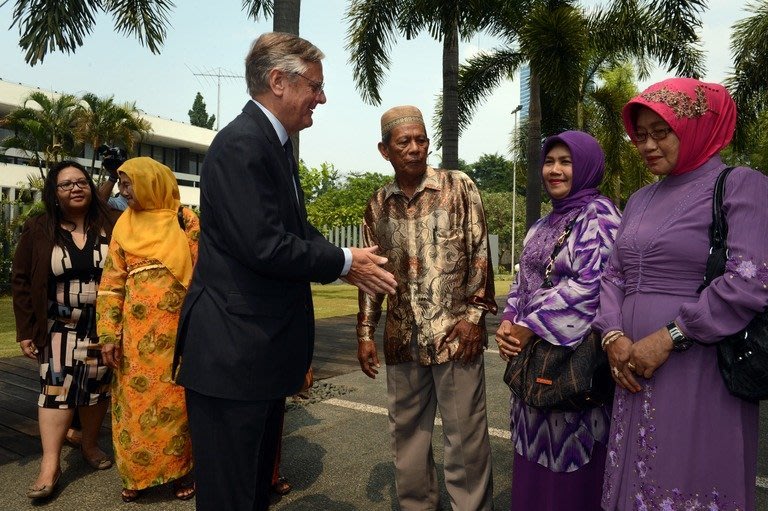
As children of some of the men who were massacred in summary executions looked on, Dutch ambassador to Indonesia Tjeerd de Zwaan offered a state apology during a ceremony at the country's embassy in Jakarta.
"On behalf of the Dutch government, I apologize for these excesses," said the ambassador.
"The Dutch government hopes that this apology will help close a difficult chapter for those whose lives were impacted so directly by the violent excesses that took place between 1945 and 1949."
He was referring to the years of the Indonesian war of independence, when the sprawling archipelago nation sought to shake off Dutch colonial rule.
The Hague had previously said sorry to the relatives of those in particular cases but it has never before offered a general apology for all summary executions.
Last month the Dutch government also announced that it would pay 20,000 euros ($26,600) to the widows of those killed.
However, 81-year-old Shafiah, whose father and brother were killed in an attack by Dutch soldiers on her village in Bulukumba district on Sulawesi island, told AFP the Netherlands had not gone far enough.
"The Dutch government must not only compensate the widows but the children as they also suffered from the loss of their fathers," said Shafiah, who like many Indonesians goes by one name and was speaking from her home village.
She added that her mother died nine years ago.
Her relatives were killed in a brutal military campaign in 1946 and 1947 on Sulawesi, in central Indonesia, and special attention was given to the atrocity on Thursday.
The Dutch government in August compensated 10 women whose husbands were executed by its army in the campaign, and their children were those present at the Jakarta ceremony.
The women themselves were too old and frail to travel to the capital but the ambassador said he planned to fly next week to Sulawesi to meet them.
In one of the worst atrocities committed by the Netherlands in Indonesia, Dutch troops carried out summary executions in a series of villages over three months in a bid to wipe out resistance to colonization.
Some in Indonesia have claimed the death toll was as high as 40,000 but historical studies have put it at several thousand.
Shafiah said she remembered vividly troops entering her village and setting fire to houses before dragging off men and boys to be killed.
"I still remember how villagers were screaming and crying as they watched their houses being burnt down. We were all helpless," she said.
In 2011 the Dutch government also offered a public apology and compensation for victims of summary executions which took place at Rawagede, on the main island of Java.
The Netherlands colonized the archipelago that is modern-day Indonesia in the 19th century, and named it the Dutch East Indies.
Japan occupied the archipelago during World War II and took apart much of the Dutch colonial state, but left when Tokyo surrendered at the end of the war in 1945.
Indonesia then declared independence but the Netherlands attempted to reassert control, sparking the war of independence. The Netherlands finally recognized Indonesia's independence in 1949. - GMA News
A Taiwanese man has been arrested for illegal fishing in the Philippines, police said Thursday as the two neighbours seek to mend fences after the shooting death of another Taiwanese fisherman in May.
Tsai Po, 54, was detained on Tuesday while diving for lobsters off the coast in the Philippines' Batan group of islands near the maritime border with Taiwan, provincial police officer Victor de Sagon told AFP.
"They have been doing this for a long time. This is rampant poaching," said de Sagon, adding that Tsai was among a group of suspects who were illegally fishing just off Siayan island.
He is to be charged with poaching, which is punishable by a US$100,000 fine, confiscation of his catch, fishing equipment and fishing vessel, the officer added.
De Sagon rejected reports in the Taiwanese press that the detained suspect had been treated roughly.
"We are not violating his rights. He is being fed well, he underwent a medical check-up, and he is in regular contact with his wife and the (de facto) Taiwanese embassy in Manila," de Sagon said.
Taiwan's Central News Agency quoted the fisherman's wife Shih Li-hua as saying he had been handcuffed and asked to kneel on the floor for four hours.
The arrest followed a diplomatic spat triggered by the shooting death of a 65-year-old crew member of a Taiwanese fishing boat on May 9 by a Filipino coastguard patrol.
Taipei banned the hiring of new Filipino workers on the island, where some 87,000 Filipinos are employed according to official figures.
Taiwanese President Ma Ying-jeou also rejected an initial official apology and demanded criminal charges against the coastguards for an act that he described as "cold-blooded murder".
The two countries began repairing the rift after Filipino authorities in August recommended homicide charges against the coastguards following pressure from Taiwan, which is not diplomatically recognised by Manila.
Taiwan has since lifted the hiring ban on Filipino workers.
The shooting occurred in waters near the Batan group of islands.
Taiwan also lays claim to the waters. - ABS-CBN News
The Philippines has recalled its ambassador to China for consultations, the foreign department said on Thursday amid fresh tensions in a seething maritime territorial row.
Ambassador Erlinda Basilio flew back to Manila as the defence department this week accused China of laying 75 concrete blocks on disputed territory in the South China Sea, foreign department spokesman Raul Hernandez said.
"She was asked to come home for consultations, and she will (be in Manila) for the next few days," Hernandez told reporters.
He said Basilio was advising Filipino officials on how to handle the alleged Chinese actions at Scarborough Shoal, a rocky outcrop about 220 kilometres off the main Philippine island of Luzon, within the country's internationally recognised exclusive economic zone.
Philippine defence officials have expressed concern the Chinese block-laying could be a prelude to building structures at the shoal.
The outcrop is about 650 kilometres from Hainan island, the nearest major Chinese land mass.
Asked if Manila would lodge a diplomatic protest or undertake other options, Hernandez said: "We are still studying the matter."
The Philippine foreign ministry earlier said President Benigno Aquino had also called off a planned trip to China on Tuesday for a trade fair after Chinese authorities imposed conditions on the trip.
The concrete blocks have raised concerns in Manila that China could be planning construction in the waters, as it did in Philippine-claimed Mischief Reef in another area of the sea, in 1995.
Chinese foreign ministry spokesman Hong Lei rejected the Philippine allegations of block-laying on Wednesday, while asserting China's sovereignty over the shoal.
China claims most of the South China Sea, including waters close to the coasts of its neighbours. - Channel News Asia
Thousands of angry rubber farmers blocked the main entrance to an airport in southern Thailand Wednesday, increasing pressure on the government to provide assistance to cope with a price slump.
The decision to target Surat Thani airport -- used by some foreign tourists to travel to the popular island of Koh Samui -- appeared to mark an escalation in the action by the farmers.
Airport director Attaporn Nuang-udom said flights were still operating but passengers were forced to use alternative access roads.
"We have notified airlines to ask passengers to gather at a certain place and we'll send a bus to pick them up and drive them to the airport," he said.
Riot police with batons and shields stood guard near the airport, which the government has vowed to defend.
Protests by royalist activists in 2008 that paralysed Thailand's main airports dealt a heavy blow to the kingdom's economy.
"We will not allow an airport shutdown because it will affect tourism and confidence," Deputy Prime Minister Pracha Promnog told reporters in Bangkok.
Thailand is the world's top exporter of natural rubber and farmers say they have been hit hard by weak global markets.
"The rubber farmers' income is not enough to live," said one of the protest leaders, Manoon Uppla, 53.
"We cannot control people. Their feelings against the government are very strong," he said.
The government earlier declined demands to guarantee a rubber price of 120 baht ($3.7) per kilo -- about 50 percent higher than the current price on world markets.
Instead it proposed paying farmers 1,260 baht per rai (0.4 acres) of rubber plantation to help with production costs, along with funds to boost the efficiency of rubber processing -- an offer rejected by the protesters.
"They want us to guarantee the price at 92 baht per kilo," said Surat Thani governor Chatpong Chatraphuti, who took part in negotiations on Wednesday.
He said the government representative would take the proposal to Prime Minister Yingluck Shinawatra to consider.
Thailand has been rocked by several mass protests in recent years, with both supporters and opponents of Yingluck's brother -- fugitive former premier Thaksin Shinawatra -- taking to the streets.
In 2010 two-month demonstrations in Bangkok by the pro-Thaksin "Red Shirts" drew 100,000 protesters at their peak before being crushed in a military crackdown under a previous government.
More than 90 people, mostly civilians, were killed during the demonstrations and nearly 1,900 were injured in Thailand's worst political bloodshed in decades. - Channel News Asia
Private sector economists have raised their economic forecast for Singapore.
According to the Monetary Authority of Singapore's (MAS) latest Survey of Professional Forecasters, economists expect the Singapore economy to grow by 2.9 per cent this year -- up from their previous median estimate of 2.3 per cent in June.
The upgrade comes after the Singapore economy expanded by a better-than-expected 3.8 per cent in the second quarter, compared to a year ago. This was much higher than the median forecast of 1.5 per cent reported in the June survey.
The government also raised the country's growth outlook for the year to 2.5 to 3.5 per cent from an earlier forecast of 1 to 3 per cent.
According to the quarterly poll, GDP growth in the July to September quarter is now estimated at 4 per cent. This is higher than the 3.5 per cent that was reported previously.
Economists said the upgraded outlook for Singapore's economy stems from a few reasons - recovering growth in the US, a bottoming out in China and a brighter economic picture in the Eurozone.
They said the recent market volatility is unlikely to have a crippling effect on Singapore's growth.
But some said other risks remain.
Mizuho Bank's senior economist, Vishnu Varathan, said: "Let's begin with the US. One thing that's been fading into the background is the debt ceiling crisis. They've not resolved that as of October. That could lead to another bout of shakiness in the markets. We can't discount that.
"The other one is China. While the incoming data has been encouraging, China is still walking a very tight rope. So they're not going to go on a no holds barred credit binge anytime soon. So whilst they're trying to balance policy, the net effect may be rather variable, so it could lead to soft patches as well."
On inflation, economists have also reduced their median estimate for this year's consumer price index to 2.5 per cent, compared to 2.8 per cent reported in the June survey.
For Q3 2013, headline inflation is projected at 2.1 per cent. However, MAS core inflation is expected to come in at 1.9 per cent in 2013, slightly higher than the 1.8 per cent in the previous survey.
Standard Chartered Bank's economist, Jeff Ng, said: "We see limited upside from demand-pull inflation at the moment. The recent cooling measures for the housing market are expected to moderate housing inflation further.
"And for the COE prices, even though they're high, they're likely to be dampened by high base effect. So we will watch out more for supply side inflation where wages could go up and that could put pressure on core inflation to go up this year."
Meanwhile, economists expect certain sectors of the economy such as the finance and insurance sector as well as the wholesale and retail sector to fare better than others in the second half of the year.
Growth in the finance and insurance sector is expected to climb 10.6 percent compared to the previous 6.1 percent forecast in June, while wholesale and retail trade is forecast to increase by 3.5 percent compared to 0.9 percent in the previous poll.
Jeff Ng said: "We look for improvement in manufacturing, especially the electronics in terms of the biomedical sector. For the services sector, we still look for the finance and business services sector to perform very well and in line with the their stellar performance in the first half."
Economists also expect the MAS to stick to its current policy stance of a gradual and modest appreciation of the Singapore dollar.
Nineteen economists took part in the quarterly survey conducted by MAS in August. - Channel News Asia
China's trade with Southeast Asia could more than double to $1 trillion by 2020, Premier Li Keqiang told regional leaders, downplaying simmering territorial disputes and stressing their "common destiny", state media reported Wednesday.
Li called for an upgraded version of the free trade deal between the two sides and insisted that "disruptive factors" should not get in the way of regional cooperation, the official Xinhua news agency reported.
Trade has grown six-fold over the past decade to $400 billion in 2012 between China and the 10-member Association of Southeast Nations (ASEAN), it said.
But Beijing claims almost all of the South China Sea -- believed to sit atop vast deposits of oil and natural gas -- even waters close to the coasts of its neighbours, and has been increasingly assertive over the issue in recent years.
Li downplayed the disputes while addressing the 10th China-ASEAN Expo and business and investment summit in the southern city of Nanning, reiterating Chinese calls for dialogue.
"We have also noticed that there exist some disruptive factors in the region that are against stability and development, but they are not mainstream," he said according to a transcript of his speech carried by Xinhua.
"The Chinese side maintains that the South China Sea disputes are not an issue between China and the ASEAN, and they should not and will not affect the overall China-ASEAN cooperation."
"China's new government will... more firmly and effectively build a community of common destiny to share peace and prosperity," he said, adding that China and ASEAN "have the power to create a 'diamond decade' in the future".
ASEAN members Vietnam, the Philippines, Malaysia and Brunei have often overlapping claims to parts of the South China Sea, and Taiwan also claims it all.
The dispute has rumbled on for decades, but Beijing's actions to support its claim in recent years have raised concerns with its neighbours, particularly Hanoi and Manila.
China rejects international arbitration, preferring to deal with the issue on a one-to-one basis while maintaining it has sole territorial rights.
Vietnamese prime minister Nguyen Tan Dung was present at the trade fair, but Philippines president Benigno Aquino did not attend after Chinese authorities imposed conditions on the trip, Manila said, signalling they were related to the territorial row.
The Philippines accused China on Tuesday of laying concrete blocks on Scarborough Shoal, a small group of reefs and rocky outcrops within its territory in the sea.
After years of resistance China has agreed to meet ASEAN members later this month in the eastern city of Suzhou to discuss a "code of conduct" for the waters, meant as an upgrade from a 2002 non-binding "declaration of conduct".
In Nanning, Li also briefly expressed willingness to discuss the Trans-Pacific Partnership (TPP) as a way to boost trade.
Beijing has not supported the US-led initiative -- which is seen as a trade framework meant to exclude China -- but the state-run China Daily reported in July that authorities were becoming "positive" to it.
China is willing to "discuss exchanges and interactions with frameworks such as the Trans-Pacific Partnership Agreement," Li said in his speech Tuesday.
ASEAN includes Brunei, Cambodia, Indonesia, Laos, Malaysia, Myanmar, the Philippines, Singapore, Thailand and Vietnam. - Channel News Asia
The Philippines accused China on Tuesday of laying concrete blocks on a small group of reefs and rocky outcrops within its territory, the latest escalation in a hostile maritime dispute.
Defence department spokesman Peter Galvez released to the media an aerial photograph of what he said were about 30 blocks on Scarborough Shoal in the South China Sea.
"It's unfortunate that they keep on doing activities that do not contribute to our pursuit towards regional peace," Galvez told reporters.
Defence Secretary Voltaire Gazmin briefed members of parliament about the issue on Tuesday, telling them the concrete blocks were a "prelude to construction", according to Galvez.
Galvez said the photograph was taken from a Philippine navy plane on Saturday, and three Chinese coastguard vessels were also observed there.
AFP could not immediately verify the photograph. When asked for comment, Chinese embassy spokesman Hua Zhang told AFP by email: "I will look into it."
Scarborough Shoal is about 220 kilometres (135 miles) off the main Philippine island of Luzon, within the country's internationally recognised exclusive economic zone.
The outcrop is about 650 kilometres from Hainan island, the nearest major Chinese land mass.
China claims most of the South China Sea, including waters close to the coasts of the Philippines and other neighbours.
The Philippines and Vietnam have in recent years repeatedly accused China of becoming more aggressive in staking its claims to the disputed waters, which are believed to sit atop vast gas and oil reserves.
The Philippines says China has effectively occupied Scarborough Shoal, home to rich fishing grounds, since last year by stationing vessels there and banning Filipino fishermen.
Malaysia, Brunei and Taiwan also have competing claims to parts of the South China Sea, and the rivalries have been a source of tension for decades.
Diplomatic relations between the Philippines and China, in particular, have become increasingly tense in recent years.
The Philippines angered China in January this year by asking a United Nations tribunal to rule on the validity of the Chinese claims to most of the South China Sea.
China rejects international arbitration, preferring to deal with the issue on a bilateral basis while maintaining it has sole territorial rights.
Legislator Walden Bello, who attended Gazmin's briefing on Tuesday, told AFP Filipino politicians were concerned China could be laying the foundations for a military garrison on Scarborough Shoal.
He said the tactics were similar to when Chinese took control of Philippine-claimed Mischief Reef in 1995.
"We're worried that this could be the start of the same process of erecting concrete structures and asserting de facto ownership like they also did at Panganiban Reef," Bello said, referring to Mischief Reef by its Filipino name.
In 2002, China and the 10-member Association of Southeast Asian Nations adopted a non-binding "declaration of conduct" for the South China Sea to discourage hostile acts.
All sides agreed then not to use threats or force to assert claims.
They also pledged in the declaration to refrain from inhabiting uninhabited islands or other features in the South China Sea, and to "exercise self-restraint" in conducting activities that would escalate disputes.
But China has since refused to turn it into a legally binding "code of conduct".
In another related issue, the Philippine foreign ministry said President Benigno Aquino called off a planned trip to China for a trade fair this week after Chinese authorities imposed conditions on the trip.
Ministry spokesman Raul Hernandez did not disclose the conditions, saying Chinese foreign ministry officials had "advised" the Philippines not to make them public, but signalled they were centred firmly on the territorial row.
"The president stood firm in the defence of the country's national interest," Hernandez said. - Channel News Asia
Indonesia's anti-corruption court jailed the country's former traffic police chief for 10 years on Tuesday after he built up an $18 million empire by accepting enormous bribes.
The sentencing of Djoko Susilo brings to an end a dramatic case that has captivated Indonesia, and is a major victory for anti-graft investigators battling against the odds in one of the world's most corrupt countries.
Susilo reportedly earned a humble police salary of $1,000 a month -- but the country's anti-graft agency seized assets from him, including houses, cars and even petrol kiosks, worth 200 billion rupiah (around $18 million).
After taking several hours to read the 3,000-page indictment against Susilo, a five-judge panel unanimously found him guilty of corruption and money laundering.
"It was clear to the panel he had committed acts of corruption," said Judge Anwar, who goes by one name, as the sentence was handed down after the verdict was announced.
Susilo was also ordered to pay a fine of 500 million rupiah ($45,000) at the end of the lengthy trial, which started in April.
Prosecutors had sought an 18-year jail term and a one-billion-rupiah fine.
The case began with the discovery that a tender for driving simulators in 2011 had been rigged, with Susilo accused of syphoning off 32 billion rupiah from the failed project.
Police initially sought to protect Susilo by refusing to let the anti-graft commission, the Corruption Eradication Commission (KPK), handle the case.
But they were finally forced to hand the case over -- and the anti-corruption agency quickly discovered a vast empire built on the back of corrupt payments.
The KPK has been granted extraordinary powers to investigate the rich and powerful in Indonesia, ranked 118th most corrupt country in the world in a 176-nation index compiled by Transparency International.
The commission has helped put senior officials and powerful businesspeople behind bars, in the process winning the fervent support of ordinary Indonesians, many of whom live in grinding poverty. - Channel News Asia
Singapore's electronics sector continues to recover in August, with its latest Purchasing Managers' Index (PMI) rising for the seventh straight month.
However, the manufacturing economy grew slower than expected last month.
The PMI for the manufacturing economy fell unexpectedly, dropping 1.3 points to 50.5 in August, its lowest reading since February this year.
A reading above 50 indicates expansion, while that below 50 shows a contraction.
Economists said the decline was partly due to fewer working days during the month as a result of the Hari Raya and National Day holidays.
However, the electronics sector brought some cheer.
The electronics PMI rose a significant 1 point to a 3-month high of 51.3, on stronger orders.
Electronics exports also grew at a faster pace, with a reading of 54 points -- the highest since May 2011.
Song Seng Wun, CIMB Research's regional economist, said: "Overall orders, particularly... export orders, are picking up pace -- very encouraging, certainly indicating and supporting the recovery in external demand story.
"We are talking about the US economy on firmer growth trend -- we are seeing firming demand for automobiles and other durables.
"In Europe, the area-wide PMI is also showing modest growth as well, with an overall reading above 50 for the second straight month, after basically two years of contraction.
"That should feed into gradual improvement as far as the tech manufacturers and exporters are concerned."
Some economists said that as the electronics sector continues to recover, some manufacturers may face challenges in hiring and managing higher wage cost, amid a tight labour market.
Another downside risk ahead is the geopolitical tension in the Middle East.
Concerns over a military strike on Syria for its alleged use of chemical weapons sent oil prices up nearly 3 percent last week.
But it has since eased as fears of an imminent strike against Syria faded.
United Overseas Bank's senior economist Alvin Liew said: "If the spike in oil prices is just temporary, I think Singapore is well positioned to deal with it.
"But if this proves to be something more pronounced and more permanent, at least lasting for a few quarters, then that surge in energy prices could have a big impact, definitely, on businesses, especially manufacturing."
Barring unforeseen events, economists expect a modest recovery in Singapore's manufacturing sector this year, and the electronics sector could lend some near-term support to offset the volatility of the biomedical cluster. -Channel News Asia
Indonesia's religious affairs minister has called for the Miss World beauty pageant to be cancelled, as opposition in the Muslim-majority country mounts the week before the contest opens in Bali.
Suryadharma Ali said that the organizers should follow the advice of the nation's top Islamic clerical body, which last week called for the contest to be scrapped even after organizers agreed to axe the bikini round.
"The Indonesian Ulema Council has expressed strong opposition to Miss World because it doesn't fit with Islamic teachings that say Muslim women should cover immodest parts of their bodies," the minister said in a statement late Thursday.
The minister is the first government official to publicly voice opposition to the pageant, dealing a fresh blow to the Britain-based organizers.
His statement came the same day a commissioner from the country's National Human Rights Commission said he opposed an event that "put women's bodies on display."
The local organizers were not fazed by the minister's comments however, saying the issue was not his domain and that "the show must go on."
"This is not an Islamic country and this event is an issue of culture, not religion," Adjie S. Soeratmadjie, corporate secretary of broadcaster and local organizer RCTI told AFP, adding several other ministers supported Miss World.
While Indonesia is a Muslim-majority nation, its constitution is not Islamic and recognizes several religions.
READ: Indonesian Muslims vow to stop Miss World
The organizers revealed in June that the famed bikini round was being axed for the pageant in Indonesia in a bid to avoid causing offense, and contestants would instead wear Balinese sarongs.
Nevertheless, hardline group Islamic Defenders Front has not been appeased and still plans to hold protests on the outskirts of the capital Jakarta, where the pageant's final will be held on September 28.
The competition opens on September 8 in Bali, a Hindu-majority island known for its many beaches where female tourists from around the world sunbathe in skimpy bikinis with few problems.
Hardline groups in Indonesia have forced the cancellation of events deemed "un-Islamic" in the past. - Rappler
The United States and the Philippines are moving towards an agreement that will expand the American military's presence in the Philippines, Defense Secretary Chuck Hagel said on Friday during a visit to Manila.
Hagel and President Benigno Aquino "reaffirmed the progress being made" in talks begun earlier this month to allow a bigger military footprint in the Philippines, the Pentagon chief said.
"This progress is welcome and encouraging. I noted that our negotiating teams are working hard to finish the framework agreement in the near future," he told reporters.
Hagel's optimistic comments appeared to open up the possibility that the negotiations, which resumed this week in the US capital, could be wrapped up in time for President Barack Obama's expected visit to Southeast Asia later this year.
An accord opening the way to a more visible role for the American military marks a shift in relations between the two countries, more than two decades after the United States closed down large bases amid anti-American sentiment.
But the Philippines now faces territorial disputes at sea with China and has asked for US assistance to better monitor coastal waters. The United States, meanwhile, is seeking to bolster its ties across Southeast Asia, partly to counter China's growing military power.
The proposed deal would allow more US troops, aircraft and ships to temporarily pass through the Philippines, at a time when Washington is refocusing its attention on Asia after a decade of war.
But Hagel sought to reassure Filipinos, whose senate had voted out the American presence in the early 1990s, saying Washington had no interest in setting up permanent outposts.
"The United States does not seek permanent bases in the Philippines -- that would represent a return to an outdated Cold War mentality," he said at a joint news conference with his Filipino counterpart.
"Instead, we are using a new model of military-to-military cooperation befitting two great allies and partners," he said.
The Philippines once hosted tens of thousands of US soldiers at two bases near Manila, but they were forced to leave in 1992. A new accord in 1999 allowed troops to return to the Philippines for joint military exercises every year.
Philippine Defense Secretary Voltaire Gazmin said the proposed agreement could permit US forces to regain access to Subic Bay, a large naval base north of Manila that the Pentagon handed over to Philippine control in 1992.
"Subic Bay is one of the facilities that was mentioned for the US forces to (have) access in. As soon as the framework agreement is complete, we will provide the necessary access to all these facilities," Gazmin added.
The US defence chief went ahead with his overnight visit to Manila despite a tense showdown over Syria, with US forces prepared to launch punitive strikes against the Damascus regime if ordered.
Even with the turmoil in the Middle East, Hagel said the US remained committed to a strategic focus towards Asia, as well as its 1951 mutual defence pact with Manila.
Hagel was in Manila at the end of a week-long Asian tour amid fresh strains between the Philippines and China over rival territorial claims in the South China Sea.
The tensions have forced Aquino to call off a planned visit on September 3 to the Chinese city of Nanning to attend a trade conference.
The Philippines accused China of aggressively pushing its territorial claims over most of the South China Sea, including waters close to Philippine shores.
Hagel endorsed efforts by China's smaller neighbours in the Association of Southeast Asian Nations (ASEAN) to negotiate a South China Sea "code of conduct", as well as Philippine efforts to solve the disputes.
Without mentioning China, he said that Washington wanted nations to settle their disputes through international law "without coercion or militarised attempts to alter the status quo".
Hagel held separate talks with Gazmin and Foreign Secretary Albert del Rosario, and visited the US military cemetery in Manila before heading back to Washington. - Channel News Asia
Defense ministers of the Association of Southeast Asian Nations (ASEAN) and partners in dialogue have signed a declaration on preventing conflicts at sea.
Representatives of Russia, the United States, China, New Zealand, Japan, South Korea, India and Australia joined the gathering alongside ASEAN member states in Brunei on August 29.
Mohammad Yasmin bin Haji Umar, a minister in the office of the prime minister of Brunei, said after the meeting that the dialogue had been fruitful for prospects of developing practical cooperation.
“We are looking forward to holding joint exercises to learn how to provide security at sea, fight terrorism and carry out peacekeeping operations,” he added.
The Brunei declaration is designed to stimulate cooperation among the military agencies of ASEAN and the organisation’s partners, as well as to avoid undesirable incidents at sea.
“We are going to strengthen interaction among the ASEAN nations and their partners and increase collective responsibility for regional security,” the declaration said.
ASEAN defense ministers and their partners meet next in Malaysia in 2015. - Philippines News Agency
Cambodian King Norodom Sihamoni on Friday urged the ruling and opposition parties to resolve their disputed election results based on the kingdom's constitution.
"Cambodia is an independent and sovereign state and has the Constitution as the supreme law, which is respected by the whole nation," the King said in a royal letter from Beijing where he has stayed for routine medical checkup since Aug. 12.
"Resolving national issues should be based on the Constitution and tasked to responsible institutions which are determined in the Constitution and other laws in the kingdom," he said in the royal letter, which was released to the media by the Office of the Council of Ministers.
He said the results of the July 28 general election would be officially issued no later than September 8.
"I'd like to appeal to Cambodian people to continue maintaining national peace and dignity," he said.
It was the second time King Sihamoni called for the two political parties to solve the contested poll results peacefully under the country's laws.
Initial election results showed that the ruling Cambodian People's Party (CPP) of long-serving Prime Minister Hun Sen won the poll with 68 of the 123 parliamentary seats, and the opposition Cambodia National Rescue Party (CNRP) of long-time opposition leader took the remaining 55 seats.
But the CNRP rejected the results, claiming that it should have won 63 seats, with the CPP getting the remaining 60 seats if alleged poll irregularities were fairly resolved.
The King's royal letter came a day after Sam Rainsy set September 7 to hold a massive nonviolent protest against the poll results if the CPP did not resume talks with the CNRP towards the formation of a proposed independent investigation committee into alleged poll irregularities.
The CPP issued a statement on Thursday, saying that the party was ready to resume talks with the CNRP, but ruled out the possibility of talks on the formation of a special investigation committee since it violated the country's Constitution.
"Article 136 in the Constitution stipulates that the Constitutional Council shall have the right to examine and decide on contested cases involving the election of Assembly members and Senate members," the CPP said.
Currently, the Constitutional Council, which is the country's final arbiter, has been resolving complaints filed by the opposition party against the election results, but the opposition accused the Constitutional Council of being loyal to the CPP.
Under the country's Constitution, a new parliament will be inaugurated no later than 60 days after the election.
Prime Minister Hun Sen said on Aug. 2 that a new parliament and a new government would be established as scheduled despite the opposition's boycott.
According to the Constitution, he said, a new government would be formed by a 50 percent plus one majority, or 63 lawmakers, in the new parliament.
Hun Sen, 61, who has been in power for 28 years, will extend his power for further five years through the election victory. - Philippines News Agency
Japan's defence ministry is looking for its biggest budget hike in two decades, partly to create a Marines-like force, it revealed Friday, as neighbours fret about Tokyo's rising assertiveness.
Military bosses want more than 4.8 trillion yen (US$49 billion) -- three percent up on last year -- with much of their focus on safeguarding remote islands, as a sovereignty row with China refuses to fade.
The move mirrors Prime Minister Shinzo Abe's policy of a more assertive diplomacy and a more active military.
Tokyo and Beijing have repeatedly butted heads over the ownership of the Tokyo-controlled islands called the Senkakus, which Beijing claims as the Diaoyus, with official Chinese ships and aircraft regularly testing Japanese forces.
Abe has long voiced worries over defence at a time when China is increasing its naval activities in waters around Japan, and as unpredictable North Korea continues its missile and nuclear programmes.
He has also called for a stronger military alliance with the United States, which is in the process of a re-balancing of its forces under President Barack Obama's so-called "pivot" to Asia.
China and South Korea -- victims of Japan's military misadventures in the first half of the 20th century -- have expressed unease in recent months about noises in Tokyo towards bolstering its military.
The budget request for fiscal 2014, which will begin April, represents a three-percent spending increase, making a second-straight annual increase after a 0.8-percent rise in the initial budget for the current fiscal year to March 2014.
If approved, it would mark the largest rise since fiscal 1992.
Under the request, the ministry plans to create a special amphibious unit designed to protect the southern islands and to take them back in case of enemy invasion.
It would spend 1.3 billion yen to buy two amphibious assault vehicles and increase participation in US-led training programmes with the US Marines.
The Marines are generally regarded as an offensive force, while Japan's constitution bars it from taking hostile acts and limits the role of its already well-equipped armed forces to that of defence.
The air defence force would create a new early-warning unit also in the southern region with radar-capable planes.
The ministry will conduct a full study on future purchases of Osprey tilt-rotor aircraft that can takeoff vertically like a helicopter.
Among big ticket items, the navy wants to buy a 73.3-billion-yen destroyer, a 51.3-billion-yen submarine, and a 50.8-billion-yen submarine rescue ship.
The ministry also wants to have a battery of PAC-3 surface-to-air anti-ballistic missile systems permanently located at its Tokyo headquarters. The system was deployed when North Korea conducted what is largely viewed as ballistic missile tests.
The ministry wants 24 billion yen for programmes related to cyber defence.
Some 3.7 billion yen would go toward studies of technologies to detect and track stealth jets.
While the shopping list appears quite extensive, the vast bulk of the increased budget request accounts for personnel cost, with the expected expiry of a multi-year salary freeze for civil servants.
The freeze was implemented to pay for the reconstruction of the region hit by the 2011 tsunami-earthquake disasters that prompted the Fukushima nuclear crisis.
The increased request also came as a result of foreign exchange fluctuations, with a lower yen boosting the prices of foreign-made military equipment.
The request might also change, as it currently does not account for an expected increase of the consumption tax.
Abe is yet to announce whether he will go ahead with the tax hike from the current five percent to eight percent from April.-Channel News Asia
Indonesia's central bank hiked interest rates for the third time in three months Thursday at an unscheduled meeting to calm investors after a plunge in the rupiah and stocks.
Emerging markets have been sent into a tailspin in recent weeks on fears that the United States may taper off its huge stimulus programme.
Indonesia has been particularly badly hit with investors also fretting about its domestic problems, such as a widening current account deficit, slowing growth and high inflation.
As the sell-off accelerated in the past week, Bank Indonesia called an extra policy meeting for Thursday -- two weeks before its board was due to meet -- and announced a 50-basis-point hike in its key interest rate to 7.00 per cent.
Bank spokesman Difi Johansyah said that the board of governors saw much "pressure and uncertainty" weighing on the Indonesian economy.
Investor reaction was positive, with the Jakarta benchmark index closing 1.92 per cent higher. It has fallen heavily in recent weeks, at one point going below the psychologically important 4,000 barrier.
The bank has now hiked rates by a total of 1.25 percentage points since June as it seeks to halt a slide in the value of the rupiah and tackle inflation which hit a four-year high after a hike in fuel prices.
The Indonesian rupiah has lost about 12 per cent his year, hitting four-year lows.
The bank also tweaked monetary policy in several other areas including a hike in the rate it pays lenders for overnight deposits by 50 basis points to 5.25 per cent.
Officials hope this will encourage lenders to leave their rupiah with the central bank, thereby reducing money supply and in theory stopping the rupiah from weakening further.
The bank stood firm at its last scheduled meeting, on August 15, amid fears that too sudden a tightening of monetary policy could hit already slowing growth.
However, the market turmoil of the past week -- which has seen stocks across Asia tumble and the Indian rupee fall to a lifetime low -- prompted the bank to call Thursday's meeting.-Channel News Asia
PH still fastest growing economy in SE Asia
The Philippine economy posted robust expansion in the second quarter, matching the pace of China as the two fastest growing in Asia, as strong fundamentals and domestic spending buttressed the country from the region's fund outflows.
The solid growth pace lifted the peso from nearly 3-year lows and would help the Philippines keep its favoured status among investors amid more market volatility.
The Philippines has overtaken emerging economies such as Indonesia as a safer investment bet due to prudent management of fiscal and monetary policy. It secured investment grade from ratings agencies this year.
The economy expanded an annual 7.5 percent in the second quarter, above the 7.3 percent market estimate, and compared with a revised 7.7 percent in the first three months of the year.
From the previous three months, the economy expanded 1.4 percent in the second quarter, higher than the 0.8 percent forecast in a Reuters poll. It was the slowest pace in a year and below the upwardly revised growth of 2.3 percent in the March quarter.
"The growth came mainly from consumer and public spending, buttressed by increased investments in fixed capital," Jose Ramon Albert, secretary general of the National Statistical Coordination Board, told reporters, adding that the services sector and manufacturing and construction also pushed up growth.
Socioeconomic Planning Secretary Arsenio Balisacan told a media briefing the economy was on course to outperform its GDP growth target this year of 6-7 percent. He also said the country's strong fundamentals would allow it to manage risks coming from market volatilities and global headwinds.
The Southeast Asian country has sustained annual growth of above 7 percent for four quarters in a row.
Like many of its neighbours in Southeast Asia, the Philippines has not been immune to the global downturn or fund outflows as the U.S. Federal Reserve starts winding down monetary stimulus.
The peso is down nearly 8 percent this year. Exports and imports fell more than 4 percent in the first half of the year.
But with a tenth of the Philippines' 97 million population abroad and sending an average $1.7 billion in remittances every month, domestic demand in the country has remained solid, helping cushion the economy from slumping trade.
Higher government expenditures and spending related to the mid-year elections in May also boosted domestic consumption, economists said, while manageable inflation allowed policymakers to keep interest rates at record low levels, supporting growth.
Public construction jumped 31 percent in the second quarter, lower than the previous quarter's 45.6 percent annual gain.
But the Philippines is expected to face growth risks in the second half.
"Government spending may slow post-election, with some concerns that the ongoing case on the abuse of a discretionary fund may curb state expenditure," said Bernard Aw, analyst at Forecast PTE Ltd in Singapore.
He added delays in public infrastructure projects could create more uncertainty that could affect investments, while recent fund outflows due to Fed tapering fears may potentially lead to destabilising capital flows in the economy.
Bangko Sentral ng Pilipinas Governor Amando Tetangco said the latest data should help boost investor confidence, and support the peso and the local stock market. He added that the authorities will ensure monetary policy would support non-inflationary robust growth.
The central bank next meets to review policy on Sept. 12. It has kept its policy rate steady at a record low of 3.5 percent since December 2012, but has slashed the rate on its special deposit account (SDA) facility by more than 150 basis points this year to divert credit to more productive use. -ABS-CBN News
Malaysia will launch what local media on Wednesday called its "biggest-ever" crackdown on an estimated half a million illegal foreign workers, as a crime wave focused the nation's attention on security.
Under the three-month operation to begin on Sunday, authorities would seek to deport some 500,000 foreigners, mostly from the country's vast and less-developed neighbour Indonesia, Immigration Department Director General Alias Ahmad said.
The operation would involve 135,000 personnel led by the department, he was quoted by The Star newspaper as saying.
Normally laid-back Malaysia has been on edge over dozens of reported shootings, many fatal, that authorities have blamed largely on a gang turf war.
While foreigners are not generally seen as a key source of crime, the presence of large numbers of undocumented workers has fuelled security worries.
The violence has added to a widespread public perception of rising crime such as thefts, burglaries, and robberies, despite government data showing crime has dropped sharply.
The figures have been met with wide scepticism.
The national police force, which has endured heavy criticism in recent months as it appeared to be caught unprepared by the shooting spree, launched a separate crackdown on August 17 targeted at gangs.
Police have said 1,400 people suspected of being involved in criminal activity have been detained under that operation.
Alias said authorities decided it was time to go after the estimated half-million people who initially registered under an amnesty scheme for illegal workers two years ago but subsequently failed to come forward to be legalised or deported.
"It is now time for full enforcement," Alias told The Star. "They can hide, but how long can they hide?"
Alias confirmed the remarks to AFP in a text message but he could not be reached for further comment.
Southeast Asia's third-largest economy is a magnet for migrant workers from poorer neighbours Indonesia, Bangladesh, Mynamar, Vietnam, Nepal and elsewhere, who fill low-paid construction, factory and plantation jobs.
The amnesty scheme was aimed at registering illegals, and 1.3 million came forward.
Of those, 500,000 have received documents permitting them to work, while 330,000 were repatriated.
The rest have not completed the process, with some workers expressing fear it would lead to deportation as the scheme requires them to be sponsored by a valid employer. - Channel News Asia