Tuesday, October 16, 2012

China leads rise in Asia military spending — US study


Military spending by Asia's major powers increased dramatically over the past decade with China leading the way, as its defense budget quadrupled since 2000, according to a study released Monday.

Defense spending in China and four other Asian countries doubled over 10 years and will surpass Europe's military expenditures this year, said the Center for Strategic and International Studies, a Washington-based think tank.

Asia's arms race still leaves it trailing US defense spending, but it will ensure the United States likely will stick to its plan to shift the country's strategic focus towards the Asia-Pacific region, it said.

Defense spending in China, India, South Korea and Taiwan reached a total of $224 billion in 2011, which "equates to almost twice the amount spent by these five countries in 2000," said the CSIS study.

"With Asian defense spending projected to overtake that of Europe by the end of 2012, the United States' posture rebalancing toward the Asia-Pacific region is likely to continue," it said.

In 2005, China's military budget outstripped Japan's as the largest in Asia and recorded a 13.4 percent annual rise that year.

Among all countries, China now ranks second behind the United States in total military spending, though the Pentagon budget still dwarfs Beijing's defense spending at more than $600 billion (463 million euros) year.

Experts say China's emergence as a global economic giant has driven the spike in military spending, as Beijing seeks to assert its influence beyond its borders to safeguard its access to sea lanes and resources.

In 2011, Beijing spent $25.8 billion on new weapons and related research and development, up from $7.3 billion in 2000, the report said.

China's total defense budget grew from $22.5 billion to $89.9 billion between 2000 and 2011, said the report, citing official figures from the Beijing government.

But the study acknowledged that independent estimates put Chinese spending at a much higher level, with the Stockholm International Peace Research Institute estimating Beijing's 2011 defense budget at $142.2 billion.

India's defense spending grew 47.6 percent over the decade, reaching $37 billion in 2011. Japan's military budget rose from $40 to $58.2 billion.

South Korea's defense investments swelled from $17 to $29 billion, while Taiwan's defense budget expanded at a slower pace, from $8 billion in 2000 to $10 billion in 2011.

Apart from Japan, which spent $238,000 per soldier in 2011, the four other countries devoted $28,000 to $44,000 to training, paying and equipping each of its soldiers, the study said.

"This discrepancy was predominantly caused by the small size of the Japanese forces, approximately 244,300 troops in 2011, relative to the other countries," it said.-GMA News (October 16, 2012 8:12AM)

Philippines, Malaysia agree on cooperation in developing Mindanao region


Malaysia has agreed to provide assistance to the Philippine government in developing the Mindanao region, after facilitating a peace deal between Manila and the Moro Islamic Liberation Front (MILF), Philippines' largest rebel group.

Malaysian Prime Minister Najib Razak and Philippine President Benigno S. Aquino III agreed to tap a joint committee to draw up social-economic development plans for the Mindanao region, in support of the Philippine government's efforts in consolidating peace and further fostering sustainable development in the region, according to a joint statement released after the two leaders met in Manila on Monday.

The statement said both leaders had called for the reconvening of the committee "at the earliest opportunity," which would focus on the cooperation such as Madrasah education, Halal industry, Tabung haji, Islamic banking, university twinning and student-exchange programs, among others.

In his first visit to the Philippines since assuming office in 2009, Najib witnessed the signing of a landmark peace agreement between the Aquino government and the MILF today, which may bring an end to the decades old insurgency in which some 120,000 had died.

The Philippine government is deeply appreciative of the continued support of the Malaysian government in the facilitation of the peace talks since 2001 and in their leadership of the International Monitoring Team (IMT) since 2004, the statement said.-The Philippine Star (October 15, 2012 11:20PM)

ASEAN not to use single currency: Thai Financial Minister


The members of the Association of Southeast Asian Nations (ASEAN) refrain from using single currency in order to maintain resilience to the volatile world economy, Kittiratt Na Ranong, Minister of Finance of Thailand said today.

While many analysts speculate that ASEAN would adapt a single currency in light of the establishment of ASEAN Economic Community (AEC) in 2015, some argue that the bloc should cast away the move to avoid mistakes made by the Eurozone.

Responding to questions during the press briefing of the 10th Asia-Europe (ASEM) Finance Ministers' Meeting as the chair, Kittirat, who is also the deputy Prime Minister of Thailand, said he had looked into the discussions about having a single currency among ASEAN members and found that it had not reached the stage yet.

He said that as a lesson learnt from the economic crisis in 1997, many Asian countries had come to realize the importance of currency in maintaining economic and financial stability, "During the crisis, we (Thailand) dollarized ourselves and suffered from deficit in both trade and foreign account. After the crisis, we floated our currency and let the market to decide the exchange rate, then it skyrocketed," said the former chief of Thailand Stock Exchange (SET). "It was very important asset we have learnt; exchange rate is a very important factor of the economy. When our currency is determined by the market to be at the right level, it helps turn the economy from deficit to surplus," he added.

Thus, none of the ASEAN members wanted to use single currency at this stage because they needed their own currencies to play the role of adjusting the competitiveness of their economies to the volatile world situation, he said.-The Philippine Star (October 16, 2012 9:48PM)

French PM to visit Philippines


French Prime Minister Jean-Marc Ayrault will undertake an official visit to the Philippines from October 19 to 21, the Department of Foreign Affairs announced on Tuesday.

Accompanied by a 130-member delegation, comprised of Ministers, parliamentarians and businessmen, Prime Minister Ayrault’s visit will mark the first ever visit of a French leader to the Philippines since the formal establishment of diplomatic relations in 1947.

“Prime Minister Ayrault’s visit does not only represent a milestone event in Philippine-French relations. More importantly, it sends a strong signal that France has taken serious notice of the positive developments in the country, and is ready to earnestly engage the Philippines as a vibrant and dynamic partner,” the DFA said.

Relations between the two countries have steadily progressed through the years, highlighted by the visit to France of the late President Corazon C. Aquino in July 1989 as Chief Guest during the bicentennial of the French Revolution. France was one of the first countries to recognize the government of former President Aquino at the height of the 1986 People Power Revolution.

“Through the theme: 'Enhancing Philippine-French relations through political, economic and cultural cooperation,' we are confident that the visit of Prime Minister Ayrault will infuse renewed dynamism to our bilateral ties and propel our partnership to greater heights,” the DFA added.

The three-day visit will be highlighted by a meeting in Malacañang between the French Prime Minister and President Benigno S. Aquino III, who will reciprocate the honor bestowed on his mother, former President Aquino, when she visited France in 1989. Both leaders are expected to exchange views on moving bilateral relations forward, as well as on regional and multilateral issues.

Economic relations between the two countries have been improving. Total bilateral trade amounted to $1.143 billion in 2011. French investments in the Philippines grew in 2011 with total approved investments of P1.145 billion, up by 90 percent compared to the previous year. French companies, such as LaFarge, TOTAL, AXA, and Alcatel, have strong presence in the country and have committed to increase their investments in the coming years. Global companies such as RATP Dev and Thales have likewise expressed interest to participate in the bidding for flagship projects under the government’s Public-Private Partnership (PPP) program.

A Philippine-French Business Forum will also be held on October 20. The Forum will serve as a venue for the Prime Minister Ayrault’s accompanying delegation of key French businessmen to have a first-hand look at the strength of the Philippine economy, and the bright opportunities for doing business in the Philippines.

During the Forum, several business contracts will be signed and announced. The members of the French business delegation represent global players in various sectors like energy, aviation and aeronautics, transportation, infrastructures, electronics, healthcare and environment.

The visit will also affirm the heightening exchanges of the two countries in the area of cultural cooperation with the signing of an Agreement on the holding of the Grand Exhibition “Philippines – Art of Exchange” at the Musée du Quai Branly, the premier museum in France for indigenous art and culture, from April 9 to July 21 2013 in Paris.

The Exhibition will put the Philippines in the cultural map of France and is expected to attract thousands of French, European, and international visitors, as well as generate media exposure. Side events will be organized during the Exhibition to include workshops on Philippine cuisine, Philippine dances, Philippine musical instruments, and others.

Prime Minister Ayrault will end his visit in Cebu where he will witness a presentation on the Bus Rapid Transit (BRT) project, which will be partly financed by the Agence Francaise du Developpement (AFD), the French government’s development cooperation arm.

There are about 50,000 Filipinos in France and about 4,000 French nationals in the Philippines. Most Filipinos in France are engaged in the services sector and skilled professionals. In 2011, Filipinos in France remitted a total of $51.3 million.-Black Pearl (October 16, 2012 3:07PM)

PHL growing very rapidly — BSP


The Philippines is growing very rapidly and its growth is bound to be sustained because the real yardsticks of growth are vividly seen in the country, a leading economist and a high-ranking official of the Bangko Sentral ng Pilipinas (BSP) affirmed.

According to deputy governor for monetary stability sector Diwa Guinigundo, at least four leverages of growth are continuously and steadily improving in the Philippines. These are gross domestic product (GDP) growth, balance of payments (BoP), gross international reserves (GIR) and infrastructure spending.

“No hard and fast rule. GDP should be sustained at or slightly higher than potential. BoP position is in a comfortable, surplus position; dollar reserves should be more than sufficient beyond the normal three to four months of imports of goods and services with some upward bias,” said Guinigundo.

The BSP gives its hindsight about the country’s future amidst naysayers who predict that the country will not grow under the current setup.

Many of the observers are saying the current administration is so slow in implementing key economic reform programs like the private-public partnership (PPP).
Some critics, led by former National Statistical Coordination Board (NSCB) executive director Romulo Virola, are saying government’s strategy in pulling the economy is entirely wrong as it only relies on the remittances of overseas Filipino workers and stable income from business processing outsource.              

According to Guinigundo, the macro-fundamentals of the country are effectively growing, thus providing anyone of better future than other countries, like those in Europe, that have been on slump for several years now.

“We have complied with these very general formulation. Growth benefits more people. Market confidence is very high with good and tight debt spreads,” Gunigundo  explained to The Daily Tribune.

Among GDP, GIR and BoP, it is the GIR that creates the biggest impact as dollar reserves of the Philippines is now more than $81 billion, the biggest in the history of the Philippines.

Some 12 years ago, GIR was only more than $13 billion.

Guinigundo said the continuous growth of GIR only proves that the Philippines “has sustainability and durability” because it’s not easy to keep an upward number of key economic statistics.

However, the official said infrastructure spending shouldn’t be set aside as good infrastructure facilities allow freer movement of goods and services, thus creating additional growth for the economy.

“Infra spending should also be apparent so people will know growth will be sustained over the long run. Sustainability, durability are the key considerations,” Guinigundo pointed out.-Black Pearl (October 16, 2012 3:07PM)

US approved $24 Million Philippine Armament upgrade plus 3rd Hamilton Warship


Philippines gets guns for US-supplied ships

The Philippine Navy will get newer and more powerful guns that could augment weapons for two patrol ships acquired recently from the United States.

The Pentagon recently awarded a $24 million contract to Kentucky-based BAE Systems Land and Armaments for 21 Mk 38 Mod 2 chain guns for the US and Philippines navies.

The Philippines is procuring the guns under the Foreign Military Sales (FMS) program, a US Navy statement revealed.

The Philippine Navy acquired the 1st of two Hamilton-class all-weather patrol ships from the US Coast Guard last year. She was re-christened the BRP Gregorio del Pilar and is the spearhead of the country's presence in the disputed Spratly Islands and Scarborough Shoal.

The US had stripped the ship of her more sophisticated weapons before turning her over. The Mk 38 Mod 2 gun is an improved version of the 25mm Bushmaster that was taken off the BRP Del Pilar.

A 2nd Hamilton-class cutter was turned over to the Philippine Navy last May (re-christened as the BRP Ramon Alcaraz). She is being refurbished and her scheduled arrival in Manila has been delayed to sometime early next year.

Another Hamilton-class cutter was retired in San Diego, California this month. A reliable source said the Philippines was seeing if it could get her as well.

The Mk 38 Mod 2 fires 180 rounds of 25mm projectiles per minute. Its 4-axis stabilized electro-optical sensor provides round-the-clock surveillance capability.

BAE Systems developed the gun with Rafael Armaments of Israel which manufactures the "Typhoon" stabilized marine gun system. The US Navy intensified procurement after the attack on the destroyer USS Cole. They plan to have the remote-controlled guns installed on most of its warships by 2015.

Navy officials say the guns provide improved protection against small threats close aboard and even help crews with more mundane tasks, such as finding channel buoys.

The brochure boasts that "Line-of-fire stabilization enables the crew to effectively engage target in great precision from safe stand-off distance and rough sea conditions." Operators can follow and fire at a target automatically using electro-optical and infrared sensors and a computer-integrated laser range finder.

If the sensors are disabled, gunner's mates can manually aim and fire the gun. It has built-in batteries that allow it to operate for 2 hours even after the whole ship loses power.

As reported by the ATMONLINE.CZ a Czech Republic Website in Europe,  the  2 class frigates Gregorio Del Pilar (former Hamilton class cutter acquired in 2011 or 2012 of the United States) - BRP Gregorio Del Pilar (ex USCGC Hamilton [WHEC-715]) and BRP Ramon Alcaraz (ex USCGC Dallas [WHEC-716]) - will be armed with antiballistic missiles RGM-84 Harpoon.

In addition, the 2 frigates would be installed modernized unspecified powerful radar, which replaces the original AN/SPS-73 with an integrated fire control system Mk.92 Mod1.-Rebuilding for the Philippines (October 16, 2012)

NASAQ: Buy Indonesia Philippines Emerging Asia ETFs to Beat China, India - ETF News and Commentary


Buy These Emerging Asia ETFs to Beat China, India - ETF News And Commentary

During the last decade, the two emerging giants within the 'BRIC' club delivered blazing growth and increased their influence in the global economy. It was expected that China would become the world's largest economy within 20 years and India would become the third largest by 2050. However both these countries are currently facing significant challenges, that prohibit them from repeating their stellar performance of the past anytime soon.

China, India: The Slowdown Continues

Last week, the IMF cut the growth rate estimates for both these countries and warned of rising risks if the Euro-zone crisis worsens and U.S. does not avoid a 'fiscal cliff'. (Read: 3 ETFs to Prepare for the Fiscal Cliff)

The World Bank also lowered its growth forecast for East Asia and predicted a more pronounced slowdown in China, cutting its growth rate estimate for the country from 9.3% to 7.7% due to weaker exports and lower investment growth.

Slow-down in China may be much worse than earlier expected, partly due to strong measures taken by the authorities in 2010-11 to slow down the overheating economy and curb the real estate bubble. Further the country has been somewhat slow in launching easing measures as it prepares for the big leadership transition later this year. (Read Obama or Romney? Win with these ETFs)

Additionally, China's population is ageing and it has already lost its low-cost manufacturing advantage to some of its smaller neighbors. While the country has renewed its efforts to promote domestic consumption and has made some progress in rebalancing the economy away from exports, the consumption is still just about 35% of GDP.

India's pace of growth is slowest in about a decade mainly due to rising inflation, widening fiscal and current account deficit and a weakening currency. Rating agencies have downgraded the outlook on the country's credit of late and warned that it may be downgraded to junk status.

Though the country has announced some major market reforms recently, the Indian government's commitment to implement the reforms still needs to be seen, more so in view of the strong political opposition to the measures. (Read: India ETFs-Getting Back on Track?)

Domestic Demand will be Key to Growth in Emerging Asia

The investors should therefore look at some other emerging countries in Asia that have better growth prospects in the near-to-medium term. Two such countries are Indonesia and the Philippines, which are shielded to a great extent from the global economic headwinds largely due to thriving domestic demand (about two-third of GDP).

Further both these countries have relatively low credit-to-GDP and loan-to-deposit ratios and ample scope for credit growth which will further fuel the domestic demand. (Read: Forget Brazil, Mexico ETF is Hot)

Philippines

Philippine economy grew at an impressive 6.1% during the first half of the year, much better than expectations.

S&P recently raised the country's debt to 'BB+' from 'BB', one notch below investment grade with a stable outlook. Earlier in May, Moody's had raised its outlook on Philippines based on their expectation of "continued fiscal consolidation and finance-ability of the Government".

While an improving fiscal situation (fiscal deficit is 2% of GDP), low inflation rate (~3%), comfortable foreign exchange reserves position (up five hold since 2005) and a stable currency have been factors in driving the growth, the country faces some significant obstacles like poor infrastructure and corruption.

Thanks to its large educated young population (country's median age is 22 years) that can speak English, Philippines has been growing in popularity as a BPO destination and has emerged as a tough competitor to India.

Long-term fundamentals for the economy look good in view of the stable political situation and the popular government that seems committed to accelerate the pace of reforms in the country.

iShares MSCI Philippines Investable Market Index ( EPHE ) is a low-cost and convenient way to get exposure to the country's equity market.

Indonesia

Indonesia's economy has grown at an annual rate exceeding 5% in seven of the past eight years, mainly due to increasing consumption by the rising middle class.

The economy is expected to grow at 6.0% and 6.3% respectively in 2012 and 2013 (per IMF) after an impressive 6.5% growth in 2011. Moody's and Fitch have recently upgraded the credit rating of the country to investment grade.

Foreign exchange reserves have risen to $109 billion (as of August 2012) from about $20 billion in mid 1997. At the same time, the external debt has declined from over 150% of GDP in 1998 to 26.7% of GDP in 2011.

The central bank left the rate unchanged at 5.75% (for the eighth month in a row) last week, though it now has much more flexibility to cut rates as inflation is down to 4.3%. But the currency has taken a beating this year as the imports surge to meet the rising domestic demand while exports have come down, weakening the current account position.

The investors have a choice of two Indonesia specific ETFs: Market Vectors Indonesia Index ETF ( IDX ) and iShares MSCI Indonesia Investable Market Index Fund ( EIDO ).-Rebuilding for the Better Philippines (October 16, 2012)

Monday, October 15, 2012

New Jakarta governor's first agenda is talking to people


Jakarta governor-elect Joko "Jokowi" Widodo says he will spend his first full day in office after he is inaugurated today by visiting the city's poorest areas.

"The first item on my agenda is to visit densely populated areas in the city on Tuesday [tomorrow]," Jokowi said after a rehearsal for the inauguration at the Jakarta City Hall in Central Jakarta yesterday.

"It's not an inspection — just a visit. We'll have a talk," the governor-elect said, declining to mention which areas he would visit.

Likely to be discussed are Jokowi's proposals to issue residents cards for free access to education and healthcare. "The 'smart card' and 'health card' programmes will be executed immediately. We should produce and give the cards to people so they can use them soon," Jokowi said.

The Jakarta Development Planning Board (Bappeda) previously said that Jokowi would have three months to draft a mid-term regional development plan for the 2013-to-2017 period. The plan gives incoming governors an opportunity to outline their programmes, set general policies for the city's development and budget and define strategies for its administrative agencies.

Bappeda has suggested several priority issues for Jokowi for the next five years, including mitigating traffic and flooding problems and improving the provision of healthcare, education and employment services.

Jokowi and Basuki "Ahok" Tjahaja Purnama will be sworn in as the new governor and deputy governor today. Around 2,000 guests have been invited to attend the ceremony, which will run from 10 a.m. until 1 p.m. Outgoing Governor and Deputy Governor Fauzi Bowo and Prijanto are expected to attend.

"We're not going to work on inauguration day. What is important on that day is to take pictures together, and greet the people who have come," Jokowi said.

Hundreds of Jokowi's supporters are expected to descend on Jakarta City Hall on Jl. Kebon Sirih for the ceremony, which will be broadcast live by local television stations.

A small stage has also been provided in front of the building so Jokowi and Ahok can greet people who have come for the ceremony.

"Of course, people can come here if they want. They will be served well. I'm a servant here," Jokowi said.

The Jakarta Police spokesman that 2,300 officers would be on hand to provide security and manage traffic during the inauguration.

"The event is at 10 a.m, so we will start early in the morning to manage the traffic around the area," Jakarta Police spokesman Sr. Comr. Rikwanto said. "If necessary, we will detour traffic," he added.

The Jakarta Transportation Agency has suggested that people avoid Jl. Kebon Sirih to avoid traffic jams from those assembled to watch the ceremony.

The Jakarta City Council secretariat has allocated around 500 million rupiah (US$52,000) for the ceremony, a cut from 1.05 billion rupiah allocated in the 2012 budget.-British Broadcasting Corporation (October 15, 2012 10:33PM)

Philippines and Muslim rebels sign key peace plan


The Philippines has signed a framework peace plan with the country's largest Muslim rebel group, the Moro Islamic Liberation Front (MILF).

The deal follows lengthy negotiations aimed at ending a 40-year conflict that has cost an estimated 120,000 lives.

The agreement was reached in early October after talks in Malaysia.

It provides for a new autonomous region in part of the south where Muslims are a majority in a mainly Catholic nation.

The framework deal was signed by the chief negotiators of the government and the rebels, and witnessed by President Benigno Aquino and MILF leader Murad Ebrahim at the presidential palace in Manila.

The two leaders met and exchanged gifts ahead of the signing. Murad Ebrahim, said to be in his 60s, is the first MILF leader to visit the palace.

''This is the sound of peace,'' he said, banging on a traditional Muslim gong that he presented to Mr Aquino.

Malaysian Prime Minister Najib Razak, who had helped to broker the deal, was also present.

"We are men and leaders who want to make a difference and we have decided that the time has come for us to choose the moral high ground," he said. "After four decades, peace is within reach."

'Devil in details'

Mr Aquino, who announced the deal a week ago, has warned that there are challenges ahead.

"As the saying goes, the devil is in the details. Much work remains to be done in order to fully reap the fruits of this framework agreement," he said just before the deal was signed.

Previous peace efforts have broken down and negotiations with the MILF over the last 15 years have been interrupted by violence.

A copy of the framework deal says the parties are to commit to reaching a "comprehensive deal" by the end of the year.

It is hoped that the agreement could be implemented on the ground by the end of Mr Aquino's term in 2016.

Both sides in this deal know it is only the beginning - the agreement is just a framework and many more details need to be added, says the BBC's Kate McGeown in the Philippines.

But for now, Filipinos are cautiously optimistic that they are one step closer to peace, our correspondent adds.

Muslims held a vigil in Manila over the weekend to show support for the agreement.

Autonomous region

The new autonomous region would be named Bangsamoro, after the Moros - or Moors, which was how the Spanish used to refer to the followers of Islam - living there.

The draft agreement would give the leaders of Bangsamoro more political and economic powers, and provides for the gradual transfer of law enforcement from the army to the Bangsamoro police in a "phased and gradual manner".

The framework also promises the people a "just and equitable share" of the region's abundant natural resources, and pledges to address the needs of poverty-stricken communities.

The MILF, created after a split with another rebel group in 1977, had earlier dropped its demand for an independent Muslim state.

The Philippines has faced separatist movements for decades in Mindanao, where the MILF is based, and in Jolo, home to the radical Islamist Abu Sayyaf group, which is reputedly linked to al-Qaeda.

Communist rebels have also waged a guerrilla conflict over parts of the country from 1969.-British Broadcasting Corporation (October 15, 2012 10:33PM)

Royal palaces remain as major tourist attractions in Bangkok


The Thai government, led by the Bureau of Royal Household, is continuously sprucing up the royal palaces and landmarks in this capital city, still the favorite sites that tourists visit when they are in Thailand.

About one million tourists, mostly from China, are expected to visit the magnificent, beautiful and well-preserved sites located in the heart of Bangkok formerly used as abodes of monarchs and members of the royal family.

These sites include the Grand Palace, which remains the city's foremost landmark, Vimanmek Mansion and Ananta Samakhom Throne Hall. Next to the Parliament in Dusit area is the world's largest golden teakwood mansion built in 1900 during the reign of King Rama V the Great.

Known as Thailand's first chamber of parliament, used since 1933 until 1974, Ananta Samakhom Throne Hall was made of marble in Italian Renaissance style by Italian architects and artisans in 1915. Displayed outside the hall are indigenous handicraft items produced under patronage of Her Majesty Queen Sirikit.

The Vimanmek Mansion had been rarely used since the end of the reign of King Rama V the Great until HM Queen Sirikit had it renovated in 1981.

The completion of the mansion's renovation in the following year was scheduled to coincide with the bicentennial anniversary of Bangkok. The world's largest teakwood mansion has become a tourist attraction since 1985.

According to Paisal Lomthong, head official in charge of the mansion and the hall which are under care of the Bureau of the Royal Household, Vimanmek Mansion and the adjacent Ananta Samakhom Throne Hall drew an estimated 700,000 tourists last year and are expected to attract as many as one million this year.

More than 2,000 tourists visit Vimanmek Mansion and Ananta Samakhom Throne Hall daily. Most are Chinese tourists with an English-speaking tour guide and interpreter. The tourists are guided through different sections of the Vimanmek Mansion.

The sight-seeing tour of the teakwood mansion and surrounding buildings is arranged in orderly fashion.

As they are guided through the various spots inside and the mansion the tourists will get a glimpse of the rich cultural heritage of Thailand and the significance of the places in the Thai history.

Exhibited inside the octagonal mansion are invaluable art objects and antique items made of silverware, ceramics, crystal and ivory as well as ancient photographs.

Besides Vimanmek Mansion, several houses, formerly residences of members of the royal family, and a Chinese dragon pavilion, are open to foreign visitors.

These include Princess Buangsoi Sa-anga Residence, Princess Arunvadi Residence, Princess Busban Buaphan Residence, Princess Krom Luang Vorased Thasuda Residence, Princess Oradaya Debkanya Residence, Tamnak Ho Residence, Suan Farang Kang Sai Residence and Abhisek Dusit Hall.

Vimanmek Mansion and adjacent homes, surrounded with green lawns and trees, were occasionally used as temporary residences for distinguished guests of HM Queen Sirikit.

Though Vimanmek Mansion has become a museum open to tourism, it remains under management of the Bureau of the Royal Household.

Inside the compound of the mansion, all visitors are required to follow a dress code and some regulations. Tourists are requested to remove their shoes before entering the mansion or surrounding buildings. They are also advised not to touch any exhibited objects, make loud noise or take pictures inside the mansion and the other buildings.

The priceless artistic collections displayed at the Vimanmek Mansion's have been carefully preserved by the Bureau of the Royal Household for the Thai public and foreign visitors to appreciate.-Sina English (October 15, 2012 08:31:12GMT

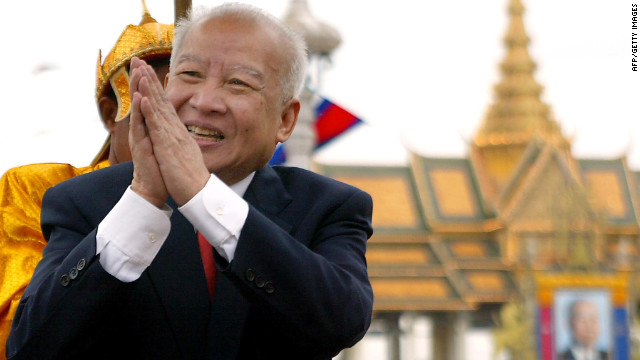
Cambodia former king Norodom Sihanouk dies aged 89


Norodom Sihanouk, the former Cambodian king who was a key figure through decades of upheaval, has died.

The former king died at a hospital in the Chinese capital, Beijing, after having a heart attack. He had been in poor health for several years.

Sihanouk, who was 89, came to the throne in 1941 and led Cambodia to independence from France in 1953.

Despite long periods of exile and his abdication in 2004 due to ill health, he remained an influential figure.

Sihanouk abdicated in 2004 in favour of his son, King Norodom Sihamoni.

"His death was a great loss to Cambodia," said his assistant and relative Prince Sisowath Thomico. "King Sihanouk did not belong to his family, he belonged to Cambodia and to history."

His body is expected to be returned to Cambodia and go on display for three months in the capital Phnom Penh before an official funeral at the royal palace.

King Sihamoni and Prime Minister Hun Sen have flown to Beijing to accompany the late king home.

A statement from China's foreign ministry hailed Sihanouk as a "great friend of the Chinese people".

Japan's top government spokesman said without him "there could not have been success in the Cambodian peace process".

Political broker

Born in 1922, Sihanouk was the eldest son of King Norodom Suramarit and Queen Kossamak.

Educated at French schools in Saigon and in Paris, the Nazi-controlled Vichy government in France crowned Sihanouk king of Cambodia in 1941, bypassing his father in the hope that the 18-year-old could easily be manipulated.

However, after the war Sihanouk embarked on an international campaign aimed at ensuring independence for Cambodia.

It was achieved without bloodshed in 1953 - after nearly a century of French rule. Two years later Sihanouk abdicated in favour of his father and became both prime minister and foreign minister of his country.

He tried - but failed - to keep the country from the Cold War conflict that engulfed South East Asia in the 1970s.

When a US-backed coup installed Lon Nol as Cambodia's leader, Sihanouk - by then alienated by US bombing raids on Vietnamese communist guerrillas inside Cambodia - was forced into exile in Beijing.

It was from there that he struck an ill-fated deal with the emerging Maoist rebel force, the Khmer Rouge. When the Khmer Rouge seized power in 1975, Sihanouk returned as head of state but was subsequently detained.

He remained confined to the royal palace for most of the four years of the regime's rule, during which time an estimated 1.7 million people died.

People were killed or worked and starved to death, as the Khmer Rouge emptied cities and forced Cambodians to work on the land.

Sihanouk later condemned the Khmer Rouge for the deaths of the Cambodians, including of several of his own children.

When Vietnamese forces ousted the Khmer Rouge, Sihanouk went again to Beijing. He was to remain outside the country for 13 years, as Cambodia faced civil war and the struggle to rebuild from economic devastation.

When the UN in 1991 persuaded the Vietnamese to withdraw and set Cambodia on the road to democracy, Sihanouk returned, and was again crowned king in 1993.

His role was increasingly one of broker between Cambodia's warring political factions. But as the country slowly worked its way towards political stability, Sihanouk's health steadily worsened.

In 2004, he announced he would step down in favour of one of his sons, the little-known Norodom Sihamoni. The former ballet dancer was crowned king in October 2004.

After that, Sihanouk spent much of his time overseas, in Beijing and Pyongyang.

But he remained a prominent national figure who - although criticised as autocratic and elitist, and blamed by some for his initial endorsement of the Khmer Rouge - symbolised constancy through Cambodia's years of violence.-British Broadcasting Corporation (Ocotber 15, 2012)

KL, Manila agree to boost bilateral ties


The Philippines and Malaysia have agreed to further strengthen their already robust bilateral relations in the fields of tourism, education, culture, health, information technology, labor and anti-trafficking.

The agreement was reached during the bilateral meeting held in Malacañang on Monday between President Benigno S. Aquino III and Malaysian Prime Minister Dato Sri Mohd Najib Bin Tun Abdul Razak, who is in the country on an official visit.

In a statement released after their meeting, the two leaders agreed to “further enhance the dynamic and productive partnerships” between the two countries by taking advantage of the Philippines-Malaysia Joint Commission Meeting to sustain the momentum of their partnership; conducting regular investment forums, exchange of trade and investments missions; taking advantage of tourism opportunities between the two countries; and hastening negotiations on proposed cooperation agreements.

Prime Minister Najib arrived in Manila on Sunday for an official visit from October 14 to 16. He is accompanied by his wife Madam Datin Paduka Seri Rosmah Mansor.

Najib is in the country to witness the historic signing of the Framework Agreement between the Philippines and the Moro Islamic Liberation Front, as third-country facilitator.

He congratulated President Aquino as he assured Malaysia’s support to the continuing peace negotiations and the implementation of the Framework Agreement.

For his part, President Aquino thanked Prime Minister Najib for the support as facilitator of the GPH-MILF peace talks since 2001 and their leadership of the International Monitoring Team since 2004. -Interaksyon (October 15, 2012 4:42PM)

ADB: Philippines Will lead for $500-Million Electric Tricycle Manufacturing in the World


Philippines seen as e-vehicle parts manufacturing hub – Foreign Companies in relocating in the Philippines.

The Asian Development Bank sees the Philippines becoming a regional manufacturing hub for electric vehicle parts, which is if the government and its partners will be able to successfully pull off the $500-million electric tricycle program.

In an interview with the Inquirer, Neeraj K. Jain, country director of the ADB for the Philippines said the e-Trike project, which will involve the roll out of 100,000 units of electronic tricycles across the country, was an initiative that could generate economic and "transformational" gains not only for tricycle drivers but for a whole new industry—the electric vehicle industry.

Sohail Hasnie, principal energy specialist at the ADB, disclosed in the interview that five to six foreign companies had expressed interest in relocating their factories to the Philippines, after seeing that the government and the ADB were aggressively pushing forward with the e-Trike project.

"These are big names in the industry," added Jain.

Companies interested in relocating in the Philippines include large battery manufacturer's overseas, spare parts manufacturers, motorcycle manufacturers and renewable energy firms.

Jain said these suppliers and manufacturers were willing to relocate because they knew the ADB was involved in the project.

"They know we can do (the same project) in Indonesia, Thailand or Vietnam. In case these companies decide to relocate here, they know we can help them set up a regional market. It becomes a win-win situation—e-Trike drivers earn more, the country saves on costly oil imports, reduces pollution, the country benefits from new (industry), new jobs are created," Jain said.

According to Hasnie, the bidding process for the procurement of the e-trikes has started. The Department of Energy conducted the pre-qualification process two weeks ago, which had attracted 11 bidders. The short-list of pre-qualified e-Trike suppliers will be released within the next two weeks.

The pre-qualified bidders will be provided with the complete design documents, including the mandatory service package, which means the suppliers will have to provide after-sales services and warranty.

The e-Trike project is supported by local auto parts makers led by the Motor Vehicle Parts Manufacturers Association of the Philippines (MVPMAP) and the Electric Vehicle Association of the Philippines (EVAP). Both groups believe that the successful rollout of the program will attract major electric vehicle partners to set up shops in the Philippines.

Under the program, the government plans to replace 100,000 fuel-fed tricycle units with energy efficient e-trikes to help reduce the transport sector's gasoline consumption by 561,000 barrels yearly, reducing 260,000 tons of carbon dioxide emission yearly.

At present, more than 3.5 million motorized tricycles are operating in the country, producing more than 10 million tons of carbon dioxide and using nearly $5 billion worth of imported fuel yearly.-Rebuilding for the Better Philippines (October 15, 2012)

Sunday, October 14, 2012

Thailand Doesn’t Need to Reduce Interest Rates, Prasarn Says


Thailand doesn’t need an interest- rate cut as credit growth is accelerating and domestic demand is countering a slowdown in exports, central bank Governor Prasarn Trairatvorakul said.

Inflation remains “benign” and Southeast Asia’s second- largest economy is estimated to grow 5.7 percent this year, Prasarn said in an interview with Bloomberg News in Tokyo yesterday. The central bank next meets to decide monetary policy on Oct. 17.

The Bank of Thailand has refrained from adding to its November and January rate reductions as the country recovered from its worst floods in almost seven decades. Prime Minister Yingluck Shinawatra has boosted state spending and raised government salaries, while demand for loans has risen.

“We don’t see necessity at the moment to use monetary policy to restore confidence because the market is already quite confident,” Prasarn said. “Exports are coming down but domestic demand is still very strong to compensate.”

Thailand’s central bank has kept its benchmark interest rate unchanged for five meetings. The one-day bond repurchase rate is at 3 percent and nine of 11 economists surveyed by Bloomberg News forecast borrowing costs will be kept unchanged on Oct. 17. Two forecast a cut of a quarter of a percentage point.

Rising Inflation

Consumer price inflation rose to a six-month high of 3.38 percent in September, a pace the central bank has said is in line with its expectations and not worrisome. Core inflation was 1.89 percent, below the 3 percent target that the monetary authority seeks to avoid breaching.

Total bank loans climbed 14.2 percent in the second quarter from a year earlier, accelerating from 13.9 percent in the previous three months.

Thai exports fell 6.95 percent in August from a year earlier, dropping for a third consecutive month as demand for products from electronics to rubber declined. The International Monetary Fund on Oct. 9 cut its projections for global expansion this year and next, saying it sees “alarmingly high” risks of a steeper slowdown.

The Bank of Thailand has room to ease monetary policy if needed, Prasarn said. He was in Tokyo to attend the IMF’s annual meeting.

“If the slowdown in the world markets curb exports to the level that Thai businesses” suffer, the central bank will act, he said.

There are no “alarming signs” of asset bubbles in Thailand, the governor said. The baht hasn’t come under “serious pressure” and the central bank hasn’t had to intervene in the currency, he said.-Bloomberg (October 14, 2012 1:01AM)

Indonesia develops drone to monitor border regions


A small green aircraft flew in the blue sky over the Halim Perdanakusuma airbase in East Jakarta on Thursday morning.

The unmanned aerial vehicle (UAV) features all the characteristics of a surveillance drone, except for its thunderous sound.

“The plane is designed to carry out surveillance. Given its noise levels, however, its targets would easily become aware of its position,” Research and Technology Minister Gusti M. Hatta said during the drone’s flight demonstration, which was also attended by Defense Minister Purnomo Yusgiantoro.

The drone was developed jointly by the Agency for the Assessment and Application of Technology (BPPT) and the research and development division at the Defence Ministry.

Purnomo said after the demo that a squadron of drones would soon join the Indonesian Air Force (TNI-AU), making Indonesia one of a few countries that develop UAVs.

The aircraft, according to the minister, would be placed in the country’s vast border regions.

Indonesia shares land borders with Papua New Guinea to the east, Malaysia and Brunei Darussalam on Borneo, and Timor Leste on Timor Island. Most illegal migrants enter the country along these borders.

As of August this year, some 7,370 migrants had illegally entered Indonesia via Nunukan in East Kalimantan, which directly borders Malaysia.

Aside from surveillance, the UAVs can also be equipped with military applications.

“These UAVs can be upgraded to fire missiles and to carry bombs,” Purnomo said.

Currently, the BPPT and the Defence Ministry’s research and development division have created around 12 UAV prototypes, which bear names including Sriti, Alap-Alap, Gagak, Pelatuk and Wulung.

Wulung, which was tested on Thursday, has a wingspan of about 6 metres, a height of 1.2 metres and a length of around 4 metres. The aircraft performed surprisingly well during the test flight.

Despite the country’s achievement with the UAVs, the BPPT’s engineering researcher, Adrian Zulkifli, admitted that Indonesia was still far behind other countries in terms of unmanned aircraft development.

A report by CNN stated that the US had only 11 drones in 2011 when it declared its War on Terror. However, it currently had around 7,500 drones that have been deployed in many of its military operations overseas, the report said.

The drones can fly as far as Afghanistan, Iran and Pakistan, despite being remotely operated by pilots from military bases in the US.

Meanwhile, their Indonesian counterpart, the Wulung, can currently only fly as far as 73 kilometres from its ground controllers.

“We are working on enabling our UAVs to travel up to 300 kilometres,” Adrian said, adding that the Wulung could fly up to four hours non-stop.

The Wulung and the other UAVs are operated by software originally made by the BPPT.

“We created the software to operate the UAVs,” Adrian said, adding, however, that the aircraft’s engines and cameras were imported from European countries.

“We are learning to produce the engines so that we will not be forever dependent on other nations. However, their quality may not initially be as good as those from countries with advanced experience in UAV production.”

With the planned inclusion of a squadron of UAVs in the Air Force, the Indonesian Army will be one step closer to achieving its minimum essential force in 2025. However, the government still has much to do to meet the goal.-Asia News Network (October 14, 2102)

WORLD NEWS: Japanese, US troops mull drill to take island – reports


Japan and the United States are mulling a joint military drill to simulate retaking a remote island from foreign forces, reports said, amid a festering row between Tokyo and Beijing over disputed islets.

The exercise, part of broader joint manoeuvres to start in early November, would use an uninhibited island in Okinawa, southernmost Japan, Jiji Press and Kyodo News agencies quoted unidentified sources as saying on Saturday.

The drill would involve Japanese and US troops making an amphibious and airborne landing to retake the island using boats and helicopters, Kyodo said.

Japan and China have long been at loggerheads over the sovereignty of rocky outcrops in the East China Sea known as the Senkaku Islands in Japan and the Diaoyu Islands in China.

The Tokyo – administered island chain is uninhabited, but is thought to be sitting on top of valuable resources.

The dispute flared in August and September with landings by nationalists from both sides and the subsequent nationalisation of the islands by Tokyo.

The exercise would reportedly use the uninhabited island of Irisunajima. The tiny island, used as a firing range for US forces, is also in the East China Sea but hundreds of kilometres (miles) away from the disputed island chain.

Jiji said some Japanese and US government officials were cautious about holding the drill, fearing a likely angry response from China.-Philippine Daily Inquirer (October 14, 2012 2:11PM)


Myanmar ruling party meets to map out its future


Myanmar’s ruling party opened a crunch meeting on Sunday to revamp its leadership and chart a new course for the army-backed group after a by-election drubbing by Aung San Suu Kyi’s pro-democracy opposition.

The Union Solidarity and Development Party gathered in the capital Naypyidaw as it looks towards a 2015 election that many expect to be the greatest litmus test of reforms that have swept the country under the current quasi-civilian regime.

President Thein Sein, who greeted delegates at the start of the three-day conference, stepped down as party chief to take office last year and the post has since remained vacant.

Members are expected to select new leadership as part of their efforts to map out the party’s strategy.

“We will discuss how we can better serve the people,” USDP general secretary Htay Oo told AFP ahead of the meeting.

“We are not only aiming to win 2015… We will continue working even if we do not win,” he said, adding that the party had not been put off by its defeat in the April by-election.

The USDP lost all but one of the 45 seats it contested in the vote which swept Suu Kyi and members of her National League for Democracy into parliament.

This week the Nobel laureate said she had “the courage to be president” if elected, signalling a willingness to take the top job.

That would require the amendment of a constitution that bars those with close foreign relatives from holding high office. Suu Kyi, who married a British academic, has two sons living in the West.

Analysts say Thein Sein is locked in a power struggle with the lower house speaker and USDP vice president Shwe Mann, widely considered to harbour ambitions of taking the presidency after 2015.

The relationship between the pair, both former generals, is believed to have soured after Thein Sein was appointed president while Shwe Mann, who was more senior under the previous regime, took the lesser role of speaker.

But observers say electoral success will be a formidable challenge for the USDP, which swept a poll two years ago that was marred by allegations of fraud and the absence of Suu Kyi, who was released from house arrest just days later.

“They cannot rig the election like before, so the USDP might need to find another way for themselves,” said Hkun Htun Oo of the Shan National League for Democracy party.-Philippine Daily Inquirer (October 14, 2012 2:01PM)

Phl, Japan sign $100-M loan deal


The Philippines and Japan signed last week a $100-million loan agreement, the Department of Finance (DOF) said over the weekend.

The loan agreement, signed on the sidelines of the World Bank-International Monetary Fund Annual Meeting in Tokyo, Japan last week, will support the implementation of the Development Policy Support Program-Investment Climate Program (DPSP-IC) Loan.

Finance Secretary Cesar Purisima and Japan International Cooperation Agency (JICA) president Akihiro Tanaka signed the loan agreement.

In a statement, the Finance department said the DPSP-IC aims to help the Philippines strengthen domestic policy for the promotion of competitiveness and inclusive growth in three areas: employment facilitation, improving competitiveness and the creation of an enabling environment for public-private partnership (PPP) infrastructure.

The program loan is co-financed with the Asian Development Bank. It is a budgetary support financing which supports the achievements of the government covering the implementation of policy reforms for the improvement of the country’s investment climate.

The loan carries an interest rate of 1.4 percent per annum, with 30 years inclusive of 10 years grace period.

Data from the Finance department showed that the total amount of budgetary support funds when combined with the Asian Development Bank’s $350 million program loan totals about $450 million.

Japan has been consistently the Philippines’ top source of official development assistance (ODA).

JICA presently supports the loan and grant aid financing totaling to about JPY250 billion primarily in the sectors of agriculture and agrarian reform, infrastructure, flood control, environment, climate change, Mindanao peace process, disaster risk reduction and management, and human resource development, the Finance department also said.-The Philippine Star (October 14, 2012)

500 Mindanao peace advocates won't leave Mendiola until GPH, MILF ink Bangsamoro framework pact

This summary is not available. Please click here to view the post.

REVIEW: ‘Eat Bulaga!’ Franchise In Singapore, Malaysia?


The success of the Indonesian franchise of “Eat Bulaga!” could result to a domino effect as other Asian countries seem to be interested in jumping on the bandwagon.

Politician-host Senator Tito Sotto has revealed on "Unang Hirit" on Aug 31 that there have been talks with other Asian countries to have their own version of the show. The same report said these may include Singapore and Malaysia.

“May mga talks with other Asian countries kasi it appeals to the Asian culture,” revealed Sotto.

He cited the "Eat Bulaga" segments “Juan For All, All For Juan” and “Pinoy Henyo” as most relatable to other Asian cultures due to their novelty.

“‘Yung ‘Juan For All, All For Juan’ project is ‘yung kinokolekta mo na yung basura ng mga kababayan natin at kumikita pa sila ‘di ba?

“At tsaka nage-enjoy pa sila, nae-entertain pa sila,” he said.

Last July 16, “Eat Bulaga-Indonesia” under the Surya Citra Televisi (SCTV) aired its pilot episode and it has been making waves since.

Similar to the original “EB,” the Indonesian version is filled with entertainment, games, prizes, and inspiration. Segments were patterned after the local version, such as “Indonesia Pintar” (“Pinoy Henyo”), “Juan For All, All For Juan,” “Bolagaan,” and “Karaoke Stud.” One of the original show’s core hosts, “Bossing” Vic Sotto, also has his Indonesian counterpart: Uya Kuya, who is called “Boss Uya.”

Even the “DaBarkads”—the collective term for the “EB” hosts—has an equivalent in the Indonesian show, and it's called “bulagang.” More, the Indonesian hosts are joined by a Pinoy presenter in the person of Pangasinense and University of the Philippines-Baguio alumnus Leo Consul.

Proving that the ties between the two shows are strong and that they have imbibed the same sense of civic responsibility displayed by “EB” for years now, “Eat Bulaga-Indonesia” hosts Uya Kuya and Rian Ibram offered help to Filipinos when a strong monsoon left the country devastated some weeks ago.

The comedic duo even personally brought the relief goods to the show, a gesture which, Bossing found highly commendable.-Manila Bulletin (August 31, 2012)

DFA: Malaysian PM, PNoy to discuss defense, security cooperation

This summary is not available. Please click here to view the post.

World Bank chief expresses support for rapidly reforming Myanmar


The World Bank is working with one-time pariah Myanmar, its president said Saturday, and is helping the country to get its debts cancelled.

"We are very supportive of the current government and we'll be especially supportive as they go through further reforms," Jim Yong Kim told a news conference in Tokyo.

"We are very engaged in Myanmar right now. We're in the process of working with the government to really sort through the arrears," he said, in response to a question about development aid to the country.

"We are expecting in the early part of 2013 we will have been able to sort through the arrears, put together plans for clearing them and move forward," Kim said.

Reports said Myanmar owes the World Bank $400 million and owes the Asian Development Bank $500 million. It also owes individual countries.

Kim, who was in Japan for the annual meetings of the International Monetary Fund and the World Bank, said he had met with Myanmar's leaders, including at the UN general assembly in New York.

"We're very impressed with the reforms they've gone through. But there are still ways to go. There's still more to do."

Japan vowed Thursday to resume loans to Myanmar and called on other creditor countries to chip in more, as representatives from two dozen nations and a handful of international organisations gathered in Tokyo.

"Japan is planning to resume its full programme in Myanmar with concessional loans... at the earliest possible time next year," Finance Minister Koriki Jojima told the meeting, without elaborating.

Myanmar's finance minister Win Shein called for more help, saying: "We are in the midst of an unprecedented and multi-faceted transition... from a state-centred economy to a free-market economy".

In a statement after the Thursday meeting, the World Bank and Asian Development Bank said they were "advancing necessary preparations to jointly assist Myanmar in clearing their respective arrears" early next year.

Japan agreed with Myanmar in April to forgive 300 billion yen ($3.8 billion) of the 500 billion yen it is owed.

Myanmar has been rapidly rehabilitated since polls that saw the election of a nominally civilian government, setting off a race to tap a potentially lucrative market that is rapidly opening up after years of isolation.-Interaksyon (October 14, 2012)