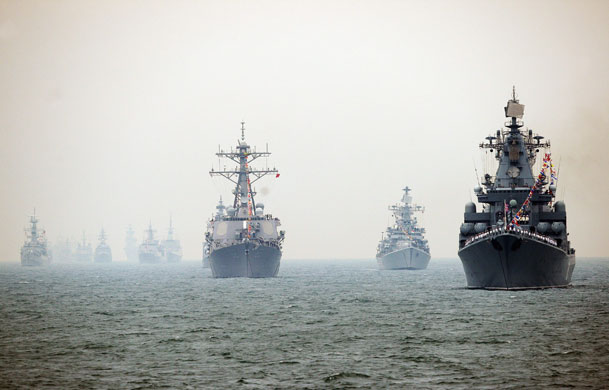
The Department of Foreign Affairs (DFA) on Tuesday asked the Philippine Coast Guard to determine the exact location of 30 Chinese fishing boats supposedly in the disputed Spratly Islands in West Philippine Sea.
“The Chinese fishing vessels must not intrude into the EEZ of the Philippines. We require China to respect the sovereign rights of the Philippines in our EEZ,” Hernandez said.
“We want to make sure where they are and if they’re in our exclusive economic zone,” Foreign Affairs spokesman Raul Hernandez said in a press briefing.
The United Nations Convention on the Law of the Sea or UNCLOS has outlined a 200-nautical mile exclusive economic zone or EEZ for maritime states like the Philippines, giving them sole right to manage, explore and exploit resources within this area.
The treaty, signed by the Philippines, China and 162 other nations, also grants coastal nations rights to continental shelf regions beyond their economic zones.
The Philippines will file a diplomatic protest once the Chinese vessels intrude into Philippine waters, Hernandez said.
 The fishing vessels, China’s largest deployment in contested waters to date, supposedly arrived in the Spratlys’s Yongshu Reef last Sunday.
China virtually claims the entire West Philippines Sea, also known as South China Sea, even where it overlaps with the territorial waters of neighbors, including the Philippines.
The vast waters, coveted for its strategic shipping lanes and rich gas and oil reserves, are home to a cluster of islands, shoals, cays, and reefs and teem with rich fishing areas.
Apart from China and the Philippines, other claimants are Vietnam, Brunei, Malaysia and Taiwan. The territorial disputes have long been feared as a potential flashpoint for armed conflict.-GMA News (July 9:47PM)
The fishing vessels, China’s largest deployment in contested waters to date, supposedly arrived in the Spratlys’s Yongshu Reef last Sunday.
China virtually claims the entire West Philippines Sea, also known as South China Sea, even where it overlaps with the territorial waters of neighbors, including the Philippines.
The vast waters, coveted for its strategic shipping lanes and rich gas and oil reserves, are home to a cluster of islands, shoals, cays, and reefs and teem with rich fishing areas.
Apart from China and the Philippines, other claimants are Vietnam, Brunei, Malaysia and Taiwan. The territorial disputes have long been feared as a potential flashpoint for armed conflict.-GMA News (July 9:47PM)
The Philippines will not withdraw from its rights over the West Philippine Sea amid conflicts with China, and will continue to pursue the disputes through peaceful and diplomatic means, Malacañang said Tuesday.
“I think that we will maintain our sovereign rights over our exclusive economic zone,” presidential spokesperson Edwin Lacierda said at a briefing. “That is something that we will not give up.”
But Lacierda also clarified that the Philippines has never used any other means aside from diplomacy in solving its issues with China.
“We have not used our military force,” he said. “We have always maintained that the only resolution to this incident is a peaceful solution – a peaceful resolution to the problem.”
China and the Philippines have been locked in a standoff since April over the Panatag (Scarborough) Shoal, when poaching Chinese fishermen were protected by their country's forces after Philippine authorities tried to make arrests.
The shoal west of Masinloc in Zambales province is within Philippine territorial limits, but China invoked historical claims to the area.
Lacierda had no doubts about who really has claims over the Panatag (Scarborough) Shoal.
“Scarborough is not a disputed territory. Scarborough is within our exclusive economic zone,” Lacierda said.
 On Monday, 30 Chinese fishing vessels were reported to have returned in the disputed Spratly Islands, where both China and the Philippines also have overlapping claims, as well as Malaysia, Taiwan, and Brunei.
Because of this development, the Philippines warned China to steer clear of its 200-nautical-mile EEZ.
The EEZ is a maritime area within 200 nautical miles from a country’s baseline. A country has rights over the economic resources of the sea, seabed, and subsoil to the exclusion of other states within its EEZ.
This zone is a provision of the United Nations Convention on the Law of the Sea (UNCLOS), to which China and the Philippines are signatories.
“The Chinese fishing vessels must not intrude in the exclusive economic zone of the Philippines. We require China to respect the sovereign rights of the Philippines over the resources within our EEZ,” Foreign Affairs spokesperson Raul Hernandez said.-GMA News (July 6:29PM)
On Monday, 30 Chinese fishing vessels were reported to have returned in the disputed Spratly Islands, where both China and the Philippines also have overlapping claims, as well as Malaysia, Taiwan, and Brunei.
Because of this development, the Philippines warned China to steer clear of its 200-nautical-mile EEZ.
The EEZ is a maritime area within 200 nautical miles from a country’s baseline. A country has rights over the economic resources of the sea, seabed, and subsoil to the exclusion of other states within its EEZ.
This zone is a provision of the United Nations Convention on the Law of the Sea (UNCLOS), to which China and the Philippines are signatories.
“The Chinese fishing vessels must not intrude in the exclusive economic zone of the Philippines. We require China to respect the sovereign rights of the Philippines over the resources within our EEZ,” Foreign Affairs spokesperson Raul Hernandez said.-GMA News (July 6:29PM)
A Chinese submersible that last month set a new national record will dive in the South China Sea next year, state media said Tuesday, as Beijing asserts its claim over the resource-rich area.
The mission is "part of the preparations for future commercial mining of the seabed", the China Daily quoted the China Ocean Mineral Resources and Research Association as saying.
The South China Sea, which extends from China's South Coast towards several South East Asian countries, is a flashpoint for territorial disputes between China and its neighbors.
China claims the entirety of the sea on historical grounds, but Taiwan, Vietnam, Brunei, Malaysia and the Philippines dispute this.
Tensions in the South China Sea have risen recently, with China and the Philippines locked in a maritime dispute over the Scarborough Shoal, a reef off the Philippine coast.
The China Daily said the "Jiaolong", China's most technologically advanced manned submersible, would conduct the mission next April and May, after it reached depths of over 7,000 metres in the Atlantic Ocean last month.
The craft gives China the ability to explore 99 percent of the world's seabeds, the China Daily said.
Its first mission in the area aims to study the "formation and evolution" of the South China Sea bed, the China Daily reported.
Chinese researchers estimate that the South China Sea holds more than 213 billion barrels of oil, equivalent to at least 80 percent of Saudi Arabia's reserves.
Those deposits are an enticing prospect for China, the world's largest energy consumer, which relies on imports to meet over half of its oil needs.-Interaksyon (July 17, 2012 4:44PM)
Myanmar's Nobel Prize-winning opposition leader Aung San Suu Kyi will travel to the United States in September on her first visit since spending years under house arrest, a think-tank said Tuesday.
Suu Kyi, who was elected to parliament this year in a dramatic sign of Myanmar's reforms, has indicated that she will attend a dinner in New York on September 21 to accept an award from the Atlantic Council, said Taleen Ananian, a spokeswoman for the think-tank.
It would be the 67-year-old Suu Kyi's first visit to the United States since the 1980s. She spent most of the past two decades under house arrest after a military junta refused to accept her party's victory in 1990 elections.
Suu Kyi did not travel abroad again until May this year when she visited Thailand. Last month, she made an extensive tour of Europe, where she was feted in major capitals and admitted that she felt exhausted.
State Department officials said that they had no announcement to make on Suu Kyi's travels, but it would be highly unlikely that she would visit the United States without meeting her supporters in President Barack Obama's administration and Congress.
The Atlantic Council dinner takes place in New York at the same time as the United Nations General Assembly, which each year brings leaders from across to the world to the global body's headquarters in Manhattan.
 The Atlantic Council said it would present its "Global Citizen" awards to Suu Kyi along with Japan's Sadako Ogata, a former UN high commissioner for refugees.
"By honoring two such brave women -- one of the most well-known political prisoners of our times and a courageous campaigner for human rights from Bosnia to Rwanda -- we help define the notion of global citizenship even as we honor it," Atlantic Council president and CEO Frederick Kempe said in a statement.
The think-tank will also present the award to Henry Kissinger, the 89-year-old former secretary of state and apostle of realpolitik, along with music legend and humanitarian Quincy Jones.-Interaksyon (July 17, 2012 9:38PM)
YANGON - Myanmar's parliament agreed Tuesday to discuss amendments to a pair of controversial laws widely used to suppress dissent during the former junta's rule.
Lower house speaker Shwe Mann confirmed that changes would be considered to the Emergency Provision Act and the colonial-era Unlawful Association Act, after a lawmaker raised the issue in parliament.
Pro-democracy campaigners have said the laws have been routinely used to detain dissidents and ethnic rebels.
While it is unclear how much support there is in parliament for changing the laws, debating their future is the latest sign of the mood for reform in Myanmar's fledgling democracy.
The wide-ranging association act has been used to punish dissidents communicating with exile organizations and the nation's myriad ethnic groups -- with both declared "unlawful" during the army's five-decade rule.
Several rebel groups have recently signed fragile ceasefire deals with the government, prompting the lawmaker pushing the amendments to say the association law jeopardises steps towards peace.
"This act is an obstacle in the peace talk process," Thein Nyunt, lower house lawmaker for the New National Democracy party, said during the televised session of parliament in the capital Naypyidaw.
"Many ordinary people were taken under this act for sending food, water or meeting with their relatives," he said, adding that the law was a hangover from British colonial rule that ended more than six decades ago.
Echoing his call Nan Wah Nu, a lawmaker with the Shan Nationalities Democratic Party (SNDP), which represents the ethnic minority Shan in eastern Myanmar, said "villagers mostly suffered" under the act rather than "insurgent groups."
Deputy Home Affairs Minister Kyaw Zan Myint however dampened hopes for a major shift, saying some parts of the law "are still in accord with the (ethnic unrest) situation and should not be discussed for abolition."
President Thein Sein has overseen sweeping political changes over the past year, including the release of hundreds of political prisoners and the election of opposition leader Aung San Suu Kyi to parliament, and his government has been rewarded with a rollback of international sanctions.
Parliament, still dominated by the military and its political allies, has a number of pressing issues on the table, including economic reforms and recent communal violence in the west of the country.-Interaksyon (July 17, 2012 7:30PM)
China is providing the Philippines P5.3 billion for the Angat Water Utilization and Aqueduct Improvement Project of state-run Metropolitan Waterworks and Sewerage System.
On Tuesday, President Benigno Aquino III inaugurated the project, which involves the construction of an additional 9.9 kilometers to Aqueduct 6 and an interconnection facility that would ensure water flow from Angat Dam to La Mesa Dam.
The project aims to ensure water supply for Metro Manila's 15 million residents and reduce the 394 million liters of wastage.
Angat Dam supplies 97 percent of Metro Manila's water requirements.
In his speech, the President said MWSS, under its new leadership, has turned around from a loss-making agency to a revenue contributor.
From P34 million in losses - and amid generous bonuses to MWSS officials - in 2010, the agency earned P330 million last year, allowing it to pay the pension benefits of retired workers reachingP236 million. MWSS also remitted P150 million in dividends to the national government.
Aquino also credited Public Works Secretary Rogelio Singson, who chairs MWSS, for the agency's turnaround.
The President said MWSS under Singson put an end to the previous situation wherein only 41 million out of 146 million cubic meters of water was put to good use.
Aquino also thanked China for helping fund the project. Chinese Ambassador to the Philippines Ma Keqing witnessed the inauguration.-Interaksyon (July 17, 2012 6:48PM)
A Filipina household worker in Jordan suffered broken bones after jumping recently from the third floor of an apartment building to escape an abusive employer, the Department of Foreign Affairs reported on Tuesday. She is now in the care of the Philippine labor office in Amman.
Foreign Affairs Undersecretary for Migrant Workers’ Affairs Estebal Conejos Jr. told Senator Manuel Villar in a letter that Dianna Lalaine Castillo is now at the Filipino Workers’ Resource Center of the Philippine Overseas Labor Office after being released by Prince Hamza Hospital, where she was treated for injuries sustained in her fall.
“Her case is being handled by the Embassy’s legal counsel, Atty. Ghazi Al Odat, who filed a case against her employer who physically abused her,” Conejos informed Villar in the letter dated July 16.
Villar called the attention of the DFA to Castillo’s plight last June 25.
The senator said Castillo’s family sought the help of his Office for OFW Concerns after she escaped from her employer. She said she was whipped with barbed wire almost every day.
Conejos did not identify the employer but he said the embassy in Jordan is now compelling Castillo’s recruitment agency to repatriate her.
“The Embassy’s Assistance to Nationals (ATN) team, in coordination with POLO, is compelling her recruitment agency in Jordan to provide her with a return ticker to Manila so that she could be repatriated as soon as possible,” Conejos wrote Villar.-Interaksyon (July 17, 2012 6:42PM)
Security forces in Thailand say they have killed eight suspected drug smugglers, seizing weapons and pills in a clash in Chiang Rai province.
Police and military troops clashed with the suspects in a forested area near the Burmese border early on Monday.
Gunfire was exchanged after the suspects refused to be searched, officials said.
The area in the northern province is notorious for drug production and trafficking.
Thailand's The Nation newspaper reported that police had received a tip-off that a drug gang would be crossing the border.
The Thai authorities said they seized more than 500,000 amphetamine pills and 70kg of crystal methamphetamine.
They also found weapons including at least one AK-47 rifle and pistols.
There were no reports of casualties among the Thai security forces.-British Broadcasting Corporation (July 16, 2012)
MANILA, Philippines- A large Chinese fleet started fishing at Fiery Cross Reef in the disputed waters of the Spratly Islands Monday night, amid a warning from the Philippines to steer clear of the country's territory.
Chinese state news agency Xinhua said 30 fishing vessels, one of the largest fleet deployed by Hainan province, have started casting their nets in waters near the reef, which it is calling Yongshu Reef.
"We pray for a bumper harvest tonight," one fisherman told Xinhua.
The ships, which are being escorted by Chinese Fisheries Law Enforcement Command vessel Yuzheng-310, arrived in the area around 3:56 p.m. Sunday and will stay for up to 10 to fish.

"Dark clouds were still lingering over the reef on Monday, but the fishermen hoped for the best," Xinhua reported.
The ships include a 3,000-tonne replenishment ship and 29 other large boats.
Deadly naval battle
Waters near the reef where the ships dropped anchor was the site of a deadly naval battle between Chinese and Vietnamese forces in 1998.
More than 70 Vietnamese troops were killed while 2 of their ships were sunk and another was heavily damaged in the skirmish.
It resulted in China gaining control of the nearby Johnson South Reef, which the Philippines calls Mabini Reef.
 Dr. Richard Cronin, senior associate and director of the Henry Stimson Center's Southeast Asia Program, told the U.S.-China Economic and Security Review Commission that the deadly outcome of the naval battle was the reason why the Philippine Navy decided to avoid a confrontation with the Chinese People's Liberation Army Navy when the latter occupied Mischief Reef in 1994.
In reponse to the arrival of the Chinese fishing fleet, Philippine Department of Foreign Affairs (DFA) on Monday said China should ensure that its ships will stay clear of the Philippines' 200-kilometer exclusive economic zone (EEZ), as set by international law.
Foreign Affairs spokesman Raul Hernandez said Philippine Coast Guard boats have been deployed to make sure that the Chinese ships do not enter Philippine territory.
 "If these (ships) are going to our EEZ, we will file a protest because this is our EEZ and it is only the Philippines (that has) the sovereign right to explore, exploit and manage the resources in that area," he told media.
"We require China to respect the sovereign rights of the Philippines," he said.
China has yet to comment on the DFA's warnings, even as it announced Monday that its deep-sea manned submersible, the Jiaolong, is also set to be deployed to the Spratlys next year for a survey mission to map the disputed area's basin.
China is claiming ownership of the entire West Philippine Sea -- which is believed to hold large oil and gas reserves -- including areas close to the coastlines of other countries and hundreds of kilometers from its own landmass.-ABS-CBN News (July 17, 2012)
Seventy-seven Chinese vessels are back in the vicinity of the disputed Panatag (Scarborough) Shoal, said Department of Foreign Affairs Undersecretary for Policy Erlinda Basilio.
Basilio said the Chinese vessels incrementally came back after they pulled out earlier this month.
“Nakikita natin na planado iyon. May plano talaga,” she said in an interview on GMA News TV program News To Go.
She said that the Chinese fishing vessels were spotted by Philippine surveillance planes over Panatag Shoal.
Basilio also said China should have pulled out all its vessels as early as June 16, when Philippine President Benigno Aquino III ordered the withdrawal of all the country’s ships from the disputed territory.
“Mayroon tayong kasunduan sa kanila, pero sila ay hindi tumupad. Tayo umalis doon kasi simultaneous sana ang pag-alis, pero hindi sila umalis,” she said.
The Philippines has been engaged in a three-month-old territorial dispute with China over ownership of Panatag Shoal, located 124 nautical miles west of Zambales.
 The Philippines asserts ownership over the shoal based on traditional use and provisions in the United Nations Convention on the Law of the Sea (UNCLOS), while China maintains that its ownership is based on historical claims.
‘Serious concern’
Basilio meanwhile described the stranding of a Chinese naval frigate near Hasa-Hasa (Half Moon) Shoal off Palawan as “a cause for serious concern.”
“Kung warship na, under the declaration of the Conduct of Parties of the South China Sea, bawal nga ‘yan,” she said.
She added that she personally saw the presence of the Chinese frigate in Philippine territory as a “threat of the use of force.”
“Meron namang Freedom of Navigation, pero kung warships yung ipinapakita, ipinapadaan daan mo diyan, hindi na yata tama yun di ba?” she said.
The Philippines asserts ownership over the shoal based on traditional use and provisions in the United Nations Convention on the Law of the Sea (UNCLOS), while China maintains that its ownership is based on historical claims.
‘Serious concern’
Basilio meanwhile described the stranding of a Chinese naval frigate near Hasa-Hasa (Half Moon) Shoal off Palawan as “a cause for serious concern.”
“Kung warship na, under the declaration of the Conduct of Parties of the South China Sea, bawal nga ‘yan,” she said.
She added that she personally saw the presence of the Chinese frigate in Philippine territory as a “threat of the use of force.”
“Meron namang Freedom of Navigation, pero kung warships yung ipinapakita, ipinapadaan daan mo diyan, hindi na yata tama yun di ba?” she said.
 The Chinese warship reportedly ran aground near Hasa-Hasa Shoal last Wednesday, but was refloated on Sunday.
The Hasa-Hasa shoal, located 60 nautical miles off Palawan’s Rizal town, is part of the Spratly Islands—a string of atolls and islands straddling vital shipping lanes in the West Philippine Sea believed sitting atop vast mineral deposits.
Apart from the Philippines and China, the Spratlys are claimed in whole or in part by rival Taiwan and the other Southeast Asian countries of Brunei, Malaysia and Vietnam.
The Philippine government said it will conduct a probe on the stranding of the Chinese warship inside Hasa-Hasa Shoal.-GMA News (July 16, 2012 9:18PM)
The Chinese warship reportedly ran aground near Hasa-Hasa Shoal last Wednesday, but was refloated on Sunday.
The Hasa-Hasa shoal, located 60 nautical miles off Palawan’s Rizal town, is part of the Spratly Islands—a string of atolls and islands straddling vital shipping lanes in the West Philippine Sea believed sitting atop vast mineral deposits.
Apart from the Philippines and China, the Spratlys are claimed in whole or in part by rival Taiwan and the other Southeast Asian countries of Brunei, Malaysia and Vietnam.
The Philippine government said it will conduct a probe on the stranding of the Chinese warship inside Hasa-Hasa Shoal.-GMA News (July 16, 2012 9:18PM)
China used the power of money in order for Cambodia to block the drafting of a joint communiqué that was the traditional manner of concluding the Association of Southeast Nations’ (ASEAN) Ministerial Meeting.
Foreign Affairs Undersecretary for Policy Erlinda Basilio, who was part of the Philippine delegation to the 45th ASEAN meeting last week in Phnom Penh, said China was behind Cambodia’s decision not to issue the joint communiqué.
The communiqué was supposed to mention the dispute between China and the Philippines over Panatag Shoal in West Philippine Sea.
“Maraming ibinuhos o iprinomisang pera. Mayroon silang maritime cooperation fund, construction fund, may connectivity fund at iba-iba pang mga bagay na inaalok nila,” she said in an interview over GMA News TV’s “News To Go” on Monday.
GMA News Online is still trying to get statements from the Cambodian and Chinese embassies in the Philippines as of this posting.
 In a statement over the weekend, the DFA said it “deplores” ASEAN’s non-issuance of a joint communiqué – the first time in the 10-member bloc’s history – due to Cambodia’s resistance.
Cambodia – an ally of China and chairing this year’s meeting – supposedly did not want the joint communiqué to mention anything about the territorial dispute between China and other ASEAN member-states.
The Philippines has been locking horns with China over Panatag (Scarborough) Shoal in West Philippine Sea (South China Sea) since last April.
Not about to back down
China was clearly “testing the resolve” of the bloc when it got one of its key allies to defend its stand in this year’s meeting, Basilio said.
The Foreign Affairs official, however, maintained the Philippines is not about to back down in the dispute with the world’s second largest economy after the United States.
In a statement over the weekend, the DFA said it “deplores” ASEAN’s non-issuance of a joint communiqué – the first time in the 10-member bloc’s history – due to Cambodia’s resistance.
Cambodia – an ally of China and chairing this year’s meeting – supposedly did not want the joint communiqué to mention anything about the territorial dispute between China and other ASEAN member-states.
The Philippines has been locking horns with China over Panatag (Scarborough) Shoal in West Philippine Sea (South China Sea) since last April.
Not about to back down
China was clearly “testing the resolve” of the bloc when it got one of its key allies to defend its stand in this year’s meeting, Basilio said.
The Foreign Affairs official, however, maintained the Philippines is not about to back down in the dispute with the world’s second largest economy after the United States.
 “Talagang ipinaglalaban namin an gating kasarinlan. Hindi kami nangingimi. Talagang matatag ang aming paniniwala na dapat ang buong sambayanang Pilipino ay dapat ipaglaban ito, kasi atin ito,” she said.
The Department of Foreign Affairs (DFA) is optimistic other ASEAN member-states, such as Indonesia and Vietnam, will also assert their respective rights to parts of the West Philippine Sea, Basilio added.
The department told Philippine ambassadors to hold dialogues with other states and explain Manila’s stand on the territorial dispute with Beijing, according to the undersecretary.
“Pinalakad lahat ng mga ambassador natin para i-eksplika sa mga gobyerno na kung saan sila naroroon para maintindihan ang sitwasyon natin na ang China ay hindi rumerespeto sa ating sovereignty,” she added.-GMA News (July 16, 2012 7:42PM)
“Talagang ipinaglalaban namin an gating kasarinlan. Hindi kami nangingimi. Talagang matatag ang aming paniniwala na dapat ang buong sambayanang Pilipino ay dapat ipaglaban ito, kasi atin ito,” she said.
The Department of Foreign Affairs (DFA) is optimistic other ASEAN member-states, such as Indonesia and Vietnam, will also assert their respective rights to parts of the West Philippine Sea, Basilio added.
The department told Philippine ambassadors to hold dialogues with other states and explain Manila’s stand on the territorial dispute with Beijing, according to the undersecretary.
“Pinalakad lahat ng mga ambassador natin para i-eksplika sa mga gobyerno na kung saan sila naroroon para maintindihan ang sitwasyon natin na ang China ay hindi rumerespeto sa ating sovereignty,” she added.-GMA News (July 16, 2012 7:42PM)
PHNOM PENH - A new species of snake which is scarlet with black and white rings has been discovered in Cambodia's rainforest, conservationists announced on Monday.
The reptile, which has been named the Cambodian Kukri, was found in the southwest Cardamom Mountains, an area under threat from habitat loss, Fauna & Flora International (FFI) said in a statement.
Kukri snakes are so named because their curved rear fangs - designed to puncture eggs - are similar in shape to the Nepalese kukri knife, FFI said.
"Most kukri snakes are dull-colored," said Neang Thy, one of the herpetologists who discovered the new species. "But this one is dark red with black and white rings, making it a beautiful snake."-Interaksyon (July 16, 2012 10:51PM)
JAKARTA - Muslim extremists in Indonesia are regrouping despite a decade-long crackdown that has weakened the deadliest networks, the International Crisis Group think-tank said in a report Monday.
Islamists are finding each other and building new cells "on the run, in prison and through Internet forums, military training camps and arranged marriages", the report said, warning the threat of terrorism was far from over.
Beefed-up anti-terror units have divided cells such as Jemaah Islamiyah -- blamed for the 2002 twin bombings on Bali that killed 202 people -- but smaller groups have formed and carried out low-impact attacks.
"Fortunately for Indonesia, most of these would-be terrorists have been singularly inept," International Crisis Group (ICG) senior adviser Sidney Jones said in a statement.
"But there are signs that at least some are learning lessons from their mistakes and becoming more strategic in their thinking. The danger is not over."
 In early 2010, police discovered a training camp in Aceh province, on the northern tip of Sumatra, "involving all major jihadi groups in the country", according to the report, "How Indonesian Extremists Regroup".
After around 200 people were arrested and some 30 suspects killed over the following two years, new alliances emerged, dormant cells were revived and recruits were made "through Internet chatting, prison visits and radical lectures".
In early 2010, police discovered a training camp in Aceh province, on the northern tip of Sumatra, "involving all major jihadi groups in the country", according to the report, "How Indonesian Extremists Regroup".
After around 200 people were arrested and some 30 suspects killed over the following two years, new alliances emerged, dormant cells were revived and recruits were made "through Internet chatting, prison visits and radical lectures".
ICG Southeast Asia project director Jim Della-Giacoma said police in Indonesia -- the world's most populous Muslim country -- had been lucky because the extremists had been incompetent in many cases.
"Ten years after Bali, there are virtually no effective programmes in place to address the conditions that allow jihadi ideology to flourish," he said.-Interaksyon (July 16, 2012 10:24PM)
Filipinos are the second most optimistic businessmen in the world despite expectations of tepid sales and less hiring in the coming quarter, the latest Grant Thornton International Business Report shows.
The report, released by Punongbayan & Araullo, has the Philippines scoring 90 percent, just behind Peru, which scored 96 percent, and at par with Chile.
Last quarter, the Philippines was at the fourth spot, behind Peru, Brazil and the United Arab Emirates.
"The Philippines’ eight-point bump in optimism from the previous quarter comes despite tepid expectations for key economic indicators, such as profitability and revenue," the report said.
For the second quarter, a balance of 40 percent of local respondents expressed expectations of increased profitability, same as last quarter.
When it comes to expectations for revenue improvement, however, the balance dropped from last quarter’s 48 percent to 44 percent.
But the proportion of businesses expecting to hike prices jumped to 30 percent from last quarter’s 14 percent.
“The drop in revenue expectations could be due to businesses expecting a reduction in sales volumes as a result of price increases,” said Marivic Españo, P&A chair and chief executive officer.
"Costs attendant to doing business, such as oil prices for example, which were on the high end at the start of the second quarter, are normally passed on to consumers, so business leaders are naturally looking at a drop in volume sales," she added.
 Another noticeable trend is the drop in employment expectations. Last quarter, a balance of 42 percent of businesses expected to add to their personnel number. That proportion already went down to 28 percent this quarter.
"But on the bright side, Filipinos who are already employed can expect to be aptly compensated for the next 12 months," the report added.
An "overwhelming" majority of the respondents, or about 80 percent, plan to increase salaries either in line with inflation or by more than inflation and none of the businesses intend to reduce pay.
“You expect business leaders to adjust where they can considering the new realities of their operations. Unfortunately, this quarter that adjustment involves holding off on hiring more people and instead focusing on coming up with competitive pay packages for their existing team,” Espano said.
Asked about their business constraints, 32 percent of Filipino business leaders cite information and communications technology as a major roadblock to their growth.
Shortage of long-term finance and of working capital also rose as major constraints - from 6 percent last quarter to 18 percent, and from 12 percent last quarter to 22 percent, respectively.
The study, which was conducted around the time when Chief Justice Renato Corona’s impeachment trial was winding up, also asked respondents if the tension between the judiciary and executive branches of government had any impact on their business.
The survey showed 84 percent of local business leaders said it had no impact, up from last quarter’s 78 percent.-Interaksyon (July 16, 2012 03:01PM)
The Philippines on Monday warned a large Chinese fishing fleet in the Spratlys to stay clear of its waters amid a continuing face-off between the two countries over disputed territory.
Foreign Department spokesman Raul Hernandez said the Philippine coastguard would check on the location of the Chinese vessels in the South China Sea, to ensure they do not enter the country's 200-nautical mile exclusive economic zone (EEZ).
"If these (ships) are going to our EEZ, we will file a protest because this is our EEZ and it is only the Philippines (that has) the sovereign right to explore, exploit and manage the resources in that area," he told reporters.
"We require China to respect the sovereign rights of the Philippines," he stressed.
He cited reports that the fleet of 30 fishing vessels from Hainan had arrived at a point near the Yongshu Reef in the Spratlys, parts of which are claimed by the Philippines, China, Brunei, Malaysia, Taiwan and Vietnam.
China and the Philippines have been in a stand-off over disputed territory within the sea since April, when Chinese government ships prevented the Filipino navy from arresting Chinese fishermen at the Scarborough Shoal.
The Philippines withdrew its ships from the shoal in June in an effort to reduce tensions.
However China had not followed suit, said Hernandez. He said that on Friday a coastguard plane sighted three Chinese government vessels, six fishing boats, two speedboats and several small dinghies still around the Scarborough Shoal.
Chinese-Philippine tensions have increased due to the standoff, with the Philippines accusing China of "duplicity" and "intimidation" at a recent regional forum in Cambodia.
China claims nearly all of the South China Sea, even waters close to the coasts of neighbouring countries. The Philippines says the Scarborough Shoal is well within its 200-nautical-mile exclusive economic zone.

A big fleet of Chinese fishing vessels arrived at the disputed Spratly Islands in the South China Sea on Sunday, state media said, amid tensions with its neighbours over rival claims to the area.
The fleet of 30 fishing vessels arrived near the Yongshu Reef in the afternoon after setting off on Thursday from the Chinese province of Hainan, the official Xinhua news agency reported.
Chinese fishing boats regularly travel to the Spratlys, a potentially oil-rich archipelago which China claims as part of its territory on historical grounds.
But the fleet is the largest ever launched from the province, according to the report.
It includes a 3,000-tonne supply ship, and a patrol vessel has also travelled to the area to provide protection, the report said. The vessels will spend the next five to 10 days fishing in the area, it added.
The fleet's arrival came after China earlier Sunday extricated a naval frigate that got stranded four days earlier on a shoal in the Spratlys, near the western Philippine island of Palawan.
However the Philippines did not lodge a diplomatic protest over the matter, saying the stranding of the vessel in its exclusive economic zone was likely an accident.
 China says it has sovereign rights to all the South China Sea, believed to sit atop vast oil and gas deposits, including areas close to the coastlines of other countries and hundreds of kilometres (miles) from its own landmass.
But Taiwan, Vietnam, Brunei, Malaysia, and the Philippines also claim parts of the South China Sea.
China says it has sovereign rights to all the South China Sea, believed to sit atop vast oil and gas deposits, including areas close to the coastlines of other countries and hundreds of kilometres (miles) from its own landmass.
But Taiwan, Vietnam, Brunei, Malaysia, and the Philippines also claim parts of the South China Sea.
The Spratlys are one of the biggest island chains in the area.
The rival claims have long made the South China Sea one of Asia's potential military flashpoints, and tensions have escalated over the past year.
The Philippines and Vietnam have complained that China is becoming increasingly aggressive in its actions in the area - such as harassing fishermen - and also through bullying diplomatic tactics.
The Philippines said the latest example of this was at annual Southeast Asian talks in Cambodia that ended on Friday in failure because of the South China Sea issue.
The Philippines had wanted its fellow Association of Southeast Asian Nations to refer in a communique to a standoff last month with China over a rocky outcrop known as the Scarborough Shoal in the South China Sea.
But Cambodia, the summit's host and China's ally, blocked the move.-Interaksyon (July 16, 2012 11:56PM)
TAIPEI - Taiwan for the first time Monday tested how a fleet of advanced submarine hunting aircraft and attack helicopters would be utilized in the event of an attack by rival China, officials and media said.
The weapons were included at the beginning of the five-day "Han Kuang No 28" computer-aided wargame -- the biggest of the military's series of annual drills.
The Defense ministry confirmed the drill started Monday but refused to provide further details.
However, Taipei-based Liberty Times said: "The authorities will use the event to evaluate how Taiwan's defense capacities could be boosted after the military obtains the two weapons."
The paper said Taiwan was expecting to receive six Apache AH-64D Longbow helicopters and six P-3C submarine hunting aircraft from the United States next year.
Washington agreed in 2007 to sell 12 refurbished P-3C Orion patrol aircraft, along with three non-operational machines for spares, in a $1.96 billion arms deal. The P-3C fleet is intended to replace the island's ageing S-2T anti-submarine aircraft.
 Despite protests from Beijing, the Pentagon in 2008 notified Congress of a $6.5-billion arms sale to Taiwan that included advanced interceptor missiles, 30 Apache attack helicopters and submarine-launched missiles.
Ties with Beijing have improved since Ma Ying-jeou of the China-friendly Kuomintang party came to power in 2008 on promises of ramping up trade links and allowing an increase in the number of Chinese tourists.
But Beijing still refuses to renounce the use of force against Taiwan should it declare formal independence, even though the island has governed itself since the end of a civil war in 1949.
This has prompted Taipei to keep modernizing its forces, with weapons mainly supplied by the United States, despite a lack of official ties after Washington switched its diplomatic recognition from Taipei to Beijing in 1979.-Interaksyon (July 16, 2012 7:12PM)
The Philippines and the United States on Monday affirmed a common direction to build up a "minimum credible defense" for the Philippines, amidst rising tensions with China over disputed territories in the West Philippine Sea (South China Sea).
President Benigno Aquino III and US Pacific Command head Admiral Samuel Locklear III met on Monday, officially to “reaffirm the long standing partnership between the United States and the Philippines," presidential spokesman Edwin Lacierda said.
More specifically, Lacierda added, "Admiral Locklear reiterated the commitment of the US to help the Philippines establish a minimum credible defense posture."
Meets with AFP top brass
After meeting President Aquino and Defense Secretary Voltaire Gazmin, Locklear later paid a courtesy call on AFP chief of staff Gen. Jessie Dellosa at Camp Aguinaldo Monday afternoon. Locklear is on a three-day visit to the Philippines.
Dellosa said Locklear’s visit signifies the strengthening of the close ties between the armed forces of the Philippines and United States.
“We are truly honored by Admiral Locklear’s visit, as it reaffirms the strong alliance and the good relations between our armed forces.
Coming after our bilateral meeting in Singapore last month, this visit further strengthens our bond and shared history, especially in the light of current regional developments in the Asia-Pacific, and other areas of engagement between our two militaries,” Dellosa said.
Locklear will head to Camp General Basilio Navarro in Zamboanga on Tuesday to visit the troops from the US Armed Forces Joint Special Operations Task Force-Philippines (JSOTF-P).
The JSOTF-P works together with the AFP to fight terrorism and deliver humanitarian assistance in Mindanao. These American forces are on a "strictly non-combat role" and will only advise and assist the AFP, share information, and conduct joint civil military undertaking in support of the peace and development activities of the government, officials said.
Details to be firmed up with DFA chief
In the earlier Palace meeting, there was no specific discussion on the West Philippine Sea, Aquino’s spokesman said, but details on what the President and Locklear took up were expected to be firmed up during Locklear's meeting with Foreign Affairs Secretary Albert del Rosario later in the afternoon.
Locklear's visit came days after the unprecedented non-issuance of a joint communique by the recently concluded Foreign Ministers' Meeting of the Association of Southeast Asian Nations in Phnom Penh.
Cambodia, current chairperson of ASEAN and an ally of Beijing, blocked the proposal of the Philippines to have the regional organization say something about China and growing tensions between it, Vietnam, and the Philippines, particularly with respected to disputed territories in the West Philippine Sea.
The non-issuance of a joint communique was a first in ASEAN’s 45 years of existence.
China claims the entire West Philippine Sea, which it calls the South China Sea, including Panatag Shoal and Recto Bank, which are well within the country's 200-nautical-mile exclusive economic zone.-Interaksyon (July 16, 2012 3:56PM)
The Philippines has been successful in its anti-human trafficking efforts that has resulted in the conviction of 16 people in nine separate cases since January.
This was what Vice President Jejomar Binay, chairman emeritus of the Inter-Agency Council Against Trafficking (IACAT) and presidential adviser on overseas Filipino workers (OFW) concerns, told Ambassador Luis CdeBaca head of the US State Department Office to Monitor and Combat Trafficking in Persons who visited him at the Coconut Palace at 10 a.m. today.
“This brings to 44 the number of human trafficking convictions under President [Benigno] Noynoy Aquino’s administration, with 58 persons convicted. We are focusing on following through with the cases until a sentence is passed. It’s not enough that we file cases against these human trafficking syndicates, we have to make sure that those involved are put behind bars,” he said.
CdeBaca, who leads the United States' global engagement against human trafficking, paid Binay a courtesy call.
Human trafficking is an umbrella term used for holding a person in compelled service, forced labor, sex trafficking, bonded labor, debt bondage, involuntary domestic servitude, forced child labor, child soldiers, and child sex trafficking.
Under the United States' Trafficking Victims Protection Act, CdeBaca’s office is the lead agency in bilateral and multilateral diplomacy, targeted foreign assistance, and public engagement on this issue of modern slavery. His office also partners with foreign governments and civil society to develop and implement effective counter-trafficking strategies.
Binay was scheduled to leave for Tokyo from the Ninoy Aquino International Airport (NAIA) terminal 2 at 2 p.m. He was invited to keynote the Secure Asia @Tokyo conference. He will leave via Philippine Airlines flight PR432. -Black Pearl (July 16, 2012 2:00PM)
NEW DELHI — A shallow 5.6-magnitude quake jolted the India-Myanmar border region early Sunday, seismologists said, but there were no immediate reports of damage or casualties.
The US Geological Survey (USGS) said the quake struck at a depth of one kilometer at about 1.30 am (2000 GMT), with its epicenter about 45 kilometers (28 miles) southeast of Kohima, the capital of Nagaland in India's northeast.
India's seven northeastern states, joined to the rest of the country by a narrow sliver of land, are located in an area of frequent seismic activity.
In September last year, a powerful 6.9-magnitude earthquake struck the border of India's northeastern state of Sikkim and Nepal, killing more than 100 people.
The quake wrought destruction in towns and villages on both sides of the Indian and Nepal border as well as in southern Tibet and the tiny kingdom of Bhutan.-GMA News (July 15, 2012)
The United Nations Human Rights Council has recently adopted its first resolution on the promotion, protection and enjoyment of human rights on the Internet, almost four months after it held its unprecedented high-level panel discussion on the topic.
Interestingly, Philippines is not a signatory to the resolution and so is China, one of the most closely watched countries on the controversial issue of freedom of expression online. A copy of the resolution is available here.
To date, the Philippines has not released any official statement on why it did not sign the UN resolution. During the first UN panel discussion on freedom of expression last February 29, however, the Philippines was one of the large list of countries represented by China.
 Aside from the Philippines, China’s intervention was given on behalf of Algeria, Bangladesh, Belarus, Burundi, Cambodia, Congo, Cuba, Ethiopia, Iran, Laos, Malaysia, Mauritania, Myanmar, Namibia, Nicaragua, North Korea, Pakistan, Palestine, Russia, Saudi Arabia, Sri Lanka, Sudan, Turkmenistan, Venezuela, Vietnam, Uzbekistan, Yemen, and Zimbabwe.
China wanted to maintain government intervention on the Internet, citing abuses of freedom of expression online such as terrorism, xenophobia, and racism.
Watch the video of China giving its intervention here.
Coincidentally, the Philippines House of Representatives has recently voted to pass on third and final reading the controversial House Bill No. 5808 or the Cybercrime Prevention Act of 2012. The bill is seeking to lay out stricter regulations against criminal offenses online, including provisions on online defamation.
 The UN resolution is not binding, but important nonetheless as it is the first for the UN council, hence affirming the significance of the issue and can be used for shaming those countries that did not bother to sign and affirm their commitment to upholding freedom of expression on the World Wide Web.
Already, the right to freedom of expression on the Internet is enshrined in the Universal Declaration of Human rights, but there it is just implied. Article 19 of the declaration reads that “everyone has the right to freedom of opinion and expression; this right includes freedom to hold opinions without interference and to seek, receive and impart information and ideas through any media and regardless of frontiers.”
In a recital in the resolution, the UN council said that ‘the right to freedom of exression on the Internet is an issue of increasing interest and importance as the rapid pace of technological development enables individuals all over the world to use new information and communication technologies.“
Freedom of expression, according to the book ‘The Borders of Free Expression’ by Ashley Packard, refers to a bundle of rights. There is press right which pertains to both access and dissemination of relevant information; political right which protects a person from undue infringement by the state and ensures one’s active participation in civil and political matters; and human right which revolves around personal development and human dignity.
It is now known to many that the Net has already changed the dynamics of exercising and ensuring freedom of expression. Take for instance defamation, an old tort that has found a new breeding ground on the digital information highway. With the Internet, it has now become easier and faster to spread defamatory remarks. Plus, any false statement on the Web sticks around, is more pronounced and thus, do more harm.
 The key provisions of the UN resolution on human rights on the internet are below:
1. Affirms that the same rights that people have offline must also be protected online, in particular freedom of expression, which is applicable regardless of frontiers and through any media of one’s choice, in accordance with articles 19 of the Universal Declaration of Human Rights and the International Covenant on Civil and Political Rights;
2. Recognizes the global and open nature of the Internet as a driving force in accelerating progress towards development in its various forms;
3. Calls upon all States to promote and facilitate access to the Internet and international cooperation aimed at the development of media and information and communications facilities in all countries;
4. Encourages special procedures to take these issues into account within their existing mandates, as applicable;
5. Decides to continue its consideration of the promotion, protection and enjoyment of human rights, including the right to freedom of expression, on the Internet and in other technologies, as well as of how the Internet can be an important tool for development and for exercising human rights, in accordance with its programme of work.-Interaksyon (July 16, 2012 PM)