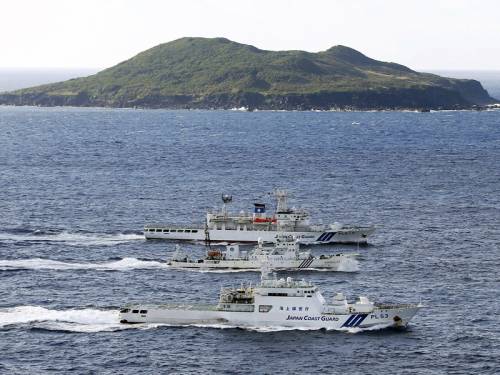
A ministry official told a press conference that two J-10 fighters flew to the area on Thursday to monitor two Japanese F-15 fighters that had trailed a Chinese Y-8 aircraft, China's official Xinhua news agency said.
The comments came after Japanese media reported Tokyo had scrambled fighter jets to head off an unspecified number of Chinese military planes near islands at the centre of an increasingly tense maritime row.
The two countries are at odds over the small, uninhabited islands controlled by Tokyo as the Senkakus but claimed by Beijing, which calls them Diaoyu.
The Beijing defence ministry official said that Japanese military planes have been increasingly watching Chinese aircraft and have also extended the areas where they are active, Xinhua reported.
China's military will be on high alert and the country will protect its air defence force, the official said.
Japan's Fuji TV network quoted Tokyo officials as saying that Chinese planes were spotted Thursday on Japanese military radar north of the islands.
The aircraft did not violate territorial airspace over the islands but flew inside Japan's so-called air defence identification zone, the report said.
Tokyo's defence ministry has said that F-15s were sent airborne to head off Chinese state-owned -- but not military -- planes four times in December, including an occasion when Japanese airspace was breached.
They were also mobilised once last week, it said.-Interaksyon (January 12, 2013 9:10PM)
For the second time after 1994, Indonesia will host this year's Asia-Pacific Economic Cooperation (APEC) Summit.
And Indonesia is determined to promote a stronger and a resilient Asia Pacific region, as the locomotive for the world`s economic growth.
Indonesia`s President, Susilo Bambang Yudhoyono, has announced this year`s theme for the summit, "Resilient Asia Pacific, Engine of Global Growth."
According to Indonesia`s Foreign Affairs Ministry`s website, "In 2013, we hope to enhance the region's economic framework. This is an opportunity for Indonesia to exemplify its leadership in the region".
To achieve this objective, Indonesia has set three priorities: attaining the Bogor goals, achieving sustainable growth with equity, and promoting connectivity.
Indonesia will focus on infrastructure investment, SMEs, participation of women in the workforce, the role of farmers, emergency response, green technology, food security, financial inclusion, health and education.
Indonesia believes that these issues will improve the growth and resilience of the region.
Bogor goals
In 1994, Indonesia hosted the APEC Summit in Bogor, West Java, where APEC leaders adopted the Bogor goals, focusing on free and open trade and investment in the Asia Pacific region by 2010 for industrialized economies, and by 2020 for developing economies.
To meet the Bogor goals, APEC focused on three areas: Trade and Investment Liberalization, Business Facilitation, and Economic and Technical Cooperation.
This year, the focus will be on the expansion of trade and investments, and structural reform.
To achieve sustainable growth with equity, the focus will be on the global competitiveness of SMEs, financial inclusion, food security and health.
In his annual speech on January 4, 2013, Indonesia`s Foreign Affairs Minister, Marty Natalegawa, said that by hosting the APEC Summit, Indonesia will reap significant benefits.
"We are confident that APEC, under Indonesia's leadership, will add significant value to the national economic growth and the welfare of its citizens, without ignoring the needs of the international community," said Minister Marty.
This year, Indonesia will have the privilege of setting the agenda of the meeting. In the agenda, Indonesia will include the following topics: increasing the competitiveness of SMEs, food resilience, health, and sustainable marine development (blue economy).
"APEC`s policies are expected to directly or indirectly help improve the welfare of Indonesians as well," he said.
Established in 1989, APEC is a Pacific-rim economic cooperation forum that includes 21 member economies. They are Australia, Brunei Darussalam, Canada, Chile, China, Hong Kong, Indonesia, Japan, Republic of Korea, Malaysia, Mexico, New Zealand, Papua New Guinea, Peru, the Philippines, Russia, Singapore, Chinese Taipei, Thailand, the United States, and Vietnam.
According to Ambassador Yuri O. Thamrin, Director General for Asia Pacific and Africa Affairs, Indonesia's foreign ministry had organized two special events last year: the APEC Symposium on December 6, 2012, and the Informal Senior Officials Meeting (ISOM) of APEC in Jakarta, on December 7, 2012.
During the Informal Senior Officials Meeting, Minister Marty officially introduced the logo of APEC for 2013.
The logo depicts the dynamic process and progress of economic development in the Asia Pacific region. The logo shows bamboo blades, which symbolize resilience, strength and flexibility. When bamboo blades are hit by strong winds, they do not bend. In fact, they return to their original position.
Before Indonesia took over as the host of APEC, Russia was responsible for hosting APEC. The Russian government handed over the responsibility of the host of APEC to Indonesia, at the end of the APEC CEO Summit in Vladivostok, Russia, on September 8, 2012, which was attended by more than 700 CEOs of the largest companies in the Asia-Pacific region.
President Susilo Bambang Yudhoyono, as the next chairman of the APEC Summit, was present at the APEC Summit in Russia. He said Indonesia will invite major businessmen from Asia and the Pacific region to the APEC CEO Forum, which will be held in Bali in October 2013.
"Let us work together to make our region the engine of global growth. I look forward to meeting you in Bali in October 2013," said Yudhoyono, in Vladivostok in 2012.
With Bali preparing for the APEC Summit, a number of infrastructure development and renovation projects are being carried out.
"The expansion project of the Ngurah Rai International Airport and the construction of the Nusa Dua highway are being carried out in Bali," said Drajad H Suseno, spokesperson for PT Jasa Marga Bali Toll.-Interaksyon (January 10, 2013 6:22PM)
School authorities in Vietnam have suspended an eighth-grade student for one year after she posted a parody of a speech by revolutionary leader Ho Chi Minh on Facebook.
State-controlled media said Tuesday that the girl's post used language from a famous speech by Ho Chi Minh in 1946 appealing for resistance against French colonialists.
The post joked about never having to take exams again.
Phap Luat Viet Nam quoted a local official in Quang Nam province as saying the girl had "distorted history and seriously insulted teachers."
The girl said the posting was "just for fun."
Ho Chi Minh is revered in Vietnam for leading the country to independence from French rule.
The current Communist government doesn't allow freedom of speech.-The Philippine Star (January 10, 2013 1;59PM)
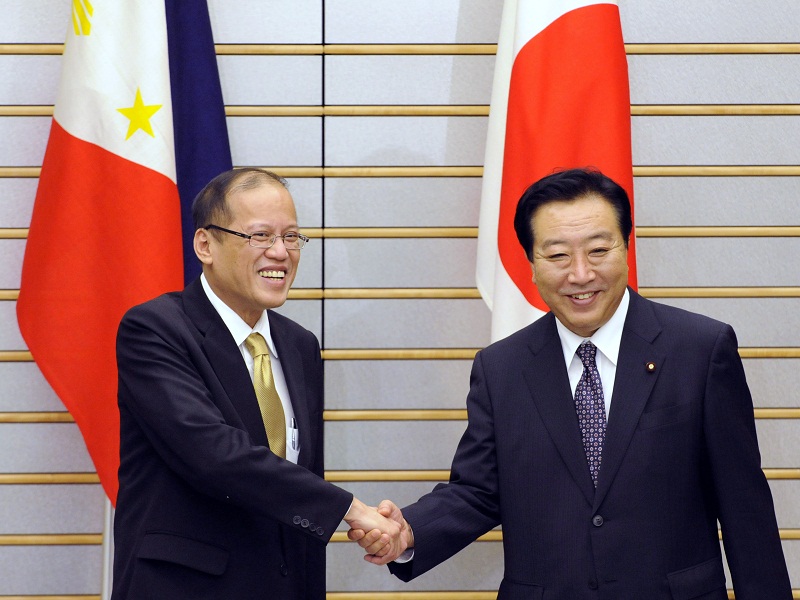
Amid parallel territorial disputes with China, the Philippines and Japan on Thursday started the New Year with the two countries’ foreign affairs chiefs discussing “maritime security” and other issues.
Japanese Foreign Minister Fumio Kishida is in Manila as part of a four-leg tour of Southeast Asia just a couple of weeks after the right-wing government of Japanese Prime Minister Shinzo Abe re-took power after Christmas.
From Manila, Kishida is scheduled to fly to Singapore, Brunei, and then Australia.
Following the meeting, Foreign Affairs Secretary Albert del Rosario said Kishida’s “timely” visit “reaffirms the strategic partnership” between the two countries.
Their talks, he added, bore “productive discussions on various important bilateral as well as regional issues, such as trade, investments, tourism, development assistance, people-to-people exchanges and maritime security and the Mindanao peace process.”
In a statement released to media after the discussion, del Rosario noted that Japan has been helping the country strengthen the capacity of the Philippine Coast Guard in patrolling the country’s long coastline.
Japanese assistance, del Rosario said, also comes in the form of “human resource development and augmentation of much needed communications system equipment for maritime safety.”
Japan’s offer to sell 10 multi-role response vessels “is undergoing serious consideration,” he added.
There is also a regular exchange of views and dialogue between officials of the two countries on maritime and ocean affairs.
In mid-December, shortly before the takeover of the new, more military-oriented Japanese government, del Rosario expressed the view that he supports a stronger Japan as a means to keep the balance of power in Southeast Asia, which is now dominated by overlapping territorial disputes of small countries against a rising China.
Abe advocates a change in his country’s pacifist constitution and seeks to re-arm Japan.
The pacifist Japanese constitution was adopted following its defeat in World War II.
Japan and its Mindanao engagement
While both China and the Philippines bear scars from the Japanese occupation in World War II, Japan and the Philippines have grown in their engagements in various aspects.
Del Rosario thanked Kishida for Japan’s assistance in the Mindanao peace process.
“Since 2006, the Japan-Bangsamoro Initiatives for Reconstruction and Development (J-BIRD) contributed to the peace process through socio-economic infrastructure projects amounting to P5.5 billion,” he noted.
Japan also participates in the International Monitoring Team (IMT) in rehabilitation efforts, humanitarian assistance and in monitoring the ceasefire and in the International Contact Group (ICG) as an observer in the peace talks.
Del Rosario noted that Japan is the only country that is a member of both the IMT and ICG in the Mindanao peace process.
On JPEPA, disaster assistance, tourism, etc.
While he recognized that the Japan-Philippines Economic Partnership Agreement remains the Philippines’ first and only bilateral Free Trade Agreement, del Rosario expressed the “hope that our two governments would continue exploring both short-term and long-term solutions to help Filipino healthcare workers to be accepted by Japanese healthcare institutions.”
Filipino nurses and other healthcare providers need to take Japanese language courses and pass Japanese language tests before they are allowed to work in Japan. The Philippine government sees Japan, with its ageing population, as a huge potential market for Filipino healthcare professionals.
On disaster assistance, Japan has consistently provided emergency relief goods worth some P21 million and extended emergency grant aid amounting to P171 million for a response action plan for recovery through various United Nations agencies. Japanese local governments, private corporations, and non-profit organizations have also extended cash donations and pledges amounting to P11.5 million.
Japan is the Philippines’ number one trade partner with total trade exceeding US$13 billion last year. It also remains as the Philippines’ top export market for 2012.
Del Rosario said Japan has been the Philippines’ number one source of approved investments since 2009 with approved investments reaching P22.35 billion in the first half of 2012 alone.
“The Philippines is also looking into possible collaboration in the promotion of investments with Japanese small and medium scale enterprises (SMEs),” he said.
On foreign aid and soft loans, Japan remains the country’s number one source of development assistance.
“Thus, the Philippines looks forward to stronger cooperation with Japan in developing our country’s infrastructure particularly in the transportation sector,” del Rosario said.
On tourism, Japan ranks third in tourist arrivals, as there were 375,248 Japanese tourist arrivals between January and November 2012. -Interaksyon (January 10, 2013 11:59AM)
It might not be long before China is declared out.
Department of Foreign Affairs Secretary Albert del Rosario on Thursday said that China has committed three strikes against the Philippines and other claimant nations of disputed territories in the West Philippine Sea, and the Philippines continues to be vigilant against any more.
In a Palace briefing following Japanese Foreign Minister Fumio Kishida's courtesy call on President Aquino, Del Rosario enumerated a laundry list of violations committed by China against international law, the first being is its excessive claims in the South China Sea.
Three strikes
"If you look at the posture of China in the South China Sea, their fixed posture is they have indisputable sovereignty over nearly all of the South China Sea. Now, this of course is an excessive claim. It’s in violation of international law—strike one," Del Rosario said.
Strike two, said Rosario, is China’s insistence about governing these disputed territories, in particular the establishment of Sansha City on Yongxing Island.
In order to be able to reinforce [their sovereignty], what they’ve done is that they have called for a reestablishment of an administrative unit to oversee the entire area which they consider as the nine-dash," Del Rosario said.
"[We’re] talking about Sansha City being in the Paracels and the administrative unit [encompassing] Macclesfield Bank, which also includes the Bajo de Masinloc," he added.
Lastly, Del Rosario cited the recent controversial law passed by China that will allow Chinese troops to board foreign ships that will ply the route of disputed territories, potentially causing adverse effects on freedom of navigation.
"Then they come up with this new law which provides for enforcement in terms of interdiction of ships in those areas. So strike three already," Del Rosario said.
Additionally, Del Rosario cited China’s insistence of building infrastructure and budget allocations as more proof of China’s belligerence in the face of the territorial disputes.
"And then, of course, they’re coming up with all kinds of infrastructure and releasing figures on budgets that they intend to use to be able to establish their presence there. So I think these are all very threatening and we have been protesting these moves by China," Del Rosario said.
Both China and the Philippines—as well Taiwan, Malaysia, Brunei and Vietnam—are locked in a dispute over ownership of the Spratly Islands, a chain of islands and islets believed to be rich in oil and minerals deposits, in the West Philippine Sea. Japan, on the other hand, claims the Senkaku Islands, which China also asserts ownership over.
Last year, China issued new passports that depicted the disputed areas in the West Philippine Sea as being part of its territory—a move that angered the Philippines and other claimants to the territories.
PHL-Japan cooperation
Yet despite these complaints, Del Rosario did not specify any actions moving forward to assert the Philippine claim over disputed territories, but instead stuck to the party line of a desire for a "peaceful resolution" over the disputes.
"I think there’s a mutual agreement that we should pursue peaceful resolution to these disputes and we’re trying to find out what the right formulation is," he said when asked if the Philippine government and Japan have agreed upon anything to resolve China’s continuing assertions.
Instead, the Foreign Secretary said the Philippines and Japan continue to work towards a speedy resolution of the disputes, for the benefit of all parties concerned.
"Well, I think what we agreed [that] because we do have this threat and this threat actually is shared by many countries not just with Japan, we should continue to talk and see to what extent and cooperate in terms of coming to a peaceful resolution of the disputes," Del Rosario said.
However, he consented to say that in discussions with Kishida, the Philippines pushed for a three-pronged approach when dealing with China.
"In the bilateral discussions that the ambassador and the Foreign Minister and I had, I explained the three-tracked approach which is the political, [the] diplomatic, and the legal," he said.
Del Rosario also reported that Japan and the Philippines will heighten cooperation toward maritime safety, particularly in patrolling disputed waters.
"I think we’re already receiving a significant measure of assistance and support from Japan in terms of capacity building for the Coast Guard. I’m referring to the Coast Guard capacity building in terms of training and, as I said, we have this communication system that Japan will be funding that will provide for a greater maritime safety element as far as the Coast Guard is concerned," he said.
The support comes in the form of a grant, Del Rosario explained, which will be used to develop 10 multirole response vessels.
"We also discussed the maritime security and we discussed assistance to the [Philippine] Coast Guard in terms of its multirole response vessels which is being funded by the Japanese government," he said. The patrol ships will be ready in about 18 months, Del Rosario added.
Other than assistance in terms of procuring new patrol ships, Del Rosario also said Japan has pledged support for LRT extension projects, as well as the development of a new Bohol airport.
"In the hands of the Japanese government are already the LRT-1 South, that goes to Cavite and LRT-2 East, that goes to Antipolo. These are extensions. In addition to that, we have the new Bohol airport," he said.-GMA News (December 10, 2013 6:11PM)
The Philippines has expressed its concern for the fate of the missing Lao national who won the 2005 Ramon Magsaysay Award for community development, Foreign Affairs Secretary Albert del Rosario said Wednesday.
However, there has been no feedback from the Lao government on what happened to Sombath Somphone, who has been missing since December 15, 2012, del Rosario said in a news conference.
The Philippines, a founding member of the ASEAN, is considered a leading force in the 10-member Association of Southeast Asian Nations. It joined the United States, the European Union (EU), and the United Nations Office of the High Commissioner for Human Rights (UN OHCHR) in expressing concern over Sombath’s disappearance.
The Philippines recently enacted the Anti-Desaparecidos Act, indicating its strong position against government-sanctioned human rights violations, particularly involuntary disappearance.
Sombath, 62, is a much-respected development worker both inside and outside Laos. He was recently at the forefront in organizing the successful Asia-Europe People’s Forum that preceded the Asia-Europe Meeting of state leaders.
He was last seen by his wife on Dec. 15, leaving their office in Vientiane. A CCTV footage showed that his vehicle was later stopped at a police post; a little bit later, he was being driven away with two unidentified persons.
The Lao government has officially released a statement that it does not have Sombath in custody, and even speculated that Sombath might have been kidnapped for personal or business reasons.
Laos is a one-party communist state which exerts total control over the media and does not tolerate criticism of its institutions.
Sombath won the 2005 Ramon Magsaysay Award for Community Leadership for his work in poverty reduction and sustainable development in a country that remains one of Southeast Asia's poorest nations.-Interaksyon (January 09, 2013 5:09PM)
The Philippines has asked China to explain its deployment of a patrol ship to guard disputed territory it claims in the South China Sea, saying the move has sparked new tensions over the potentially oil-rich waters, Foreign Secretary Albert del Rosario said Wednesday. Del Rosario said Chinese diplomats have previously said that Beijing will only assert its claims, including by possibly intercepting foreign ships, in waters off its southernmost province of Hainan. But China also claims that most of the South China Sea falls under Hainan's jurisdiction, he said.
The Philippines has asked China to specify the limits of the territory it will guard, del Rosario said.
"Everybody's hot and bothered," del Rosario told reporters. "That's why we're saying, define, please define for us, but they're not answering."
The Chinese patrol ship, equipped with a helipad, left the southern city of Haikou for the South China Sea on Dec. 27, China's official Xinhua News Agency reported late last month.
Chinese officials established last year what they called Sansha city on a remote island 350 kilometers (220 miles) from Hainan to administer hundreds of thousands of square miles (kilometers) of offshore territory and islands that are also claimed by Brunei, Malaysia, the Philippines, Taiwan and Vietnam. Sansha is administered by Hainan.
The Philippines, a U.S. treaty ally, has described China's move as unacceptable. Vietnam called it a violation of international law. Washington has also criticized China's formal establishment of Sansha city and a military garrison there, saying the move risked an escalation in tensions.
Although China and the Philippines have taken steps to patch up relations that were strained by the territorial disputes last year, del Rosario said Manila has not changed its policy of pursuing its claims. The Philippines, he said, will continue raising the issue with other countries, a move rejected by China, which wants to resolve the disputes through bilateral negotiations with each of the claimant countries.
Del Rosario said he will discuss the territorial rifts with his Japanese counterpart, Fumio Kishida, when they meet in Manila on Thursday. Japan's own territorial feud with China has flared recently.
Newly elected Japanese Prime Minister Shinzo Abe has said he would support a reinterpretation of Japan's pacifist postwar constitution to loosen the reins on the military and stand up to Beijing over the territorial dispute. Asked to comment on the possibility of a stronger Japan in Asia, del Rosario welcomed it.
"I think that there is a view that a stronger Japan would be a balancing force and could contribute in a great way to stability in the region," del Rosario said.
He said there also are plans for Brunei, Malaysia the Philippines and Vietnam, which are all members of the Association of Southeast Asian Nations, to discuss the disputes on the sidelines of an annual meeting of the 10-nation bloc in Brunei this year.
Del Rosario said the Philippines is considering developing islands it controls in disputed South China Sea areas into tourism destinations, but added that he was not aware of the details of the plan.
Many fear the territorial disputes could spark Asia's next armed conflict.-The Philippine Star (January 09, 2013 8:12PM)
Merrill Lynch (BofA-ML) said the Philippines may likely attain investment grade status this year as its strong economic growth and better finances make it more attractive and less risky for those who would place their bets on the country.
In its outlook, the investment bank said the country's improving balance sheet, large current account surplus and falling public debt ratios will likely earn it the credit rating upgrade this year.
In addition to its better finances, the Philippines' strong growth in recent years has not been accompanied by a sharp rise in household debt or domestic credit, BofA-ML said.
The Philippines is rated just a notch below investment grade by the world's top three credit rating agencies, namely Fitch Ratings, Moody's Investors Service and Standard and Poor's Ratings Services.
Last month, S&P revised its outlook on the Philippines from stable to positive, signaling a possible upgrade in the actual rating.
A rating upgrade means the cost of borrowing, especially from foreigners, would fall given the improvement in the Philippines' risk profile.
This would also benefit big companies that borrow abroad since the sovereign rating is a factor that determines their debt scores as well.
First Metro Investment Corp on Monday said the Philippines' success in retiring old and more expensive debt or extending maturities of its existing obligations would likely earn for the country a credit upgrade this year.
BofA-ML said the Philippines' plan to extend the duration and retire bonds has "helped underpin investor interest." This is evident in the country's liquid debt papers maturing in years 2021, 2026, 2034 and 2037. The interest rates of these bonds have already tightened by 3-9 basis points, slightly more than that of Indonesia's, considered another investors' darling.-Interaksyon (January 08, 2013 3:46PM)
In any casino, the odds favour the house. Using its house edge, Singapore is seeking to maximize economic profits and minimize social costs with tighter rules and tougher fines for two casino operators, along with new steps to curb problem gambling.
The wealthy and regimented city-state has enjoyed a windfall of tourism, jobs and revenue since Las Vegas Sands Corp and Genting Singapore Plc opened casino complexes in 2010, in part by linking their licences to how well they develop attractions that are not related to gambling.
Under that mandate, the two operators have added theme parks, museums, theatres and high-end hotels, boutiques and restaurants to Singapore's landscape as the Asian business hub recasts itself as a global city and oasis for the rich.
Amendments to the Casino Control Act cleared parliament late last year and now await formal passage into law, giving the operators of Marina Bay Sands and Resorts World Sentosa little choice but to adapt to the new rules - including fines of up to 10 percent of gaming revenue - and the costs of compliance.
"It is timely that the legislation be reviewed and further tweaks be made to ensure that the objectives of setting up the integrated resorts are achieved," said Yap Wai Ming, a partner at Stamford Law Corp who tracks casino regulation. "They have already invested billions of dollars and the casinos are still generating very healthy profits despite the enforcement actions."
Marina Bay Sands declined to comment on Singapore's new rules and a spokeswoman did not respond to another query about the prospects for its non-gaming business.
Lim Kok Thay, chairman of Genting Bhd, said last month he expects tourists to play a big part in Resorts World Sentosa's growth and its non-gambling business to continue to do better than the gaming side that brings in the bulk of revenues.
SOCIAL COST?
Although casino takings have dipped as some of the novelty wears off on a small island of 5.3 million people, earnings at both resorts likely topped $1 billion last year as visitors poured in from China, Indonesia, Malaysia and further afield.
But there are rumblings about social ills. Some lawmakers question whether Singapore really needs casinos and counsellors say they see more people who cannot control their betting.
For Jimmy, the opening of the two all-hours casinos pulled him back into a gambling addiction he had managed to keep in check for 14 years, sending his world crashing down with losses of S$250,000 ($203,000) over 13 months at the Baccarat tables.
"Casinos did bring more jobs, more visibility for Singapore, more economic benefits," said the education professional, who is now free of debt and in counselling. "Yet it's also undeniably true that the undercurrents behind these benefits are there too - broken families and ruined lives and the increased social costs that come with it."
FINES AND BANS
Lee Kuan Yew, Singapore's founding leader and influential elder statesman, resisted casinos for decades. He finally relented, he told National Geographic magazine in 2009, when younger colleagues said "we must have a casino, otherwise we are out of the circuit of this fast set that goes around the world."
The government, which makes citizens and permanent residents pay a casino entry levy of S$100 a day or S$2,000 for an annual pass as part of efforts to deter problem gambling, shows no sign of abandoning its support for the two resorts.
But Las Vegas Sands and Genting Singapore could see fewer locals in their casinos under the new rules and risk much costlier punishments for breaking them.
The operators, which have been fined for admitting minors and failing to collect the levy for the government, will face a maximum penalty of 10 percent of annual gross gaming revenue. The current cap on fines is S$1 million but, if fully enforced, the new ceiling could be closer to S$200 million.
A panel will also be set up by the trade ministry to help the Casino Regulatory Authority determine how attractive the resorts are as tourist destinations - an assessment that will apply to the renewal of their casino licences from January 2015.
"Protecting vulnerable groups and the society at large from the harm of casino gambling is another priority," S. Iswaran, Singapore's second minister for trade, said in October.
For those deemed to be at risk, the new rules include a monthly limit on casino visits to bolster existing safeguards.
Under a programme now run by the National Council on Problem Gambling, more than 85,000 people have banned themselves from the casinos and nearly 1,300 more were excluded at the request of family members, the latest data shows. Another 43,000 people who are bankrupt or get state aid are automatically banned.
Singapore's "archaic and outdated" rules on Internet betting are a future target for changes, said Yap at Stamford Law. "Problem gambling and massive tax leakages and lack of visibility continue to pervade this sector," he said.
"This is a space to watch."
GLOBAL APPEAL
For Genting Singapore, gaming revenues at Resorts World Sentosa fell 15 percent in the first nine months of last year from the same period of 2011. Analysts have cut earnings estimates and downgraded the stock.
Third-quarter casino revenues at Marina Bay Sands fell nearly 30 percent, Las Vegas Sands said. Still, the Singapore casino had a gross profit margin above 40 percent - higher than any of the company's U.S. and Macau properties.
Despite the tougher climate, the money rolls in.
"The domestic market is the one that gives you the adrenaline rush when it first opens, but it will be sustained by inflow from the foreign players," said Genting's Lim.
"As we open more facilities, that will give us an edge in marketing overseas and in telling the world we are not just a gaming resort, but we have other things for families to do. It does help us in our gaming revenue."-ABS-CBN News (January 08, 2013 6:09PM)
A Chinese amphibious warfare ship has been making its presence felt in the contested Spratly archipelago in a bid by Beijing to continuously expand naval dominance over the region, according to a local official in Kalayaan Island.
Mayor Eugenio Bito-onon Jr. took photos of China’s amphibious warship, believed to be laden not only with amphibious landing tanks but also Chinese marines.
The warship is among six combat ships Beijing has reportedly maintained in the region to press its territorial claim over almost the entire West Philippine Sea (South China Sea), some areas of which are also being claimed by the Philippines, Vietnam, Taiwan, Malaysia and Brunei.
China has also assembled an array of modern warships in the island province of Hainan and in mainland Guangzhou intended for the People’s Liberation Army (PLA) naval operations in the South China Sea.
“The hard fact is that China has been continuously expanding its naval dominance in the region, occupying and developing unoccupied islands in the region. I think they have already occupied three-fourths of the entire Spratlys region,” Bito-onon said in an earlier interview.
In October last year, a Kalayaan Island four-boat convoy was harassed twice by a Chinese amphibious warfare ship while transporting supplies from Palawan to Pag-Asa island, one of the country’s regime of islands and reefs in the region.-The Philippine Star (January 13, 2013 12:00AM)
Japan will raise military spending this year for the first time in over a decade under a ruling party plan, an official said, as Tokyo summoned Beijing's envoy amid a territorial row.
The national defence task force of the newly-elected Liberal Democratic Party will increase the defence budget request by more than 100 billion yen ($1.15 billion) in response to an emboldened China, a party official told AFP.
The relatively small amount -- just over two percent of the total military budget -- is largely symbolic, but reflects anxiety at what Japan sees as an increasingly hostile region in which China appears happy to throw its weight about.
"We have decided that the additional budget will be used for research into a new radar system as well as fuel and other maintenance costs for early-warning aircraft," the official said on condition of anonymity.
The news came as the foreign ministry called in China's ambassador to protest at the latest dispatch of official vessels into waters around the Tokyo-controlled Senkaku islands, which Beijing claims as the Diaoyus.
The summons was the first under nationalistic Prime Minister Shinzo Abe, and reflects the tough line he pushed on China on the campaign trail in December.
Nerves are also rattled by an unpredictable North Korea. It sent a rocket over Japan's southern islands last month in what it insisted was a satellite launch, but Tokyo and its allies said was a covert ballistic missile test.
The military is bound by the country's US-imposed pacifist constitution, which restricts its ability to project power or to wage aggressive war. However, commentators say it is a modern, well-funded and well-equipped force.
In the run-up to last month's election, the LDP pledged to expand the number of personnel in the Self-Defence Forces and boost their equipment and spending power.
The proposed increase in funding comes after declines over 10 consecutive years as Tokyo grappled with its huge public debt.
The initial defence budget for fiscal 2012, which ends in March, stood at 4.65 trillion yen. This compares with a budget for fiscal 2002 that peaked at 4.94 trillion yen.
Defence Minister Itsunori Onodera has said Abe's government will review Japan's long-term basic defence programme, adopted in 2010 under the Democratic Party of Japan which was routed at the polls.
The current programme includes plans to trim troop numbers by around 1,000.
Kazuhiko Togo, director at the Institute for World Affairs of Kyoto Sangyo University, said the planned rise in defence spending was a direct result of China's more hostile attitude, specifically over the disputed islands.
"China has publicly said it would seize the islands by force if necessary and acted as such. To avoid a possible armed clash, Japan has no choice but to possess deterrence by boosting its defence budget," he said.
"But at the same time, Japan needs to have dialogue to achieve its diplomatic goal. Deterrence and dialogue are two halves of the same circle," he added.
Abe has pledged to improve ties with key ally the United States and other democracies in the region, including Australia and India, as a counterbalance to China.
The United States stations some 47,000 troops in the world's third-largest economy in a legacy from World War II, after which Japan was stripped of its right to maintain a full-fledged military.
The alliance enjoys broad support among Japanese leaders but tensions have repeatedly flared with communities that host US bases, particularly on Okinawa.
A rise in defence spending will likely be welcomed in Washington, which has called for Tokyo to shoulder more of the burden of regional security.
However, any attempt to reinforce Japan's military has traditionally aroused suspicion in countries like China and the two Koreas that fell victim to its wartime rampage.
Domestically, the pacifism policy enjoys widespread support.-Google News (January 08, 2013 8:38PM)
Indonesian police on Monday said they are investigating an advertisement offering two babies for sale at $1,000 each after it was spotted on the popular auction and shopping website Tokobagus.com.
"We are still investigating the existence of the online advertisement," Jakarta police spokesman Rikwanto told reporters.
"We have asked Tokobagus how the advertisement came to be posted, for how long, and whether any transaction was made," he added.
The National Commission for Child Protection lodged a police report last week after spotting the posting, its chairman Arist Merdeka Sirait told AFP.
"There was a photo of a baby and a telephone number. We called the advertiser and he said he wanted to sell two 18-month-olds, a boy and a girl, for Rp 10 million ($1,000) each," Sirait said.
"We were negotiating, talking about birth certificates when he suddenly hanged up. We tried contacting him again but failed," he added.
"This seems to be a new modus operandi by baby-selling syndicates. We are very concerned and must stop this crime against humanity," Sirait said, adding that human-traffickers could be jailed from 15 to 20 years.
Tokobagus posted an apology on Twitter, saying the advertisement was a result of "pure human error and was unintentional" and had been removed.
Indonesians have been using local auction and shopping sites to sell anything from cars and jewellery to body organs such as kidneys, exploiting a loophole in local laws.
Hundreds of advertisements have appeared on Indonesian personal advertising websites offering kidneys for as little as 50 million rupiah each.-ABS-CBN News (January 10, 2013 10:42AM)
China on Monday said that it opposed "violations" of its territory in response to the Philippines' recent plans to build a new airport along the disputed Spratly Islands in the sensitive South China Sea.
Media reports said the government will begin developing infrastructure projects on Philippines-controlled Pag-asa (Thithu) island. Among the scheduled construction projects is that of an international airport.
"China has indisputable sovereignty over the Nansha Islands. China opposes all actions that violate its sovereignty. We hope that relevant countries can effectively abide by the Declaration on the Conduct of Parties in the South China Sea, and do not take actions that will complicate or escalate the problem," Chinese Foreign Ministry spokesman Hong Lei told a daily news conference in Beijing.
The island is part of what are called the Spratly Islands in the Philippines, and Nansha in China.
Claims by an increasingly powerful China over most of the South China Sea have set it directly against U.S. allies Vietnam and the Philippines.
Brunei, Taiwan and Malaysia also claim parts of the mineral-rich waters.-ABS-CBN News (January 07, 2013 8:38PM)
An Algerian computer hacker wanted by the FBI for allegedly stealing millions of dollars from American banks to fund a lavish lifestyle has been arrested in Bangkok, Thai police said Monday.
Hamza Bendelladj, 24, appeared unruffled by his looming extradition to the United States as he was paraded before the media in handcuffs with a beaming smile.
"When asked what he did with the money, he said he spent it on travelling and a luxurious life like flying first class and staying in luxury places," Immigration Police chief Phanu Kerdlabphol told reporters.
The FBI has been tracing the computer science graduate for three years after he began hacking into US banks at the age of 20, Phanu said.
"He said he had hacked several US banks and once he hacked a bank with a transaction of 10 million dollars," he added.
Bendelladj was detained at Bangkok's Suvarnabhumi airport on Sunday after arriving from Malaysia for a connecting flight to Cairo.-ABS-CBN News (January 07, 2013 9:20PM)
The Asia Pacific Solidarity Council (APSC) asked on Monday, January 8, for the Association on Southeast Asian Nations (ASEAN) to put more pressure on Myanmar to end its airstrikes against rebels in the northern Kachin state.
“As this situation unfolds into a humanitarian crisis, the ASEAN governments are obliged under its own Charter and international laws to address systematic human rights violations,” the ASPC said in a statement.
The human rights group claimed that at least 300 people were killed in the latest airstrike by the Myanmar military in an area where around 75,000 residents have been displaced since 2011.
ASPC called on ASEAN governments to join the international community in telling the Naypidaw government that "further military action that would only intensify the conflict and result to widespread human rights abuses" in the country.
The regional bloc should also demand the "unimpeded flow of humanitarian assistance to the internally displaced peoples caused by the conflict.”
Ethnic conflict
Myanmar has been facing growing international pressure to halt air attacks on ethnic minority rebels in Kachin state, where an escalating conflict has overshadowed wider political reforms.
Fighting between the military and the armed wing of the Kachin Independence Organization (KIO) in the far north of the country also known as Burma has worsened in recent days as the army battled to regain one of its bases.
Tens of thousands of people have been displaced in the state of Kachin since June 2011, when a 17-year ceasefire between the government and the Kachin Independence Army broke down.
After decades of military rule, Myanmar's new quasi-civilian government has reached tentative ceasefires with most of the other major ethnic rebel groups, but several rounds of talks with the Kachin have shown little tangible progress.
The fighting has persisted despite President and former general Thein Sein's order a year ago for the military to halt offensives against ethnic minority rebels, raising questions about his government's control of the armed forces, and the UN recently asked to stop blocking aid to the displaced people in rebel-held territory.
ASPC stressed that while individual ASEAN member countries have voiced concern on the reported abuses in Myanmar, the regional bloc itself has not taken a unified stand due to its "non-interference policy."-Rappler (January 07, 2013 5:27PM)
Four Chinese government ships entered territorial waters around Japan-controlled islands at the centre of a dispute Monday, January 7.
The marine surveillance ships were seen moving within 12 nautical miles of the islands, known as the Senkakus in Japan and the Diaoyus in China, just before midday, Japan's coastguard said in a statement.
They were still inside the zone at 7 pm (1000 GMT), with Japanese patrol boat crews telling the Chinese ships to leave the waters, a coastguard official said.
Japan's foreign ministry lodged a protest with the Chinese embassy in Tokyo over the incident by telephone, a ministry official said.
In Beijing, China's State Oceanic Administration said the four ships "continued to patrol territorial waters off China's Diaoyu Islands", according to the state-run Xinhua news agency.
It was the first time since December 31 -- and the 21st time since Japan nationalised the islands in September -- that any state-owned Chinese ship has been seen in the archipelago's waters, which lie in the East China Sea.
A state-owned Chinese plane flew through airspace over the islands early last month. Tokyo responded by scrambling fighter jets and said it was the first time Beijing had breached its airspace since at least 1958.
On Saturday, another Chinese state-owned plane approached the islands without entering the airspace, prompting another Japanese fighter jet dispatch.-Rappler (January 07, 2013 7:00PM)
The Philippines and China may forge ahead with the joint exploration of oil and gas reserves in the West Philippine Sea, which the latter calls the South China Sea, even as their leaders continue to squabble over boundaries.
Chinese Ambassador to the Philippines Ma Keqing made this suggestion as she said these resources could remain idle for a very long time if the Philippines and China waited for a final resolution of their territorial dispute before engaging in any commercial development in the area.
In an interview with the Philippine Daily Inquirer editorial team last month, Ma said the Philippines and China should allow oil and gas prospectors-China National Offshore Oil Corp. (CNOOC) and the Forum Energy-led consortium of businessmen Manuel V. Pangilinan and Enrique Razon Jr.-to strike a deal to confirm and maximise the oil and gas potential of Recto Bank off the coast of Palawan province.
Estimates showed that the Recto Bank prospect has potential reserves of 3.4-trillion cubic feet of gas and 440 million barrels of oil that would make this a bigger find than the Malampaya gas field, also off Palawan.
"I think they (Forum Energy) are now discussing a joint cooperation with China. It's a very positive sign. Why not let two companies discuss the cooperation? I think cooperation will be the best way," Ma said.
Joint understanding
The Chinese ambassador took note of "previous proposals to shelve sovereignty disputes and pursue joint cooperation," referring to the Joint Maritime Seismic Understanding (JMSU) that the Arroyo administration initiated in 2005.
Under the JMSU, the three signatories-CNOOC, Petron Corp. of the Philippines and Vietnam Oil and Gas Corp. (PetroVietnam)-agreed to explore for three years the potential for oil in the disputed waters among the three countries.
The arrangement was criticised as unconstitutional for failing to comply with the 40-per cent foreign ownership limit on join exploration deals involving natural resources of the Philippines.
Formula valid
"I think it is still a very valid formula pending the solution of the disputes. We can have cooperation with each other to [explore] the resources because we cannot see in the near future... that we can solve all the disputes," the Chinese ambassador said.
Ma said the disputes over sovereignty and territorial integrity were very sensitive matters.
"We must be very, very careful when talking about the territorial issues or disputes, that's why. Why not shelve the issues and talk about cooperation?" she said.
Bigger picture
Ma said that in this era of globalisation, the interests of China and those of other countries in the region were intertwined.
"China's interests are interconnected with its neighbours' and other countries' at large. I think that is the bigger picture. If we want to seize opportunities [and] not lose time, we should get along with each other," she said.
In a text message, Pangilinan, chairman of Philex Mining Corp., concurred with the views of Ma to explore Recto Bank. But he said he must face the "political reality" involved in any Recto Bank find.
"I must say that the Chinese position, as articulated by the current Chinese Ambassador Ma and by [its] past ambassadors, has, as far as I know, been consistent in respect of the dual sovereignty or commercial aspects of the potential oil and gas resources in the West Philippine Sea. That's the same stance CNOOC conveyed to us last year," he said in a text message.
"As businessmen, we can only respond appropriately to one side of that duality-the commercial one. That's a course we would like to pursue keenly, purely as a commercial matter. After all, if there is nothing out there under the seas, what is there to quibble and quarrel about?" he said.
Pangilinan added: "We appreciate that we cannot abstract from the political realities obtaining and, since we're only a contractor to-not owner of-those potential resources, we must respect and work within the political guidelines and rules."
In a text message, Razon, chairman of International Container Terminal Services Inc., said that reaching a "commercial solution" first between the Philippines and China was possible while the territorial dispute remained unresolved.
Negotiate profit sharing
Razon said the parties could negotiate on profit sharing and royalties from any oil and gas find that would be agreeable to both the Philippine and Chinese governments. He suggested that drilling rigs be provided by operators from third-party countries.
Pangilinan and Razon are the joint holders of Service Contract No. 72, the state-granted exploration franchise that covers 80,000 hectares in Recto Bank. The bank falls within the 330-kilometre exclusive economic zone (EEZ) under the Philippine Archipelagic Baselines Law.
Pangilinan's Philex Mining, though its subsidiaries FEC Resources Inc. and Philex Petroleum, owns a controlling 64.45 per cent of Forum Energy Plc, which holds 70 per cent of SC 72. The remaining 30 per cent of SC 72 is owned by Razon's Monte Oro Resources and Energy Inc.
Pangilinan met with CNOCC officials last year for a possible tie-up but Razon said Monte Oro was not too keen on getting a Chinese partner for its share in SC 72.
President Aquino is adamant that all royalties go to the Philippines because Recto Bank is clearly inside the Philippine EEZ, being 150 km off Palawan while Hainan, the nearest Chinese territory, is 570 km away.
Forum was scheduled in October last year to check the soil stability in the area in preparation for an appraisal well drilling in the first or second quarter of this year. But the Department of Energy refused to give Forum the go-signal pending the resolution of the territorial dispute with China.-Asia News Network (January 07, 2013)
The Philippines yesterday expressed its full support for Brunei as the Asean Chair and reaffirmed its commitment to work with Asean member states to strengthen peace, stability and growth in the region.
The Ministry of Foreign Affairs had on Wednesday [January 2] announced that Brunei's top agenda as Asean Chair was to come to a political solution to the ongoing territorial dispute in the South China Sea.
Philippines Ambassador, Nestor Z Ochoa in an email to The Brunei Times said maritime security and cooperation were necessary to ensure freedom of navigation, combat piracy, and maintain peace and stability in the region.
"The Philippines fully supports Brunei as Asean Chair and reaffirms its commitment to work with Asean member states in strengthening the region's stability and security, economic growth, social progress, and cultural development," the ambassador said.
"Brunei shall likely build on Asean's accomplishments in previous years [where are we now?], be guided by the vision of an Asean community [where do we want to go?], and pursue its priorities as Asean Chair based on internal and external considerations ['how do we get there?']," he said.
The Chair shall also be able to benefit from the Asean Secretariat's institutional memory and advice on matters such as Asean's unfinished business, he added.
"We hope that Asean and its regional partners are able to find ways to effectively implement the Six-Point Principles on the South China Sea, which shall highlight the fruits of constructive dialogue, strengthen Asean's resolve, and respect for international law such as United Nations Convention on the Law of the Sea; one such initiative in support of these principles is the drafting of a Code of Conduct on the South China Sea, as called for in the Declaration on the Conduct of Parties in the South China Sea [2002]," he said.
Another priority will be to carry out activities of the Asean Intergovernmental Commission on Human Rights, a consultative body established in 2009 to promote regional co-operation on human rights.
"The Philippines looks forward to the implementation of instruments for the protection and promotion of the rights of migrant workers and their families, and for combating trafficking in persons," Ochoa said.
One of Brunei's primary economic objectives during its tenure will also to support negotiations for the Regional Comprehensive Economic Partnership — a free trade pact encompassing Asean, Australia, China, India, Japan, South Korea and New Zealand.
The Sultanate also aims to promote inter-Asean trade and lower the cost of doing business in Southeast Asia.
Ochoa said, "The Philippines is confident that with the declaration of 2013 as 'Asean Small to Medium Enterprises (SME) Year,' Asean can further promote SMEs as effective engines for inclusiveness and hence benefit Asean peoples."
Asean Community
Asean is right on track in achieving one community by 2015.
Connectivity remains a priority for Asean in 2013 onwards given that it is a vital building block in realising the Asean Community by 2015, the ambassador said.
"Asean will give equal importance to physical, institutional and people-to-people connectivity initiatives as these three elements of Asean Connectivity, as a whole, will accelerate Asean's community building process," he added.
Ochoa also touched on the importance of sub-regional initiative such as the Brunei Darussalam-Indonesia-Malaysia-Philippines East Asean Growth Area (BIMP-EAGA) in realising Asean's community building goals.
"In BIMP-EAGA, the Philippines is especially pleased with the work done by the sub-regional mechanism, especially in the prospective launching of direct air and sea links, development of Community-Based Ecotourism sites to increase tourist arrivals in the sub-region, and implementation of the sub-region's food basket strategy [agri-business and fisheries development]," he said.
Asean's dialogue partners are an integral part of the community building process through initiatives in the various areas of cooperation within the dialogue partner mechanisms such as the Asean Plus Three APT), Asean Plus One, Asean Regional Forum and East Asia Summit. Some of these initiatives are the signing of the Asean Plus Three Emergency Rice Reserve (APTERR) Agreement, launch of the Regional Comprehensive Economic Partnership negotiations in November 2012, he said.
Asean Spirit
Asked how awareness and understanding of the Asean Spirit and Asean community can be increased among the region's population of more than 600 million, he said Asean member states can best achieve this by communicating the benefits of Asean to their stakeholders to validate and reinforce domestic support for Asean.
"Brunei's theme of 'Our People, Our Future Together' during its chairmanship of Asean in 2013 clearly demonstrates Brunei's commitment towards realising Asean's community building goals and achieving one caring and sharing community by 2015.
"Its emphasis on Asean peoples sharing one future together further shows Brunei's focus not only on continuing Asean's community- building agenda but also on accomplishing the action lines set in the Roadmap for an Asean Community by 2015," the ambassador said.-Asia News Network (January 07, 2013)
With its glossy pages of pouting models and racy romance tips, Myanmar's first sex education magazine has got the usually demure nation hot under the collar as it cashes in on new-found cultural freedom.
"Hyno" has sparked fevered debate since hitting Myanmar's bookstores in November, where it has become a must-read among the young and curious, just a few months after the end of direct censorship in the former junta-ruled nation.
Perhaps tame by western standards, Hyno's photo spreads of semi-clad women and columns espousing "bedroom secrets" and "the benefits of cuddling" -- to the more cryptic "modern lies before marriage" -- have raised eyebrows in conservative Myanmar, earning it an adult-rating.
But its editor brushes off accusations that the monthly publication is too risque for the country, or in any way as salacious as "Playboy" magazine as critics have claimed on Facebook.
"This magazine is a combination of sex education and entertainment," Ko Oo Swe told AFP, saying the red label on the front page warning it is for over 18s has stirred the unfavorable comparisons.
"Issues about sex remain hidden in Myanmar. Our society is becoming more open but I think sex education is still weak," he added.
Hyno -- which translates as "enchant" or "hypnotise" -- is the first magazine of its kind and is proving very popular despite the relatively-expensive $3 cover price at bookstores and street stalls.
Its debut follows the abolition in August of Myanmar's stringent pre-publication censorship which had seen officials scrupulously flag photos or articles deemed distasteful to public morality, as well as stifling dissent.
But since censorship was scrapped, fashion and lifestyle magazines have started to push the boundaries with their content -- so far without sanction.
Hyno has raised the stakes, so much so that some bookshops refuse to stock the magazine, saying its aim is to titillate rather than educate.
Ominously, the Ministry of Information sent a letter to the interim press council registering its unhappiness with the "unethical" lifestyle magazine.
The ministry accuses Hyno of breaching its licence as a fashion publication by printing "sex-related articles and photos that are not appropriate for Myanmar's culture."
"I even saw some comments on the Internet saying how shameless the editor is to print such magazine," said Ko Oo Swe, urging people to avoid criticism until they have read it and seen how he has "stuck to the cultural rules."
Despite the uproar, Hyno's young readers believe it could play a major role in raising awareness of sexually transmitted diseases and, in the longer term, shifting rigid social mores as Myanmar edges out of decades of isolation.
"For those who are quite old-fashioned it (sex education) is a very shameful thing," said Yoon Lae Khin, a 20-year-old student, who is also a volunteer for the Myanmar Medical Association (MMA).
"My mother understands there are things we need to know, but it is difficult to talk about sex in front of my father and siblings. So we need to get this awareness from magazines."
Medical professionals have joined Hyno's corner saying it is high time the country talked about sex.
"Young people do not have enough knowledge so problems such as underage pregnancy, pregnancy before marriage and infection with HIV/AIDS and venereal disease occur," said Khine Soe Win, a project officer for a youth development program with the MMA.
"Old-fashioned people turn their noses up in disapproval" of sex education, he added, criticising them for judging the issue by the yardstick of "a culture they don't understand."
His comments were echoed by Ne Win, a doctor working for the United Nations Population Fund in Myanmar, who believes a modern, progressive media can fill the void left by the nation's reluctance to promote sex education.
"Our activities are not as strong as media coverage which can reach hundreds of readers in a short time," Ne Win said.
While its editor says Hyno is here to stay, a battle is brewing with those who see it as a threat to decency in hitherto modest Myanmar.
Mg Mg Lwin, manager of Innwa Book Store -- one of Yangon's leading bookshops -- refuses to stock Hyno despite fielding a barrage of enquiries, mainly from women, about its availability.
"Even if someone gives me those magazines to sell at my shop, I will not accept them," he said.-ABS-CBN News (January 07, 2013 6:51PM)





.jpg)