The Philippines on Tuesday agreed to apologize for the fatal shooting last week of a fisherman from Taiwan by Filipino coast guard officers.
The agreement was announced hours before an ultimatum from Taiwan for an apology was due to expire at midnight.
Manila agreed to apologize, clarify the truth, punish those held responsible and start early negotiations with Taiwan on a fishery agreement.
But it has not officially agreed to pay compensation for the incident, in which coast guards killed a 65-year-old fisherman on Thursday, Taiwan media reported.
Reports said the Philippines will send Amadeo Perez, chairman and chief executive officer of the Manila Economic and Cultural Office, as an envoy to Taiwan on Wednesday to make a promise on compensation and to visit the victim's family.
Observers said the deal, in which Manila acknowledges its mistakes, can largely satisfy Taiwan's demands and ease public outrage on the island.
On Saturday, Taipei issued a 72-hour ultimatum to the Philippines to make an official apology, or face sanctions including a freeze on sending Filipino workers to the island.
There are about 87,000 Filipino domestic helpers and other workers in Taiwan, who send home hundreds of millions of dollars a year.
Taiwan also sent four coast guard and naval vessels to protect its fishermen in waters near the Philippines at the weekend.
It is unclear whether Taiwan will still conduct a naval drill in the waters where Hung Shih-cheng, skipper of the 15-metric-ton Guang Ta Hsin 28 was shot dead. Taiwan authorities said earlier on Tuesday the decision would depend on the reaction of the Philippine government.
Yang Baoyun, an expert on Southeast Asian studies at Peking University, said the possibility of Taipei staging the exercise still exists, but the scale and intensity might be reduced.
"Under the new circumstances, the military exercise could take the form of routine maritime patrols to account for heightened public sentiment, to better protect fishermen and to further deter the Philippine side," Yang said.
Beijing on Tuesday voiced support for Taiwan, saying it has always firmly safeguarded Taiwan compatriots' security and legitimate rights, Xinhua News Agency reported.
"We hope the Philippines will conduct a thorough investigation into the incident and provide a concrete explanation at an early date," Foreign Ministry spokesman Hong Lei said at a regular news conference.
On Friday, the Philippine Coast Guard admitted the shooting, which left more than 50 bullet holes in the fishing vessel, but insisted it happened within its own waters.
This claim was denied by the victim's son, who was with his father and two other fishermen on the boat at the time, as well as by Taiwan authorities who said the incident happened in an overlapping area of the two sides' exclusive economic zones.
Luo Yuan, deputy secretary-general of the China Military Science Society of the Chinese People's Liberation Army, said the Philippines brutally violated international law.
On Monday, Washington urged all sides "to refrain from provocative actions", while Philippine President Benigno Aquino called for calm, and guaranteed an in-depth investigation into the incident.
On Sunday, Antonio Basilio, resident representative of the Manila Economic and Cultural Office in Taiwan, visited the victim‘s family, and "extended condolences and apologies".
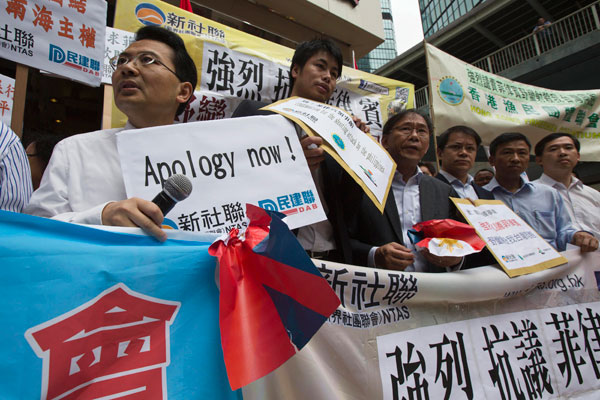
But Taiwan was not satisfied with these actions. Hundreds of fishermen burned Philippine flags, and hurled eggs at the Manila Economic and Cultural Office in Taipei on Monday.
Li Guoqiang, deputy director of the Center for Chinese Borderland History and Geography at the Chinese Academy of Social Sciences, said Manila's response came late, as it was stuck in an "awkward situation".
"The Philippines believed the incident area was within its own territory, so answering Taipei's requests means a retreat from its previous territorial claims; but Manila cannot stay silent as well."
Li also said Manila had tried to play down the incident but strong reactions from Beijing and Taipei made this attempt difficult.-China Daily
A fleet of Chinese boats prepared to fish and a naval patrol conducted drills near disputed islands in the South China Sea, state media reported Tuesday.
State-run broadcaster CCTV said 24 fishing boats arrived Monday, after a 7-day voyage, in waters near the Spratly Islands, which are claimed all or in part by China, Taiwan, Vietnam, Malaysia and the Philippines.
"Tonight we plan to have four fishing ships sent into the water for fishing. For tomorrow we plan (to send) two boats for fishing operations. Of the four boats, two will be deep sea fishing, and the other two will carry out mid-level water fishing," the fleet's supply ship captain Chen Rihai told CCTV on Monday.
More ships are due to join the fleet on Wednesday (May 15), CCTV said, bringing the total number to 32. The fleet plans to fish along the islands over a duration of 40 days.
The South China Sea Naval Fleet conducted firing and boarding drills near the Spratly Islands on Sunday (May 12) as part of routine military patrols, CCTV reported.
The East China Sea Naval Fleet also entered the South China Sea on Monday for drills and patrols near the islands, CCTV said.
The Chinese Foreign Ministry said on Monday that the country would protect the legal rights of its fishermen.
China and some of its Southeast Asian neighbours are embroiled in diplomatic rows over territory in the South China Sea, potentially rich in oil and gas and criss-crossed by crucial shipping lanes.-ABS-CBN News
Taiwan stepped up pressure on Manila Tuesday, May 14, saying it would conduct a naval drill in waters near the Philippines if Manila did not officially apologize for the killing of a Taiwanese fisherman.
Taiwan has demanded the Philippines apologize by midnight Tuesday (1600 GMT) over the killing of the 65-year-old fisherman by coastguards last week or face a potential freeze in sending workers to the island.
The defence ministry said the military was prepared to conduct an exercise in the waters where Hung Shih-cheng of the 15-tonne Guang Ta Hsin 28 was shot Thursday.
"We've prepared ourselves and staging an exercise in the Bashi Channel is one of the military's options," he told AFP.
"Whether or not to conduct the drill would be up to the reaction of the Philippine government."
Taiwan has also asked the Philippines to bring to justice the coastguards responsible and start negotiating a fisheries agreement.
Lo declined to provide details but the state Central News Agency said the exercise would be held Thursday and involved a Kidd-class destroyer, a Perry-class frigate and 3 coastguard frigates.
A number of fighter jets would also be involved in the drill which would for the first time target the Philippines as the enemy, it said.
The incident has sparked public outrage in Taiwan, where hundreds of angry fishermen burned Philippine flags and hurled eggs at Manila's de facto embassy in Taipei Monday.
Taiwan at the weekend sent 4 coastguard and naval vessels to protect its fishermen in waters near the Philippines.
US State Department spokeswoman Jen Psaki has urged all sides "to refrain from provocative actions" while Philippine President Benigno Aquino called for calm and guaranteed an in-depth investigation into the incident.
The Philippine coastguard has admitted firing at one of four Taiwanese fishing vessels it said had strayed into its waters, allegations denied by the victim's son who was with his father and two other sailors on the boat at the time.
Taiwan prosecutor Liu Chia-kai described the incident as "nothing but a slaughter", after examining the boat which he said was hit by more than 50 bullets.
The incident comes at a time of heightened tensions around the region over rival claims to the nearby South China Sea.
China, the Philippines, Taiwan, Vietnam, Malaysia and Brunei all have competing claims to parts of the sea.- Rappler
Japan Tuesday seized a Taiwanese fishing boat inside its exclusive economic zone, the first incident since Tokyo and Taipei signed a fishing rights accord for disputed waters, the Fisheries Agency said.
The Taiwanese fishing boat was spotted in waters near Taketomi island, part of Japan's southern Okinawa chain, the agency said.
One of the agency's patrol ships seized the boat and arrested the captain, it said.
The incident occurred outside the waters that are at the center of a three-way territorial tussle involving Taipei, Tokyo and Beijing for which Japan and Taiwan have agreed fishing rights.
Under the agreement, Taiwanese trawlers are permitted to fish in waters off East China Sea islands controlled by Japan as the Senkakus, but also claimed by China and Taiwan as the Diaoyus.-GMA News
Thailand and Myanmar will sign a deal on May 27 to set up a special purpose vehicle (SPV) to manage the massive Dawei project for a deep seaport and economic zone, said Prime Minister's Office Minister Nivatthamrong Boonsongpaisal.
The signing will take place after a meeting of the Joint High-Level Committee, co-chaired by Myanmar Vice President Nyan Tun and Thai Deputy Prime Minister Kittiratt Na-Ranong, from May 26-28 in Thailand.
Nivatthamrong, who co-chairs the Myanmar-Thai Joint Coordinating Committee, said the Thai government had assigned the Neighbouring Countries Economic Development Cooperation Agency to sign the SPV deal with a state agency under aegis of Myanmar's Ministry of Planning and Economic Development.
Thailand and Myanmar each will hold a 50-per-cent share in the SPV in the initial stage.
He added that Thailand and Myanmar each separately invited Japan to take part in the SPV but Tokyo is expected to take time to consider the case. He expects that in the future the SPV will see two more countries as shareholders besides Thailand and Myanmar. He said the appropriate number of countries taking shares in such an SPV was four to maintain a balance of interests.
The signing of the SPV will show that the project is making progress and will encourage investors to form special purpose companies (SPCs) to invest in specific areas such as roads and the seaport.
Nivatthamrong said Italian-Thai Development had continued construction work on the roads and port.
He added that Myanmar wanted to study Thailand's industrial zones to acquire information on all aspects of the Dawei project, given its size and comprehensive nature. The Thai government has coordinated with relevant state agencies to provide all crucial information to Myanmar.
The Thai state agencies have also prepared key information for potential investors to help them calculate the cost-effectiveness of participating via SPCs.
Many state agencies such as the Industrial Estate Authority of Thailand and the Electricity Generating Authority of Thailand are keen to take part in the project, Nivatthamrong said, adding that PTT might also invest in it.-Asia News Network
Malaysians are more positive on the global and local economic outlook compared to the second half of 2012, according to Ernst & Young's latest bi-annual South-East Asia issue of the Global Capital Confidence Barometre.
The survey, which covered over 1,500 senior executives from large companies around the world across various sectors, also indicated that the Malaysian confidence level was higher than its international peers.
The report showed that 100 per cent of the Malaysian respondents surveyed believed that the global economy was stable or improving compared to 54 per cent six months ago. They felt likewise about the Malaysian economy compared to 77 per cent in the previous survey.
“The majority of respondents expected the country's growth to be within 1 per cent to 5 per cent over the next 12 months, similar to that achieved in 2012,” it said.
Ernst & Young Malaysia Transaction Advisory Services leader George Koshy said: “There has been a significant positive shift in corporate confidence among the corporates in Malaysia. The confidence level is also higher than the outlook of their peers globally and regionally.”
He said Malaysian companies were optimistic about global corporate earnings and credit availability, while there was also a positive trend in the stock market outlook and expectations in employment growth coupled with favourable sentiments on the regulatory environment for business growth.
“As such, we can expect companies in Malaysia to focus on growth and capital optimisation over the next year,” he added.
Regionally, confidence has picked up, with most Southeast Asian markets maintaining steady growth and providing good prospects for investments, underpinned by the increased growth certainty in China, steady monetary and economic policies in main Southeast Asian markets, the opening up of frontier markets such as Myanmar, and improved capital markets around the world, stated the report.-Asia News Network
The Lao government has gained a new partner to back its hydropower development policy after the World Bank resumed its support for the construction of dams.
According to a report published in the Washington Post this week, the bank is making a major push to develop large-scale hydropower projects in Africa and Asia after a decade of backing away from such projects.
“Large hydro is a very big part of the solution for Africa and South Asia and Southeast Asia. I fundamentally believe we have to be involved,” said Rachel Kyte, the bank's vice president for sustainable development as quoted in The Washington Post.
The earlier move out of hydro “was the wrong message. That was then. This is now. We are back.”
According to the US newspaper, World Bank lending for hydropower has scaled up steadily in recent years, and officials expect the trend to continue amid a world wide boom in water-fueled electricity.
Such projects were shunned in the 1990s, in part because they can be disruptive to communities and ecosystems. But the World Bank is opening the taps for dams, transmission lines and related infrastructure as its president, Jim Yong Kim, tries to resolve a quandary at the bank's core: how to eliminate poverty while adding as little as possible to carbon emissions.
The bank backed out of large-scale hydropower because of the steep trade-offs involved. Big dams produce lots of cheap, clean electricity, but they often uproot villages in dam-flooded areas and destroy the livelihoods of the people the institution is supposed to help.
A 2009 World Bank review of hydropower noted the “overwhelming environmental and social risks” that had to be addressed but also concluded that Africa and Asia's vast and largely undeveloped hydropower potential was key to providing dependable electricity to the hundreds of million s of people who remain without it.
“What's the one issue that's holding back development in the poorest countries? It's energy. There's just no question,” Kim said in an interview.
The World Bank and Asian Development Bank played an important role in helping Laos to develop the Nam Theun 2 dam in Khammuan province, the largest existing hydropower plant in Laos. The dam became operational in 2010.
The Lao government aims to develop dams in ways that are sustainable as part of efforts to generate revenue for poverty reduction projects.
The government believes the use of dams as an energy source will help to reduce greenhouse gas emissions, which is a major problem faced by the global community.
Laos has the potential to build about 100 dams with a combined generating power of about 26,000MW. At present, Laos has only 14 dams with a combined installed capacity of about 3,200MW.-Asia News Network
Deputy Trade Minister Bayu Krisnamurthi has sent its first exports of crude palm oil (CPO) by land at the Indonesia-Malaysia Nanga Badau border checkpoint in Kapuas Hulu, West Kalimantan.
Sixty tonnes of CPO will be sent to Serawak, Malaysia, by PT.
Paramitra Internusa Pratama, a subsidiary of PT Sinarmas Agribusiness and Food, one of Indonesia's leading conglomerates.
"The opening of an export land lane in Badau is very strategic to our interests in our effort to sell our commodities externally," the deputy minister said on Saturday.
Badau is currently the nation's only industrial-scale export land lane. The government has opened a customs and excise office at the border post to speed exports.
Paramitra CEO Susanto said the company would soon expand capacity to 80 tonnes to meet market demand and would pay attention to local residents and local business businesses.
"We are not just doing business here. We’re also building the society and infrastructure like education and healthcare facilities," he said.
Palm oil plantations in Kalimantan are expected to produce 4.5 tonnes of CPO in 2013, which would be up from 2.4 million tonnes last year and would place the island behind Sumatra, which produced 18 million tonnes of CPO last year, as the nation’s largest producer.-Asia News Network
Four Filipino UN peacekeepers abducted by armed men while patrolling in the demilitarised area between Syria and the Israeli-occupied Golan Heights have been released, officials have said.
The UN and the Philippine army both say that the four are in good health.
They are now with the Philippine battalion in the Golan Heights, a Philippine army spokesman told AFP.
Martyrs of Yarmouk rebels abducted them on Tuesday "for their own safety" amid clashes in the Yarmouk Valley.
Strategic significance
"They are fine, but as a matter of procedure they will have to undergo stress debriefing and a medical check-up," Philippine Brigadier General Domingo Tutaan told AFP.
"We are happy that this has been resolved and the soldiers have been released seemingly unharmed."
In March, the Martyrs of Yarmouk detained 21 UN observers from the Philippines, before releasing them three days later.
The Golan Heights, a rocky plateau in south-western Syria, has a political and strategic significance that belies its size.
Israel seized the region from Syria in the closing stages of the 1967 Six-Day War, and thwarted a Syrian attempt to retake it in 1973.
Both countries signed an armistice in 1974, after which the UN Disengagement Observer Force (UNDOF) was put in place to monitor the demilitarised zone. It has 917 lightly-armed military personnel from Austria, India, the Philippines, Morocco and Moldova.
UN spokeswoman Josephine Guerrero said the Filipino peacekeepers were abducted while patrolling near Position 86 inside the demilitarised zone, about 4km (2.5 miles) from the Jordanian border.
UN Secretary-General Ban Ki-moon strongly condemned the detention of the four peacekeepers and called for their immediate release.
In a post on its Facebook page, the Martyrs of Yarmouk Brigade insisted the peacekeepers were not hostages. The heavy presence of Syrian government forces posed a danger to the peacekeepers, as well as "criminal elements" in the area, it said.-British Broadcasting Corporation
The government of Taiwan has given the Philippines until Wednesday to apologise for the death of a Taiwanese fisherman whose vessel was fired on by the Philippine coastguard.
Taiwan is also demanding compensation and the arrest of those responsible.
It has warned the Philippines of diplomatic and economic measures if it does not respond positively.
The Philippine coastguard acknowledged that it had fired at the boat to "disable" its machinery.
It says that it was acting in self-defence.
Demands
Fisherman Hung Shih-cheng, 65, was shot dead on Thursday when the coastguard vessel opened fire on his boat.
He was in waters south-east of Taiwan and north of the Philippines, an area considered by both countries to be their exclusive economic zone.
Hours after his remains and vessel were returned to Taiwan, the president's office and the foreign ministry issued a series of demands to the Philippines.
They asked for a formal apology, the speeding up of the investigation into his death, punishment of the perpetrators, the payment of compensation to the fisherman's family and talks over fishing rights in the disputed area.
Taiwan also threatened to send the Philippines' representative back to Manila if its neighbour does not respond within 72-hours.
The BBC's Cindy Sui in Taiwan says that while the Philippines' representative to Taiwan has expressed sympathy and condolences to the victim's family, the Philippines has refused to apologise, pending the investigation.
Officials in Manila have said that their initial findings suggest that the coast guard acted in self-defence and that fishing boat tried to ram into the coastguard vessel.
The three surviving fishermen on board the vessel, including Mr Hung's son and son-in-law, have disputed this account.
After inspecting the boat, Taiwanese officials also said they did not find this explanation credible as there were 52 bullet holes in the boat and the fishermen were unarmed.
"This is very brutal and cold-blooded," Taiwanese President Ma Ying-jeou said on Saturday, warning that his country would consider sanctions against the Philippines amid widespread public anger towards Manila over the shooting.
Taiwanese officials say that the coastguard chased the boat for some time and did not offer help to the distressed vessel after it was damaged by the shooting.
It argues that opening fire on an unarmed fishing boat violated international law.
Tens of thousands of Filipino migrant labourers work in Taiwan's manufacturing sectors and homes.-British Broadcasting Corporation
Thailand was among the top four countries in Asia, excluding Japan and the emerging markets that have beaten consensus earnings expectations in magnitude and breadth so far in the ongoing first-quarter earnings season, said Morgan Stanley Research.
Fifty percent of Thai companies tracked by MSCI have reported quarterly results, which came in 6 percent above expectations, it said in a note dated May 8.
Among the misses, Indonesia was among the countries with the highest misses and negative breadth, it said. Eighty-four percent of those tracked by MSCI have posted quarterly earnings that missed consensus expectations by 3 percent, it said.
In ASEAN, 41 percent of Singapore companies tracked by MSCI have announced results that met consensus expectations by 6 percent on a weighted basis, while 16 percent of Philippine firms tracked by MSCI have beat consensus expectations by 2 percent.
For Malaysia, 9 percent of companies tracked by MSCI have so far showed quarterly results below consensus expectations by 2 percent, it said.-Yahoo News
ASEAN and its six free-trade agreement (FTA) partners on Friday began talks for a wider pact said to rival the US-led Trans-Pacific Partnership (TPP).
In a statement, Asean said detailed negotiations for the Regional Comprehensive Economic Partnership (RCEP) are in full swing with officials of the 10 Asean members—Brunei Darussalam, Cambodia, Indonesia, Laos, Malaysia, Myanmar, the Philippines, Singapore, Thailand and Vietnam—as well as of its FTA partners, namely Australia, China, India, Japan, New Zealand and South Korea in attendance at their first-ever meeting in Bandar Seri Begawan.
RCEP negotiations are scheduled for completion “by the end of 2015,” Asean said.
Under the RCEP, Asean and its six FTA partners aim to:
- Achieve a modern, comprehensive, high-quality and mutually beneficial economic partnership agreement establishing an open trade and investment environment in the region to facilitate the expansion of regional trade and investment and contribute to global economic growth and development; and
- Boost economic growth and equitable economic development, advance economic cooperation and broaden and deepen integration in the region through the RCEP, which will build upon our existing economic linkages.
“Negotiations for the RCEP will recognize Asean centrality in the emerging regional economic architecture and the interests of Asean’s FTA partners in supporting and contributing to economic integration, equitable economic development and strengthening economic cooperation among the participating countries,” Asean said.
The RCEP is expected to have a “broader and deeper engagement with significant improvements” over the existing FTAs of Asean with each of the trading partners.
“The RCEP will include provisions to facilitate trade and investment and to enhance transparency in trade and investment relations between the participating countries, as well as to facilitate the participating countries’ engagement in global and regional supply chains,” Asean said.
The trade pact “will include appropriate forms of flexibility including provision for special and differential treatment, plus additional flexibility to the least-developed Asean member-states,” Asean added.
The second round of RCEP negotiations will be held in Australia in September.-Interaksyon
Indonesian police have arrested 4 men suspected of robbing banks to fund militant activities as part of a major counter-terrorism operation across the country, an official said on Friday, May 10.
Seven alleged militants have so far been killed and 17 detained during 3 days of raids, some of whom are suspected of involvement in a plot to bomb the Myanmar embassy in Jakarta that was uncovered last week.
The latest arrests were made in 3 places in Lampung province on Sumatra island overnight from Thursday, May 9, to Friday, May 10, said national police spokesman Boy Rafli Amar.
He said the men had been robbing banks to raise funds for attacks, and were suspected of involvement in one robbery where 460 million rupiah -- $472,000 -- was stolen.
"These fund-raising activities are meant for terror training," Amar said.
They were suspected of channelling funds to militants hiding in the jungle around Poso, on Sulawesi island, as were several others arrested in the raids, he said.
Their links to the Myanmar embassy plot were also being investigated, he added.
Police last week arrested two men suspected of planning to bomb the mission in Jakarta, highlighting growing anger in Indonesia, the world's most populous Muslim-majority country, at anti-Muslim violence in largely Buddhist Myanmar.
Myanmar has been rocked by several recent outbreaks of religious violence, which have left many minority Muslims dead and tens of thousands displaced.-Rappler
The Philippines agreed on Friday to investigate the shooting death of a Taiwanese fisherman after criticism from Taipei and Beijing, but pledged increased efforts to prevent further incursions in its territorial seas.
A Philippines fisheries official said one of its vessels, acting under the threat of being rammed, opened fire on Thursday on a Taiwanese fishing boat about 170 nautical miles southeast of Taiwan, killing one person on board.
The Philippines and Taiwan, as well as China, Brunei, Malaysia and Vietnam, are embroiled in diplomatic rows over territory in the South China Sea, potentially rich in oil and gas and criss-crossed by crucial shipping lanes. The disputes have sometimes escalated to confrontation between vessels.
This incident occurred in waters north of the Philippine archipelago, where the economic zones of the Philippines and Taiwan -- extending 200 nautical miles from shore -- overlap.
Asis Perez, director of the Philippines' Bureau of Fisheries and Aquatic Resources, said a Taiwanese fishing boat, one of four vessels in the area, tried to ram the 30-metre surveillance boat after an attempt was made to board another fishing boat.
"This incident is very unfortunate, and efforts will be instituted to prevent similar occurrences. The government will increase our visibility in the area to prevent future incursion of our waters," Perez told reporters at the coast guard headquarters.
"We sympathize with the family of the fisherman who died and we assure them as well as the government of Taiwan of a transparent and impartial investigation."
The fisherman was killed as officers fired on the ship's engine to try to put it out of action.
The Philippine Coast Guard operates the small surveillance ships armed with a .30 caliber machinegun that are technically part of the country's fisheries bureau. A Philippine Navy spokesman earlier had denied navy involvement in the shooting.
"We have expressed strong condemnation to the Philippines, urging them to probe what happened, apologize, and arrest whoever was responsible," Taiwan Foreign Affairs Ministry spokeswoman Anna Kao told Reuters.
China, which considers Taiwan a breakaway province, also condemned the shooting.
"China demands that the Philippines immediately conduct an investigation and quickly offer an explanation. We express our heartfelt sympathies to the family of our deceased Taiwanese compatriot," Foreign Ministry spokeswoman Hua Chunying told reporters on Thursday.-GMA News
The Western Command is monitoring the presence of two Chinese military surveillance vessels that were reported to have been stationary since Tuesday afternoon near the Philippine-occupied Ayungin Shoal in the disputed Spratly’s region.
The two Chinese vessels were identified by other defense sources, who asked not to be identified, as “maritime surveillance vessels.”
The vessels were reported to be some six nautical miles west of Ayungin Shoal since Tuesday afternoon.
According to the source, the information about the Chinese presence “has been relayed to proper authorities,” including Malacañang and the Department of Foreign Affairs.
Wescom spokesperson Lt. Cherry Tindog confirmed that the regional military command has received reports about the Chinese vessels but declined to issue additional information concerning the reported intrusion.
Ayungin Shoal, also known internationally as Second Thomas Reef, is one of the reef formations within the six islands where Philippine troops are present and is considered by the country as part of the municipality of Kalayaan.
It is closest to Mischief Reef, which until 1995 was occupied by the Philippines until the Chinese built a fortification on it.-Philippine Daily Inquirer
Indonesia is studying shale oil or non-conventional fuel to replace oil whose production is depleting.
The Drector General of Oil and Gas of the Ministry of Energy and Mineral Resources, Edy Hermantoro, said here on Wednesday that Indonesia would invite investors from home and abroad especially the United States to study shale oil potentials in the country.
"The US has successfully produced shale oil up to 700,000 barrels a day in North Dakota using `fracturing` technology," he said.
Besides shale oil the US has also successfully produced non-conventional gas or "shale gas" in a large amount, he added.
Edy hoped Indonesia would also be able to produce shale oil like other non-conventional gas such as coal bed methane (CBM).
He said the shale oil potentials in the country are estimated to be quite big, located among others in central part of Sumatra.
"Technically if gas has already surpassed "window" (its period) it will turn into liquid," he explained.
Edy said the government has already produced Energy and Mineral Resource Ministerial Decree Number 5 of 2012 to manage exploitation.
According to the regulation signed by Energy and Mineral Resources Minister Jero Wacik on January 31, 2012, non-conventional oil and gas that come from "reservoir" with low permeability include shale oil, shale gas, tight sand gas, CBM and methane hydrate which could be produced using the fracturing technology.
Right now non-conventional oil and gas sources that have been registered in Indonesia are CBM and shale gas.
The shale gas is estimated to reach 574 trillion cubic feet and CBM 453 trillion cubic feet.
The biggest non-conventional gas potentials are found in Sumatra and Kalimantan.
Indonesia has already produced CBM at 0.5 million cubic feet per day (MMSCFD) in the field in East Kalimantan managed by Vico Indonesia.
The government has set a target of increasing production in the field to 10 MMSCFD until the end of 2013.
Right now there have been 58 CBM cooperation contracts, he said.
Meanwhile the signing of the first cooperation contract for shale gas production with PT Pertamina (state-owned oil and gas firm) is scheduled to be done in the middle of May this year.
The location of the shale gas production field is in North Sumatra with its reserves reaching 15 trillion cubic feet (TCF).
Apart from that the government also plans to start the initial bidding for shale gas blocks in Central Kalimantan and Riau.
The government hopes the first production of shale gas in the fields could be started in 2018, he said.-Philippines News Agency
Taiwan on Thursday demanded an apology from the Philippine government as it condemned the shooting of a Taiwanese fishing boat by a Philippine vessel. At least one fisherman was reported dead in the incident.
A report on Taiwan's Central News Agency said Taiwan's Ministry of Foreign Affairs confirmed the shooting came from an "official Philippine ship."
Earlier, Beijing-based Xinhua News Agency reported on its website Xinhua.net that a Philippine Navy ship fired upon the fishing vessel in seas south of Taiwan.
Quoting the foreign ministry, the CNA report identified the slain fisherman as Hung Shih-cheng, 65, adding the shooting occurred Thursday morning.
It said the Taiwanese boat "Kuang Ta Hsing No. 28" was some 170 nautical miles off the southern coast of Taiwan at the time, and was seriously damaged.
Aside from an apology, Taiwan demanded that the Philippine government identify those responsible and make compensation for the losses.
The CNA report noted there had been past incidents where Taiwanese fishermen operating in the area were arrested and detained by Philippine authorities.
But it said there had been few reports of shooting.
Quoting Taiwan's representative to the Philippines Raymond Wang, who met with Philippine Coast Guard head Rear Admiral Rodolfo Isorena, the Philippines found one of its ships shot the Taiwanese fishing boat.
It said the type of vessel deployed by the Philippines and the weapons used were not immediately known.
A separate report on Taipei Times said the vessel was operating at around 164 nautical miles (304 km) southeast of Oluanpi in Pingtung County.
It quoted the Coast Guard as saying a 2,000-ton ship equipped with an automatic cannon and two 50mm machine guns had been dispatched, which arrived at 7 p.m. Thursday.
The vessel was to accompany the Kuang Ta Hsing No. 28 as it waits for a tow back to port Friday.
The ministry said said it asked Taiwan's representative office in Manila to express concern over the incident, upon learning of the incident from the Coast Guard Administration.
It also said it instructed the representative to ask the Philippine authorities to probe the death of the Taiwanese man.
Also, the ministry said it has expressed concern over the shooting incident to the Philippines' deputy representative to Taiwan, Carlo Aquino Thursday afternoon.
Meanwhile, the ministry said it has conveyed its condolences to Hung's family and offered to provide any necessary assistance.
Other passengers
The CNA report quoted the fishermen's association in Pingtung, southern Taiwan as saying Hung's son, son-in-law and an Indonesian fisherman were also on board when the shooting occurred.
Earlier, the ministry said Taiwan's Coast Guard Administration dispatched a vessel to rescue the Taiwanese fishing boat, which suffered engine failure.
It said the boat in distress were under tow on its way back to Taiwan with the help of two other fishing boats and under the escort of a coast guard vessel.-GMA News
Germany has agreed to sell 164 tanks to Indonesia, information released by the government showed Wednesday, after the Dutch parliament rejected a similar request over human rights concerns.
Chancellor Angela Merkel's government has given the green light to Duesseldorf-based weapons maker Rheinmetall AG to sell the tanks to the Southeast Asian country, an opposition lawmaker's request for information showed.
The shipment includes 104 Leopard 2 battle tanks and 50 older Marder 1A2s infantry fighting vehicles.
The deal with Southeast Asia's biggest economy also includes 10 other tanks, including vehicles used in mountain terrain, mobile bridge layers and armoured earth movers. The total price of the contract was not known.
Merkel's national security council decides on arms export licences in closed meetings.
The confirmation came from a formal request for information on arms deals approved since November, made by Greens party lawmaker Katha Keil and published on her website.
Her party has voiced concern that Indonesia, which has often been criticised for rights abuses by Amnesty International and other groups, could deploy the weapons against protesters and ethnic minorities.
Indonesia, the world's largest Muslim country, had first requested the tanks in 2012 during a visit by Merkel, pledging not to use the weapons against its own people.
Opposition parties in Indonesia's former colonial power the Netherlands had stopped a proposed tank deal with the country, citing the risk Jakarta would use them to suppress Christian and other minorities.
The Merkel government has promoted weapons sales to countries it considers strategic partners and also recently approved controversial weapons sales to Saudi Arabia, Qatar and the United Arab Emirates.-ABS-CBN News
The Philippines called on China Wednesday to respect its internationally-recognized territory and sovereignty in the South China Sea amid reports that 30 Chinese vessels have been deployed to scour the contested waters for fish and other resources.
Department of Foreign Affairs (DFA) spokesman Raul Hernandez said it would be a violation of the United Nations Convention on the Law of the Sea (UNCLOS) if China proceeds with its fishing expedition in areas that would include Philippine territorial waters.
“The Philippines has international obligation to ensure the sustainable management of these resources. China is in violation of international law if it interferes with the sovereign rights of the Philippines,” Hernandez told a press briefing.
In another provocative assertion over the resource-rich waters, a flotilla of fishing vessels—the largest Chinese deployment to date— has reportedly sailed to the South China Sea, where the Philippines, Vietnam, Malaysia, Brunei and Taiwan have overlapping claims.
The vessels, according to Chinese state media, will harvest marine resources for about 40 days.
Hernandez said the Philippines has all the rights to defend its maritime entitlements, noting “the maritime resources in the Philippine Exclusive Economic Zone belong to the Filipino people.”
China cites historical entitlements as the basis for its huge claim in the South China Sea, where some parts are called West Philippine Sea by the Philippines.
Tensions flared between Manila and Beijing last year when Chinese government ships prevented the Philippines from arresting Chinese poachers in the Philippine-administered Scarborough Shoal or Bajo de Masinloc, resulting to a standoff.
The incident further emboldened China to pursue its territorial claim over the waters and has since blocked Philippine access to the shoal, which Manila says lies within its UN-sanctioned 200-nautical mile EEZ entitlement to coastal states.-GMA News
Thousands of Malaysian opposition supporters have rallied against alleged fraud in the election, defying police who said the protest was illegal.
Opposition leader Anwar Ibrahim called the protest after what he said were "stolen" polls, won by PM Najib Razak's ruling coalition.
Mr Najib's Barisan Nasional (BN or National Front) coalition won 133 of the 222 parliamentary seats on Sunday.
It was the coalition's worst result in more than half a century in power.
While it secured a simple majority, it failed to regain the two-thirds parliamentary majority it lost for the first time in 2008.
The BN has vehemently denied the opposition's allegations of cheating and accused Mr Anwar of deliberately choosing a small stadium on the outskirts of the capital Kuala Lumpur for the rally to ensure it would spill onto the streets.
But the three-party opposition alliance - which mounted its strongest-ever challenge to the coalition - has called for a recount.
Up to 40,000 protesters, many dressed in mourning black, gathered at the demonstration to denounce the results. Participants filled the stadium's stands and spilled onto the football field.
They complain that indelible ink - meant to prevent multiple voting - could be easily washed off and that accounts abound of a government scheme to fly tens of thousands of "dubious" - and possibly foreign - voters to flood key constituencies.
The United States has also raised questions about the conduct of the election, with the White House urging the government to address concerns.
'Fierce movement'
Mr Anwar called on his supporters to gather at Kelana Jaya Stadium at 20:30 local time (12:30 GMT) on Wednesday.
"This shall be a beginning for a fierce movement to clean this country from election malpractice and fraud, for there is no opportunity for renewal without a clean and fair elections," Mr Anwar had told Reuters news agency on Tuesday.
"Enough of this oppression. Please for once, for once, see the change in the mood of the people."
But National Police Chief Ismail Omar told state news agency Bernama on Tuesday the protest was illegal because organisers did not have a permit.
But Tian Chua, spokesman for the opposition, said the protest was lawful.
"Strictly speaking, the police do not have the power to ban a rally which is held within a stadium," he told Radio Australia.
He added that under the law, people have the right to hold a peaceful gathering if the owners of the venue agree.
The government has insisted that the 5 May polls were free and fair, and say that evidence of fraud should be presented.
However, the independent Institute for Democracy and Economic Affairs (Ideas) and the Centre for Public Policy Studies (CCPS) watchdogs have said there were "serious flaws".
"Having conducted an independent and impartial observation of the elections, Ideas and CPPS conclude that [the election] was only partially free and not fair," its joint report said.
Irregularities included questions over campaign spending and the Election Commission's independence from the government coalition.
The watchdogs also cited inequalities in how the constituencies were demarcated.-British Broadcasting Corporation
Two Chinese vessels were reportedly spotted near one of the disputed islands in the West Philippine Sea, a source said.
One frigate ship was seen five nautical miles east of Ayungin Reef while another--a Chinese Naval Patrol Vessel--was spotted six nautical miles east of the same island, a senior military officer who refused to be named said.
Last week, a report quoting the Ministry of Foreign Affairs of China asked the Philippines to withdraw all its assets in the disputed islands, specifically those being claimed by China including the Ayungin Reef.
In 1990s, the Philippines intentionally grounded its naval vessel BRP Sierra Madre in the area. It now serves as outpost of the Philippine troops in the area, to strengthen its claim over the island.
A group of 11 Chinese vessels in line formation were also seen around Kalayaan Island Group last month, the same officer said.
Considered to be fishing vessels, these vessels had already entered the territory of the Kalayaan Island Group in Palawan, a municipality composed of 7 islets and three reefs located in the West Philippine Sea (WPS).
“We’re informed through fishermen who fled the maritime area this morning after the arrival of the Chinese vessels,” another officer said in a separate interview.
KIG is composed of the islands of Pagasa, Likas, Parola, Lawak, Kota, Patag, and Panta and three reefs called Rizal, Balagtas, and Ayungin.
The center of KIG’s political power is in Pagasa with less than 400 civilian inhabitants together military personnel. The island has a dilapidated airstrip.
The town is led by Mayor Eugenio Bito-onon.
"I think this is part of China's intimidation and bullying of sorts [against] the Philippines. The Philippine Government should take it seriously," the officer said.
Meanwhile, Lieutenant Cherryl Tindog of the AFP Western Command confirmed that they have received reports about the sightings but are still verifying the information.
In Camp Aguinaldo, military spokesman Brig. Gen. Domingo Tutaan Jr. said the military leadership is closely monitoring the situation as the Western Command (Westcom) and its naval unit, the Naval Forces West Command (NAVFORWEST), have been alerted on the situation.
The Westcom is led by Major. Gen. Rustico Guerrero.
“[The command has to] intensify its [patrol] and monitoring to verify the truthfulness of the reports,” he said after the AFP’s “Battle Staff” meeting held in Camp Aguinaldo in Quezon City.-Interaksyon
From June 30 this year, Vietnamese fresh fruits and vegetables will be granted quarantine certificates for export to the European Union (EU) market, according to the Ministry of Agriculture and Rural Development (MARD) on Wednesday.
Nguyen Van Nga, head of MARD's Flora Quarantine Department, told local media that his department will re-grant quarantine certificates to fresh fruits and vegetables for export to the EU after more than one year of suspension.
In early 2012, the MARD decided not to grant quarantine certificates for export of five kinds of fresh fruits and vegetables to the EU after failing to meet EU's requirement for food safety.
Meanwhile, the MARD advised domestic fruit and vegetable exporters to purchase products from producers who have applied the Good Agricultural Practices (GAP) farming model.
According to the Vietnam Fruits and Vegetables Association (Vinafruit), the country expected to earn US$ 1 billion from fruit and vegetable exports this year, up from last year's US$ 829 million.
In the first four months, fruit and vegetable exports reached US$ 187 million in value, a year on year increase of 10 percent.
Vietnamese fruits and vegetables were sold to more than 50 countries and regions, with China, the United States, EU and Japan being the main importers, according to the association. -Philippines News Agency
A fleet of at least 30 Chinese fishing vessels set off for the disputed Spratly Islands Monday, and they are to linger there for about 40 days, China's Xinhua news agency reported.
The fishing vessels, each with a capacity of more than 100 tons, set sail from a harbor in China's Hainan province. The vessels are equipped with all-weather communication devices and will be under a unified command.
Also, a supply ship and transport vessel will be accompanying the fishing fleet.
"We are exploring ways to exploit high-seas resources in systematic manners," said Huang Wenhui, who heads the fishing office in the Department of Ocean and Fisheries of Hainan Province.
The operation aims to develop a "business model" that lets fishermen catch fish around the islands on a regular basis, Huang added.
The Spratlys are claimed by the Philippines, China, Malaysia, Brunei, Taiwan, and Vietnam.-GMA News (May 07, 2013)
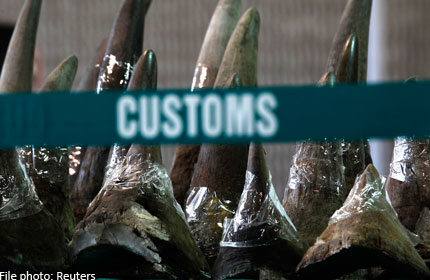
More than seven kilos of rhino horn have been seized by customs officials in Vietnam, state-run media said Monday, amid pressure on the communist country to stem demand stoking a poaching boom.
The two horns, believed to have come from Africa and worth an estimated $365,000, were found hidden in the luggage of a passenger who arrived in Ho Chi Minh City on a flight from Doha on Sunday, the southern city's Phap Luat newspaper reported.
The Vietnamese passenger has been taken into police custody for investigation, the report said, without specifying whether the man had been officially arrested.
Illegal hunting of rhinos has risen in recent years to meet surging demand for their horns in parts of Asia, in particular Vietnam where they are highly prized for their supposed medicinal qualities.
Sales of rhino horn are illegal, but a hundred grams costs up to $5,000 on the black market in Vietnam, where people mistakenly believe is can cure anything from cancer to hangovers.
At a major CITES meeting in March, Hanoi was asked to develop a database to track legal rhino horn trophies and to reduce local demand for the substance. -MSN News (May 07, 2013
The United States has expressed its support for the collective efforts of the Association of Southeast Asian Nations (ASEAN) to move forward and craft a legally binding Code of Conduct (COC) with China over the disputed South China Sea, the Department of Foreign Affairs (DFA) has reported.
In a statement, the DFA said US senior officials who attended the 26th ASEAN-US Dialogue held in Washington, DC, last May 2 and 3 also reaffirmed support for the arbitration move of the Philippines to settle its territorial conflict with China over the West Philippine Sea (South China Sea).
But Chinese Ambassador to the Philippines Ma Keqing, in a meeting with Vice President Jejomar C. Binay, said the issue should not have been brought to the United Nations for arbitration. Ma was responding to Binay's call for the tensions between the two countries to stop.
In a meeting, the US delegation emphasized the importance of upholding the rule of international law in the West Philippine Sea and opposed the use or threat of force to advance claims in the region.
"US Deputy Secretary of State William Burns, as well as Joseph Yun, acting Assistant Secretary for East Asia and head of the US delegation to the ASEAN-US Dialogue, reaffirmed the right of any state to use mechanisms under international law for the peaceful and just settlement of disputes, including arbitration," said the DFA.
Senior officials from all 10 ASEAN Member States and the ASEAN Secretariat were present during the meeting.
"The Philippines welcomes the support of the US and other countries for our efforts to resolve outstanding issues in the West Philippine Sea through peaceful means and consistent with the rule of law and our obligations under United Nations Convention on the Law of the Sea (UNCLOS)," the DFA quoted Foreign Affairs Undersecretary for Policy Evan P. Garcia as saying in the dialogue.
Garcia said the need for a COC was made more urgent by recent developments in the West Philippine Sea. He stated that despite the Declaration on the Conduct of Parties in the South China Sea (DOC) and calls by ASEAN and Dialogue Partners to exercise restraint and avoid any action that will escalate tension, "concerns regarding destabilizing activities remain."
The DFA undersecretary also gave an update on the Philippines' recourse to international arbitration under the UNCLOS, citing that it "is rooted in good global citizenship and will benefit all parties as it will clarify maritime entitlements under UNCLOS."
He added that this "will help assure peace, security, and stability in the region and contribute to its continued economic growth and prosperity."
"The zeal of the Philippines to conclude a Code of Conduct has not changed," Garcia stressed. "This is not inconsistent with our arbitration efforts. In fact, these are mutually supportive of each other as both are deeply rooted in the rule of law and the peaceful settlement of international disputes."
The dialogue was held to deepen ASEAN-US cooperation and discuss regional and international developments.
The meeting, co-chaired by the US and Myanmar, also discussed preparations for the ASEAN Post Ministerial Conference with the US and ASEAN-US Leaders' Summit scheduled later this year.
ASEAN-US dialogue relations were established in 1977. Starting with discussions on political and security matters in its early stages, the dialogue has expanded to other issues such as climate change, biodiversity, food and energy security, disaster risk reduction and maritime security.-Yahoo News (May 07, 2013)
Myanmar has delayed by five years its deadline to eliminate drug production within its borders, a senior official said Monday, as the impoverished nation struggles to stem a growing narcotics crisis.
Authorities are “very concerned” about a rebound in poppy cultivation over the last six years in Myanmar, the world's second-largest opium producer, while amphetamine-type stimulants (ATS) are also surging, said deputy police chief Zaw Win.
Due to “threats posed by ATS” and to achieve a reduction in poppy cultivation, Myanmar's narcotic control board has “extended its drug elimination to 2019,” he said at the opening of six nation talks in Yangon. The previous target was 2014.
He added that Myanmar's authorities were “doing our best” to help stem the flow of drugs in the region.
Officials from China, Laos, Thailand, Cambodia and Vietnam have gathered in Myanmar for days of talks on a worsening drugs crisis, which the United Nations has warned poses a threat to public security.
A minister-level meeting in the capital Naypyidaw on Thursday is expected to produce a regional declaration on the issue.
Zaw Win told delegates that it was “crystal clear that (the) methamphetamine problem is growing rapidly,” adding that “more and more international drug syndicates are becoming involved.”
“Illicit drug production and trafficking are closely linked to instability, human security and insurgency at the border areas, which creates serious challenges to the ability of law enforcement agencies,” he said.
The drugs trade is closely linked to Myanmar's long-running insurgencies in remote areas bordering Thailand, Laos and China — known as the golden triangle — with ethnic minority rebels widely thought to use drug profits to fund operations.-China Post (May 07, 2013)
Indonesia's economy expanded by 6.02 percent in the first quarter, official data showed Monday, the slowest pace in more than two years as exports fell due to the weak global economy.
It was the slowest quarterly, year-on-year growth in Southeast Asia's biggest economy since the third quarter of 2010 and came in below forecasts. The economy grew 6.11 percent in the fourth quarter of last year.
Exports fell by 4.33 percent compared to the previous quarter, according to the statistics agency. Economists attributed the slowing growth to a fall in demand for commodities.
Indonesia is the world's biggest producer of palm oil -- found in a wide variety of everyday goods from soap to cosmetics and biscuits -- and also a major exporter of coal, tin and rubber.
Many firms were experiencing "lower demand for commodities, not only in Europe and the US but in China as well", said Bank Danamon Indonesia chief economist Anton Gunawan.
Nine economists surveyed by Dow Jones Newswires had forecast first quarter growth of 6.10 percent.
Last month, concerns about the weak recovery in the global economy led the central bank to lower its growth forecast for this year to 6.2-6.6 percent from 6.3-6.8 percent.
The economy grew 6.23 percent in 2012.
Despite the slight slowdown, Indonesia still has one of the best growth rates in the world, driven by strong domestic consumption and high levels of foreign investment.
Monday's data will reduce the likelihood of the central bank hiking interest rates anytime soon from 5.75 percent, where they have been for more than a year, analysts said.-ABS-CBN News (May 07, 2013)
Malaysians started going to polls on Sunday in the closest general election ever-held in the country.
Some 13.3 million registered voters are set to choose between another five years under the Barisan Nasional, which has been in power since the country's independence in 1957, and a historical regime change by bringing the opposition People's Alliance in power.
A total of 222 parliamentary seats and 505 state legislation seats are contested.
The Barisan Nasional, led by Prime Minister Najib Razak, has vowed to regain the two-third parliamentary majority that it lost in the last general election in 2008.
On the other hand, the People's Alliance, led by former Deputy Prime Minister Anwar Ibrahim, is eyeing a step forward after delivering a biggest setback in decades to the Barisan in 2008.
Last survey suggested a close race between the two sides.
The preliminary election results are expected to be announced by late Sunday at the earliest.-The Philippine Star (May 05, 2013)
Indonesia is to host an ASEAN plus 8 join exercise in counterterrorism in the country's Peace and Security Center in Bogor, West Java, in September, media reported here on Saturday.
"We will host this joint training in counter terrorism as a co- chair along with the US in the ASEAN Defense Ministers Plus Eight country program," said Defense Ministry Secretary General Budiman, quoted by the Jakarta Post.
Ten ASEAN member countries plus eight other countries, including China, the US, South Korea, Australia, Russia, India, New Zealand and Japan, will take part in the exercise.
The secretary general said the peace keeping training area in Bogor was currently being developed and was expected to be ready for use on the date of the event.-The Philippine Star (May 05, 2013)
Three Chinese government ships sailed into the waters of disputed Tokyo-controlled islands on Sunday, Japan’s coastguard said.
The maritime surveillance ships entered the 12-nautical-mile zone off the Senkaku islands, which China calls the Diaoyu, around 11:00 a.m. (0200 GMT).
Chinese government ships have frequently sailed around the five islands in recent months, sparking diplomatic clashes with Japan.
In late April, eight Chinese government vessels sailed into the disputed waters, the biggest flotilla in a single day since Tokyo nationalized part of the island chain in September.
The move sparked an angry response, with Japanese premier Shinzo Abe vowing to “expel by force” any Chinese landing on the archipelago, which is believed to harbour vast natural resources below its seabed.-Philippine Daily Inquirer (May 05, 2013)